Showing posts with label Khomeini. Show all posts

Wednesday, October 16, 2013

The Persian conversion?

[Originally posted at NOW]

With Lebanese schools increasingly teaching the Persian language, NOW investigates the cultural and political implications.

The Imam al-Khomeini school, in the southeastern Beirut suburb of Hadath, is in several respects an atypical one. Two young men carrying walkie-talkies, with yellow bands bearing the Hezbollah logo strapped around their upper left arms, guard the gates, politely asking to search visitors’ bags before allowing entry. Once inside, ornately framed portraits of the school’s namesake, the late founder of the Islamic Republic of Iran, adorn the walls, as does a message board smothered with photos of young “martyrs.” A chador-clad woman approaches with a length of black cloth to inform NOW that all women are required to be similarly veiled inside the premises.

NOW had come because, as of last month, the school – which is run by al-Imdad Islamic Charitable Association – is the latest of a number of private schools in Lebanon to start teaching the Persian language, al-Imdad having signed an agreement with the Cultural Chancellery of the Islamic Republic of Iran to jointly manage the program across the Association's four schools. In so doing, al-Imdad followed a path already taken by the thirteen Hezbollah-administrated al-Mahdi Schools, which have been teaching Persian throughout Lebanon since 2008.

While defenders of these initiatives point to the cultural and vocational benefits of studying a rich language of both historical and contemporary significance to the Middle East, critics argue the move is a political endeavor to expand the Islamic Republic's influence in Lebanon, particularly within the Shiite community.

In this regard, on Friday NOW met the principal of the Khomeini School, Abbas al-Dhayne, to clarify the exact nature of the new Persian program. A good-humored man with a short, greying beard, he chuckled as he gestured to the many photos of the Iranian ayatollah as well as Hezbollah leader Hassan Nasrallah hanging on his office walls. “You might think I really like Sayyid Khomeini. The truth is I just have more pictures than I know what to do with.”

The new Persian classes, he explained, are taught twice a week to the approximately 720 students from the sixth to the ninth grades (nationwide, al-Imdad has over 3,000 students in four schools spanning Beirut, Keserwan and Batroun). Though he said the classes are optional, he added that “we encourage [students] to take them.” Asked whether any students are not taking them, he replied that “no one so far has asked not to.”

As for why the school decided to introduce Persian, al-Dhayne cited the educational and professional advantages afforded the students. “Our graduates are increasingly going to Iran to pursue higher studies and find employment, so of course Persian is essential for that. In the past, they would go to Europe or America, but now Iran can compete with the West in science, in engineering, in technical fields. It is replacing the West for our students,” he told NOW.

Though this does not, said al-Dhayne, constitute a political agenda, he said he wouldn't necessarily object if there were one.

“For us, it's not political, it's just to prepare our students for higher studies. Maybe Iran has a political objective, we don't know. But honestly, when we hear about the 'Iranian agenda' in the Western press, we laugh. If the Iranians are expanding, I don't mind. They're giving me a hand, while not taking anything from me in return.”

Nor does al-Dhayne deny al-Imdad's affiliation with Hezbollah.

“We feel we are tied to Hezbollah. We, as a charity, are tied to Iran. And Hezbollah has relations with Iran too. So you can say we and Hezbollah are in parallel.”

To further understand Hezbollah's role in Persian language instruction, NOW contacted the public relations officer of the party-run al-Mahdi Schools. Though he confirmed Persian was taught at the schools, the officer declined to divulge further details without formal permission from the Hezbollah Media Relations Office. On 26 September, NOW visited the office in Beirut's southern Bir al-Abed suburb and submitted a written application to this end, which was turned down the following week. The request had been deemed “invasive,” explained a party official via telephone.

NOW was, therefore, unable to establish much about al-Mahdi's Persian program, beyond what has been published in the Arabic press. At a ceremony in May 2013 at the group's Hadath school attended by dignitaries including the Iranian ambassador, al-Mahdi's supervisor for Persian studies, Amal Nasr al-Din, said over 3,700 students were being taught Persian across the group's thirteen schools. Significantly, while several speeches at the ceremony emphasized the cultural and literary merits of Persian, the ambassador's speech also touched on politics, saying the study of the language would “form a bridge” between Iran's “Islamic revolution” and Lebanon's “resistance.” Elsewhere, a 2008 news article declared the initiation of al-Mahdi's Persian program in coordination with the Iranian Cultural Chancellery – the same organization that is now assisting al-Imdad's schools in Persian instruction.

At the Cultural Chancellery's office in the south Beirut suburb of Bir Hassan, NOW met with Hajj Abu Qassem, director of Persian instruction at the Chancellery, which itself offers Persian language courses to the general public. Like al-Dhayne, Abu Qassem kept a number of framed photos of Nasrallah and Khomeini on his walls, including a large one of the latter forming the centerpiece of the wall behind his chair – a reminder that the Chancellery is, after all, an arm of the Iranian state.

“We offer classes here just as any other embassy, such as the Russian one, does,” explained Abu Qassem in effortless classical Arabic (though he later said he was Lebanese, one wouldn't know it from his accent – nor from the ease with which he answered several phone calls in Persian). Every two months, he continued, students take a 300-hour course, by the end of which they should be able to speak well, if they know Arabic. “Arabic and Persian are 60% the same. The Persian script is basically the Arabic one, plus four new letters.”

The classes attract a wide range of students, he said, from journalists to doctors, engineers, and film-makers. The Chancellery also teaches Persian teachers, who go on to give courses at several Lebanese universities including Université Saint-Joseph, Lebanese University (LU), and the Holy Spirit University of Kaslik.

Like al-Dhayne, Abu Qassem highlighted the desire of some Lebanese to study and work in Iran as the key reason for teaching Persian. “Mostly, it's the strong reputation of Iranian universities, especially in medicine and engineering, that makes Lebanese students want to continue their studies in Iran. It's also closer and less expensive than the West.”

Unlike al-Dhayne, however, Abu Qassem rejects any suggestion of the involvement of political interests.

“There have been ties between Lebanese and Iranians since the days of the Phoenicians,” he told NOW. “And in the wider Arab world, you hear many words, for example in Egyptian films, that are of Persian origin. This isn't political, it's civic.”

That is a claim disputed by critics of the way Persian instruction is being carried out in Lebanon.

“This is political, for sure,” said Dr. Mona Fayyad, professor of psychology at LU and vice-president of the Democratic Renewal (Tajaddod) Movement. “In principle, there is nothing wrong with learning foreign languages, it's a very good thing. But it should be an optional choice for mature students, not forced on little children. There is no urgent reason to learn Persian. This is a kind of ideological steering. It's not innocent.”

Similarly, for Dr. Imad Salamey, professor of political science at the Lebanese American University, the move represents a further consolidation of Iran's grip on the Lebanese Shiite community, taking after previous historical examples of dominant foreign powers exploiting Lebanon's sectarian fragmentation to secure and advance their interests.

“Our different sects were always tied to colonial powers who had political, economic, and social influence over the country. Why do we learn French at schools? Because at one time France was the colonial power, and the Maronites were strongly linked to them and their schools were teaching French. Now the Shiites are establishing strong economic, political, and strategic relations with Iran, so it's natural that social and cultural aspects should follow.”

Indeed, said Salamey, the bond of language is an especially potent one to cultivate between hegemon and subordinate.

“Language is the ultimate kind of cultural association. This is when you start to 'Algerize' the sect; to do what the French did in Algeria. It worked with the Maronites; why shouldn't it also work for Iran and the Shiites? I think a part of the Shiite sect is going there.”

Maya Gebeily and Luna Safwan contributed reporting.

Monday, December 12, 2011

A Novel Solution: The intellectual necessity of fiction

Picture the scene: you’re in the company of a new acquaintance whose intelligence and humour have been made evident to you, but whom you do not yet know well. Navigating the climbs and declensions of conversation in the hope of expanding on established common ground, you hazard to bring up the subject of novels. Nothing pretentious – no need here for page-length recitations of Proust or Pride and Prejudice – but perhaps “Did you happen to catch Martin Amis’ latest?” or whatever it might be. And then that sinking sensation as your mystified companion shakes their head and politely asks who that is, explaining that they “only really read non-fiction”. If he’s a man, this statement might even be made with a hint of pride, as though to imply that reading anything less would be a frivolous, infantile and basically effeminate waste of time. I hope at least some of you will know what I’m talking about.

The belief that non-fiction is the terrain of the serious thinker, whilst fiction is little but fairytales for adults is an all-too-common one, I fear, and one which is long overdue repudiation. This is not just because of its essential philistinism, or for any sentimental notion of the ‘transcendence’ of art. On the contrary, the assiduous study of literature offers a practical and tangible education to even the most hard-headed utilitarian. In no sphere is this truer than in politics. 

As an example, I have just finished Palace Walk, the first instalment in the famous ‘Cairo Trilogy’ by the brilliant Egyptian novelist, Naguib Mahfouz. I couldn’t have known when I started the book that its author would make a posthumous appearance in the three-way contest between secularists, Islamists and the military that is defining the quagmire of post-Mubarak politics, but I’m very glad that he has, for it’s given me the chance to build on a loathing for religious extremism that I never thought could get any greater. For those who missed the news from last week’s parliamentary elections in Alexandria, the candidate representing the Salafi coalition – that is, the ultra-orthodox Islamists who denounce even the Muslim Brotherhood as infidels, and yearn to replicate the system of government of 7th century Medina – decried the works of the Nobel Laureate as “inciting promiscuity, prostitution and atheism”. (Well yes, one wants to reply, but what of the books’ faults?) Happily, the sexless fanatic was defeated – albeit by a Brotherhood man...

Palace Walk itself is an irreverent yet humane satire on piety from start to finish. When Mahfouz writes of Amina, the luckless mother of the tyrannically patriarchal al-Jawad household, that “[s]he knew far more about the world of the jinn than that of mankind”, he manages in fourteen words to summarise the entirety of the pity of Islamic fundamentalism. And when the father, al-Sayyid Ahmad, is confronted by a cleric on his notorious extra-marital indulgences, his reply is an unimprovable indictment of religious double standards: “Don’t forget, Shaykh Mutawalli, that the professional women entertainers of today are the slave girls of yesterday, whose purchase and sale God made legal. More than anything else, God is forgiving and merciful.”

It was for these and other moral victories over the faithful that Mahfouz was eventually stabbed in the neck at the age of eighty-two; left debilitated but not dead by a knife belonging to just the sort of person who might vote for a Salafi today. Thus to the ignorant question – ‘why read fiction?’ – one of many possible answers is that fiction and politics are inseparable, and an understanding of one without the other is impossible1. For who could fully grasp the danger and derangement of the Salafis without first understanding Mahfouz’s novels? Equally, who, without having read The Satanic Verses, could know how insane it was for Ayatollah Khomeini to demand the murder of its author? Incidentally, those who saw the 1989 fatwa as the first shot fired by a newly militant Islamism are overlooking the banning in 1959 of Mahfouz’s Children of Gebelawi, which, like the Verses, included the Prophet Muhammad and his contemporaries amongst its dramatis personae. (It was no coincidence that Mahfouz joined dozens of distinguished Middle Eastern men of letters such as the poets Adonis and Mahmoud Darwish and the intellectuals Edward Said and Amin Maalouf in expressing unconditional solidarity with Salman Rushdie in a dedicated collection of essays published in 1994, in which Mahfouz wrote, “The veritable terrorism of which he is a target is unjustifiable, indefensible [...] One idea can only be opposed by other ideas. Even if the punishment is carried out, the idea as well as the book will remain.” Contrast this with the condemnation Rushdie faced in the Anglophone world from people like Jimmy Carter, Roald Dahl and John le Carré, and you arrive at one of the bleaker ironies of the term ‘Western civilisation’.)

Speaking of Edward Said – that Columbia Professor of English and Comparative Literature, who, like Palace Walk’s Kamal, also grew up in inter-war Cairo in the shadow of a disciplinarian father – did he not make his name in 1978 by saying that it was the fiction of ‘Occidental’ writers, from Homer through Shakespeare and Dante and Goethe and Flaubert to Conrad and Kipling, that reinforced the notion of an untamed ‘Orient’, and thus paved the path for European imperialism? That book, along with its 1993 sequel, Culture and Imperialism, would be a locked door to the strict non-fictioner. 

There are more additional examples than I would care to list or you would care to hear about, but I will mention just three if I may. One probably doesn’t have to have read Orwell’s Animal Farm and Nineteen Eighty-Four to understand dictatorship and totalitarianism, but his concepts of ‘Big Brother’, ‘doublethink’, ‘thoughtcrime’ and ‘Newspeak’ have acquired so universal and versatile a currency that it would save one a lot of time and effort to do so (responding to le Carré’s philistine reduction of the Verses to an “insult” of a “great religion”, the expression Rushdie chose in his letter to the Guardian was that he had been “accused of thought crimes”). Orwell’s almost preternatural instinct for the relationship between language and politics (cf. his 1946 essay, ‘Politics and the English Language’) enabled him, in the words of Christopher Hitchens, to conclude that the 1938 Moscow trials were fraudulent “on internal literary evidence”2 alone, at a time when many more intellectuals than it is polite to remember were celebrating the justice served on the enemies of the Party. And even – if not especially – to those for whom English was not a first language, Orwell’s novels commanded respect among the dissident and endangered: here is the Polish anti-Stalinist Czesław Miłosz in his 1953 classic, The Captive Mind:

A few [of us] have become acquainted with Orwell’s 1984; because it is both difficult to obtain and dangerous to possess, it is known only to certain members of the Inner Party. Orwell fascinates them through his insight into details they know well, and through his use of Swiftian satire. Such a form of writing is forbidden by the New Faith because allegory, by nature manifold in meaning, would trespass beyond the prescriptions of socialist realism and the demands of the censor. Even those who know Orwell only by hearsay are amazed that a writer who never lived in Russia should have so keen a perception into its life.3

All that remains to be said here is that if oppositionists living under the Stalin regime thought it worth their while to read the fiction of Orwell (and Swift), then very few of us indeed have valid reason not to.

Moving closer to the present, the conflict in Israel and Occupied Palestine has tended to produce more poetry than prose, though there are a few fine novels to be found. The Palestinian Ghassan Kanafani had already published his masterpiece, Men in the Sun, by the time he was assassinated in 1972, while his contemporary Emile Habibi was even to win an Israeli literary prize in 1992. David Grossman’s has probably been the most powerful Jewish Israeli voice, while Philip Roth’s 1987 tour de force, The Counterlife, captured in just five words the terrifying absolutism of the West Bank settlers: “The Bible is their bible.” Perhaps the most striking scene I’ve yet read, however, appears in the Lebanese novelist Elias Khoury’s Gate of the Sun. The book centres around Yunis, an aged former Palestinian fida’i, as he lies comatose in an improvised hospital in Shatila, the refugee camp south of Beirut, while the equally improvised ‘Doctor’ Khaleel regales him with an epic repertory of stories of the villages, valleys and violence that make up the collective Palestinian memory (Khoury was himself a member of Fatah in Jordan in the 1960s, before siding with them against the Israelis – and most of his Christian co-religionists – in the Lebanese civil war. He’s been involved with the refugees one way or another ever since). 

To the scene, then: we know in advance to expect something eventful, because Umm Hassan, a Shatila refugee, has managed to get herself back to El Kweikat, the Galilean village of her youth, where after 1948 the Jews “demolished every single house [...] and built the settlement of Beyt ha-Emek – all except for what had been new houses on the hill”, of which Umm Hassan’s had been one. Finally summoning the courage to knock on the door, a Jewish woman answers in surprisingly fluent Arabic, and ushers Umm Hassan and her brother inside. They follow her in and have a seat as the woman fetches them a drink.

The Israeli woman left her in front of the water jug and returned with a pot of Turkish coffee. She poured three cups and sat calmly watching these strangers whose hands shook as they held their coffees. Before Umm Hassan could open her mouth, the Israeli woman asked, “It’s your house, isn’t it?”

“How did you know?” asked Umm Hassan.
“I’ve been waiting for you for a long time. Welcome.”

Umm Hassan took a sip from her cup, the aroma of the coffee overwhelmed her, and she burst into tears.
The women talk about a jug of Umm Hassan’s that’s still on the kitchen counter, decades later. They walk into the garden and discuss the orange orchards, or ‘groves’, as the Jewish woman calls them. Umm Hassan eventually explores the entire house. And then she’s telling her about her life today; how she now lives in a camp on the outskirts of Beirut:

When the Jewish woman heard the word Beirut, she jumped up and changed completely.

“You’re from Beirut?” she cried, the words tumbling out of her mouth and her eyes filling with tears.

“Listen, sister,” the Jewish woman said. “I’m from Beirut too, from Wadi Abu Jmeel. You know Wadi Abu Jmeel, the Jewish district in the centre? They brought me from there when I was twelve years old. I left Beirut and came to this dreary, bleak land. Do you know the Ecole de l’Alliance Israélite? To the right of the school there’s a three-storey building that used to be owned by a Polish Jew called Elie Baron. I’m from there.”

“You’re from Beirut?” Umm Hassan asked in amazement.

“Yes, from Beirut.”

“How did that happen?”

“What do you mean, how did that happen? I’ve no idea. You’re living in Beirut and you’ve come here to cry? I’m the one who should be crying. Get up and go. Get up, sister, and go. Send me to Beirut and take this wretched land back."

Now, a history book can tell you that there were once as many as 20,000 Lebanese Jews, all but a couple of hundred of whom are now in Israel. It can also tell you that perhaps 100,000 Palestinians took refuge in Lebanon after the nakba of ’48. But no historian can tell you what would happen if two such exiles were actually to meet: that task is left to the novelist alone.

Of course, this symbiosis between letters and politics ceases to work the moment one trespasses on the other’s domain. A review of Azar Nafisi’s 2003 memoir, Reading Lolita in Tehran, by Hamid Dabashi provides a cautionary tale. The book tells the story of how Nafisi – a Professor at the University of Tehran until her expulsion for refusing to veil herself, after which she moved to America – would invite her brightest female students to her home in Tehran once a week for informal discussions on four staples of the modern Anglophone canon: Lolita, naturally enough, along with The Great Gatsby, Daisy Miller and Pride and Prejudice. These symposia, which were intended as relief from the alternating tedium and terror of life under Khomeini as much as anything else, eventually cultivated rich and entirely original interpretations of the works, with whose heroines the girls identified far more personally than Nafisi had imagined they could have. 

For this modest but perhaps symbolic achievement, Nafisi receives a tirade of venomous, hysterical abuse from Dabashi, who calls her a “native informer”, a “colonial agent”, a “comprador intellectual” (his most irritating phrase, used twelve times in the review), a “servant of a white-identified, imperial design” and even an “ideologue in George W Bush’s empire-building project”. Her thoughtcrime – sorry, crime, it appears, was to have Betrayed The Cause by disseminating works of doctrinal impropriety:

[The book] promotes the cause of “Western Classics” at a time when decades of struggle by postcolonial, black and Third World feminists, scholars and activists has [sic] finally succeeded to introduce a modicum of attention to world literatures [...]

Decades into a sustained struggle against the domination of Eurocentric curriculum [sic] in the US academy, fighting to restore democratic dignity to the world literary scene, Nafisi once again pushes the clock back for about half a century by a singular and exclusive praise for the Eurocentricity of the literary imagination.

This sheer Stalinism – appraising books solely on the basis of their ideological purity – seems to form the core of Dabashi’s critical approach. The primary achievement of Nafisi’s book, he says, is to have:

[S]ystematically and unfailingly denigrat[ed] an entire culture of revolutionary resistance to a history of savage colonialism

Apparently, then, literature is not about things like art or beauty or language: it’s actually about revolutionary resistance. Oh sure, Nabokov might have written good novels, but what the hell did he ever do for the struggle? 

In fact, Dabashi’s spittle-flecked and bloated review gets a great deal worse, to the point of telling outright lies4 (that the man is a Professor of Literature at Columbia is surely a disgrace to the institution). But his most laughably philistine moment is this:

[O]ne reads this book in vain in search of even a single conversation with any relevant literary theory amassed for generations about and around the works of the [four] authors

Of course – because one may not simply enjoy literature: one has to anaesthetise and sterilise and dissect and analyse it, in “conversation” with “relevant literary theory”! Never mind what the readers think - what do the literary theorists have to say? I shall leave the last word on this sorry subject to Kingsley Amis, who once reproached some comparable mediocrity for his suggestion that a certain novel of somebody else’s was not “important” enough to have merited inclusion in some now-forgotten literary shortlist:

Important! Fearful contemporary word, smacking of the textbook, the lecture-hall, the ‘balanced appraisal’. So-and-so may be readable, interesting, entertaining, but is he important? Ezra Pound may be pretentious and dull, but you’ve got to admit he’s ever so important. What? You haven’t read Primo Levi (in translation, of course)? But he’s important. As the philosopher J. L. Austin remarked in another context, importance isn’t important. Good writing is.5

And there it is. Literature is not to be conscripted into the service of academia, or any other ‘sphere’ or ‘discourse’, least of all politics. While it might make contributions in each of these respects, to read it solely as a means to these ends would be like gulping down a glass of wine just for the cardiovascular benefit: it can be done, but it would rather miss the point... Instead, both fiction and wine ought to be enjoyed for their own sake, and to forgo the former is every bit as joyless and puritanical as abstaining from the latter. Ultimately we should all be with that Persian genius, Omar Khayyam, who warned us a thousand years ago that:

Since neither truth nor certainty is granted
You cannot sit in doubtful hope all your life;
Let us be careful not to set the wine-cup aside,
Since a man is in ignorance, drunk or sober.6

1 The same answer can be given, of course, to the no-less-ignorant question, ‘why read politics?’ 
2 See Hitchens, C., Why Orwell Matters (2002), pp. 59-62 
3 As quoted in Ibid., pp. 54-55 
4 “No one will ever know, reading Reading Lolita in Tehran, that Iranians, like all other nations, have a literature of their own”, writes Dabashi. I cite the following quotes from the 2008 Harper Perennial paperback edition (this list is by no means exhaustive): “We read Persian classical literature, such as the tales of our own lady of fiction, Scheherazade, from A Thousand and One Nights” (p. 4); “Like a group of conspirators, we would gather around the dining room table and ready poetry and prose from Rumi, Hafez, Sa’adi, Khayyam, Nezami, Ferdowsi, Attar, Beyhaghi” (p. 172); “Our great epic poet Ferdowsi had rewritten the confiscated myths of Persian kings and heroes in a pure and sacred language. My father, who all through my childhood would read me Ferdowsi and Rumi, sometimes used to say to me that our true home, our true history, was in our poetry” (p. 172). 
5 Amis, K., Memoirs (1991), p. 297
6 Avery, P. & Heath-Stubbs, J., The Ruba’iyat of Omar Khayyam (1979), p. 89

Friday, October 21, 2011

From Beirut to the Blue Line: A day in south Lebanon

My morning of Friday, 7th of October, began in a way that could fairly be described as untypical: immediately upon rising, I read from the bible. The passage in question was Ezekiel 26: Jerusalem has just been sacked by the Babylonians, and the people of Tyrus have met the news with enthusiasm, on the grounds that they stand to gain new trade as a result of their competitor’s fall. A not-unreasonable, if perhaps ignoble response, one might think – in any case, surely no act of war. God having adopted the Israelites as his ‘chosen’ people, however, and being the short-tempered egomaniac that he is in general, he promises an assault of abominable proportions:

Therefore thus saith the Lord GOD; Behold, I am against thee, O Tyrus, and will cause many nations to come up against thee, as the sea causeth his waves to come up. And they shall destroy the walls of Tyrus, and break down her towers [...] And they shall make a spoil of thy riches, and make a prey of thy merchandise: and they shall break down thy walls [...] And I will cause the noise of thy songs to cease; and the sounds of thy harps shall be no more heard [...] thou shalt be built no more.

Thus began an enmity between the two ‘nations’, more than twenty five centuries ago, that has by no means abated today. Indeed, the very fact of the feud’s engraving in the biblical record has itself been a key – if not the key - guarantor of its longevity. It was with reflections of this kind that I set off later the same morning for the southern Lebanese city of Tyre, as it’s now known, where I planned to lunch and possibly have a drink before continuing via Naqoura to the border with the present-day State of Israel – the ‘Blue Line’, as the UN misleadingly names those hills of dark green with their blood-red history – along which we would drive east until we reached the governorate of Nabatieh before heading back north via Qana to Beirut.

Accompanying me were two bold, but exquisitely feminine Lebanese ladies, as well as one decisively nonfeminine driver, whom I shall call Ali, and of whose identity I shall reveal no more except to say that his status during the 1975-90 civil war would not meet many definitions of the term ‘civilian’. From Beirut we took the coastal highway south; past the airport wall with its artless graffiti (the themes ranging from “Ramzi was here” to “Ramzi + Fatima = Love” to the mysterious but warming “I love you” – a world away from the sass and satire on display in Hamra); past Damour with the beautiful thick green knots of the Chouf mountains rising to the left; past Jiyeh with its beach clubs and its power station, bombed by the Israelis in 2006 to such catastrophic effect; until we reached the first major city of our trip, Sidon (Saida in Arabic: I will stick to the English names for much the same reason as I wrote ‘Jerusalem’ earlier, and not al-Quds, or, indeed, Yerushalayim).

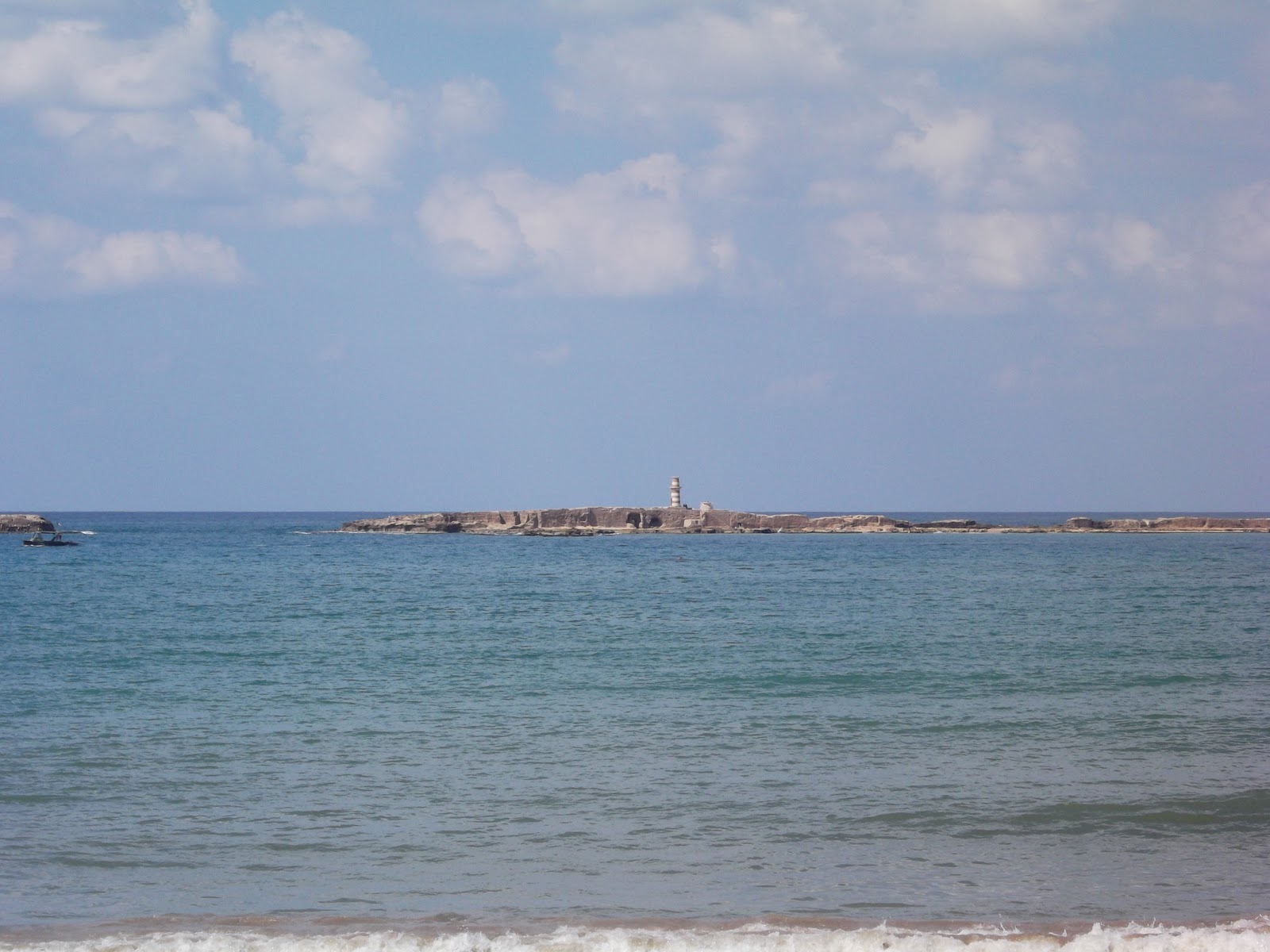
Sidon is one of the great ancient cities of the eastern Mediterranean littoral; a thriving Phoenician metropolis mentioned in the literature of Homer and Herodotus, as well as both the Old and New Testaments (where, in a naked display of Jewish chauvinism, Jesus twice refuses to heal a Canaanite woman, whom he compares to a dog – Matthew 15:21-8), whose population has survived millennia of foreign conquests, be they Assyrian, Babylonian, Egyptian, Greek or Roman (Beirut was always a relatively inconsequential settlement by comparison, not reaching prominence until the 19th century). Today the place retains much of its history, with the ruins of the Crusaders’ Sea Castle and the adjacent Old Souk perched atop the promontory of the port, bejewelled with the winsome lighthouse on the nearby Zeereh Island. The atmosphere is agreeable in other ways, too; for while Sidon is primarily a Sunni city – indeed, it is the hometown of the late Prime Ministers Rafiq Hariri and Riadh es-Solh – the menace of sectarianism is much less palpable than in the northern Sunni heartland of Tripoli, where the residents have even seen fit to erect tributes to Saddam Hussein. Such was my hastily-formed first impression, anyway: with more than half the distance to the border still ahead of us, we lamentably didn’t have time for more meaningful exploration. 

Crusader Sea Castle and Old Souk, Sidon

Zeereh Island, Sidon

Saddam Hussein poster, Tripoli


And so we pressed on south, tracing the gentle convexity of the brilliant Mediterranean through al-Ghaziyeh, site of the killing of eleven children and fifteen other civilians by two Israeli air strikes in ’06; and through Saksakieh, where yet another luckless shop owner fell victim to Hizbullah’s perennial war on alcohol when he arrived one morning in July to find his premises burnt to cinders – a casual trashing of a poor man’s livelihood that shows how much Nasrallah’s gangsters really care for the ‘downtrodden’. Just north of the Litani river, we passed Mazraat al-Yahoudieh – ‘the Jewish Farm’ – where the Jews of Deir al-Qamar had fled during the Christian-Druze war of 1848. God knows whether any Jews live there today - the website of the Lebanese Jewish Community Council puts the total size of today’s Jewish population at “less than 200”; a community that once numbered tens of thousands of Lebanese patriots, forced from their land by barbarous minds who could not distinguish between Jew and Zionist. 

The British Foreign & Commonwealth Office advises against “all but essential travel south of the Litani”. This seems to me an arbitrary point of reference, for there is nothing obviously different about the other side. True, the Party of God certainly makes its presence known, littering the streets with its green-and-yellow flags (bearing the AK-47 insignia it shares with the Iranian regime’s death squads); its morbid galleries of fallen ‘martyrs’; and of course its endless veneration of the Dear Leader himself. But the same could also be said of just about every village we passed since Sidon. It’s also true that crossing the Litani takes one closer to Israel; a state rather famed for its preference for bullets over questions in its dealings with unexpected company. But then the Israeli armed forces can, and do, hit any part of Lebanon they like - as the residents of al-Aabde, a small port town by the northern border with Syria, were reminded when fourteen were killed by Israeli air strikes in '06 (“Nothing is safe”, as the IDF Chief Dan Halutz bragged at the time). 

No, the only difference I could discern as we approached the bay of Tyre (Sour) was an amplification of the splendour of the general surroundings; the sea taking on a lighter, glossier sheen; the clouds breaking apart in tufts of cotton. The city itself is a living refutation of biblical ‘prophecy’; for despite the words of Ezekiel (and more than three decades at the frontline of the Arab-Israeli war), Tyre not only still exists but is once more a centre of regional commerce and culture. Seeing the city in 1697, ruined successively by Crusader and Mamluk conquests, the Oxford academic and Anglican priest Henry Maundrell crudely declared a vindication of scripture:

On the north side it has an old Turkish ungarrison’d castle; besides which, you see nothing here, but a mere Babel of broken walls, pillars, vaults, &c. there being not so much as one entire house left. Its present inhabitants are only a few poor wretches [...] subsisting chiefly upon fishing; who seem to be preserv’d ill this place by Divine Providence, as a visible argument, how God has fulfill’d his word concerning Tyre, viz. That it should be as the top of a rock, a place for fishers to dry their nets on, Ezek 26:14.1

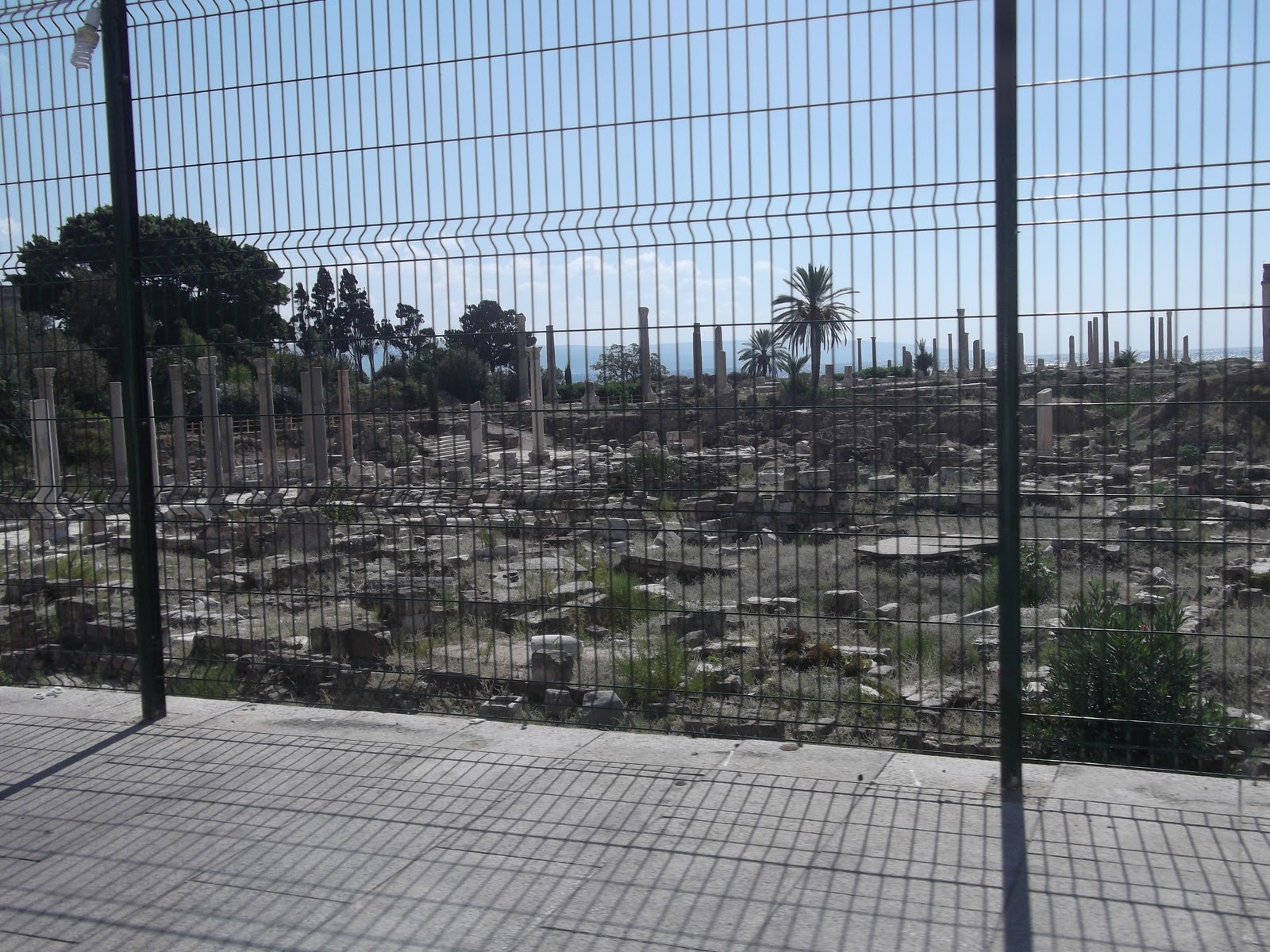
How satisfying it is to see this infantilism made laughable, and to find in Tyre today a population of over 100,000 flourishing in very much “entire” dwellings that, moreover, strike an enviable balance between the polish of urban modernity and the ungroomed charm of the seaside. Stopping at a Byzantine villa-turned-resort – where I was able to get that drink after all – we encountered a group of Europeans who told us they’ve been holidaying in Tyre for years, and I can’t say I blame them. From its unique location, protruding so starkly from the mainland, one can see almost as far as Sidon to the north, and to the beginnings of Israel to the south. And should one tire of idling on the beach, the Roman ruins of the Al Mina excavation site, a mere five minute drive away, are the equal of anything to be seen in Byblos (Jbeil) – just as the shawarmas I had in the city centre were the equal of anything on Beirut’s Bliss Street. I left the city much as I had left Sidon; with regret that I couldn’t have stayed longer and with a wish to return for much more extensive investigation in future. 

View north from the Al Fanar resort, Tyre. Taken by MA

Al Mina Roman excavation site, Tyre


Heading south of Tyre, the road veers inland somewhat, the sea disappearing behind the vast banana plantations that will be disturbingly familiar to those who have seen Ari Folman’s 2008 film, Waltz With Bashir. An ostensible sign of increased danger arrives in the form of an army checkpoint, bearing a stern warning that no “foreigners” may pass without permission from the moukhabarrat, or intelligence agency, in Sidon. My heart plummeted, for I most certainly hadn’t obtained any such permission, and could scarcely imagine the headache that would be involved in doing so. However, by a blessing of fortune that mystifies me to this day, our car was waved through before we had even come to a halt. And so for the next twenty minutes it was us and the bananas, the sighting of other human beings becoming suddenly infrequent. Good pace was made possible by the remarkably fine condition of the roads – newly rebuilt, no doubt, after annihilation in ‘06 – and as the trees cleared and the Mediterranean came once more into view, we soon found ourselves being waved through the checkpoint at the entrance to Naqoura, the small town just two miles from the border that is also the headquarters of the United Nations Interim Force in Lebanon, or UNIFIL. These ‘peacekeeping’ units were initially deployed in response to Operation Litani, Israel’s first invasion of Lebanon in 1978, “for the purpose of confirming the withdrawal of Israeli forces, restoring international peace and security and assisting the Government of Lebanon in ensuring the return of its effective authority in the area”. Given that only the first of these three has been achieved – 22 years later than scheduled, at that, and little thanks to UNIFIL – the poor bastards, despised by Israel and Hizbullah alike, look doomed to be stuck in south Lebanon for quite some time yet. 

Checkpoint south of Tyre
UN base in Naqoura
“From here”, Ali announced as we left Naqoura, “UNIFIL bas”: UNIFIL, and nobody else. And so it proved, as we entered territory that, from 1978 to 2000, was for all practical purposes a part of the Israeli state. To come across a landmine or an unexploded cluster bomb would by no means be unheard of in these deserted plains, and so it was rigidly to the tarmac that we stuck as we began the final stretch, alone but for a UNIFIL jeep a few hundred metres ahead of us. What struck me most about the moment that the road ran out, and we were forced to turn east, was how utterly tranquil the whole scene was. No sniper-topped watchtowers; no rows of tanks; no convoys of helicopters swirling overhead. The border fence itself was the sort of thing a moderately foul-tempered farmer might erect to keep out teenage pranksters, not the frontline between two militarised nations officially at war. The dark green field through which we were driving simply dipped down a slight recess and there, not more than fifty metres away, was a parallel road in Israel. And behind it, not more than five hundred metres away, were the beige walls and red roofs - the same colour scheme I had seen at the Ma’ale Adumim settlement in the West Bank - of the Israeli village of Kfar Rosh HaNikra, a kibbutz and tourist attraction renowned for its grottoes.

UNIFIL jeep
A road in Israel


Israeli village


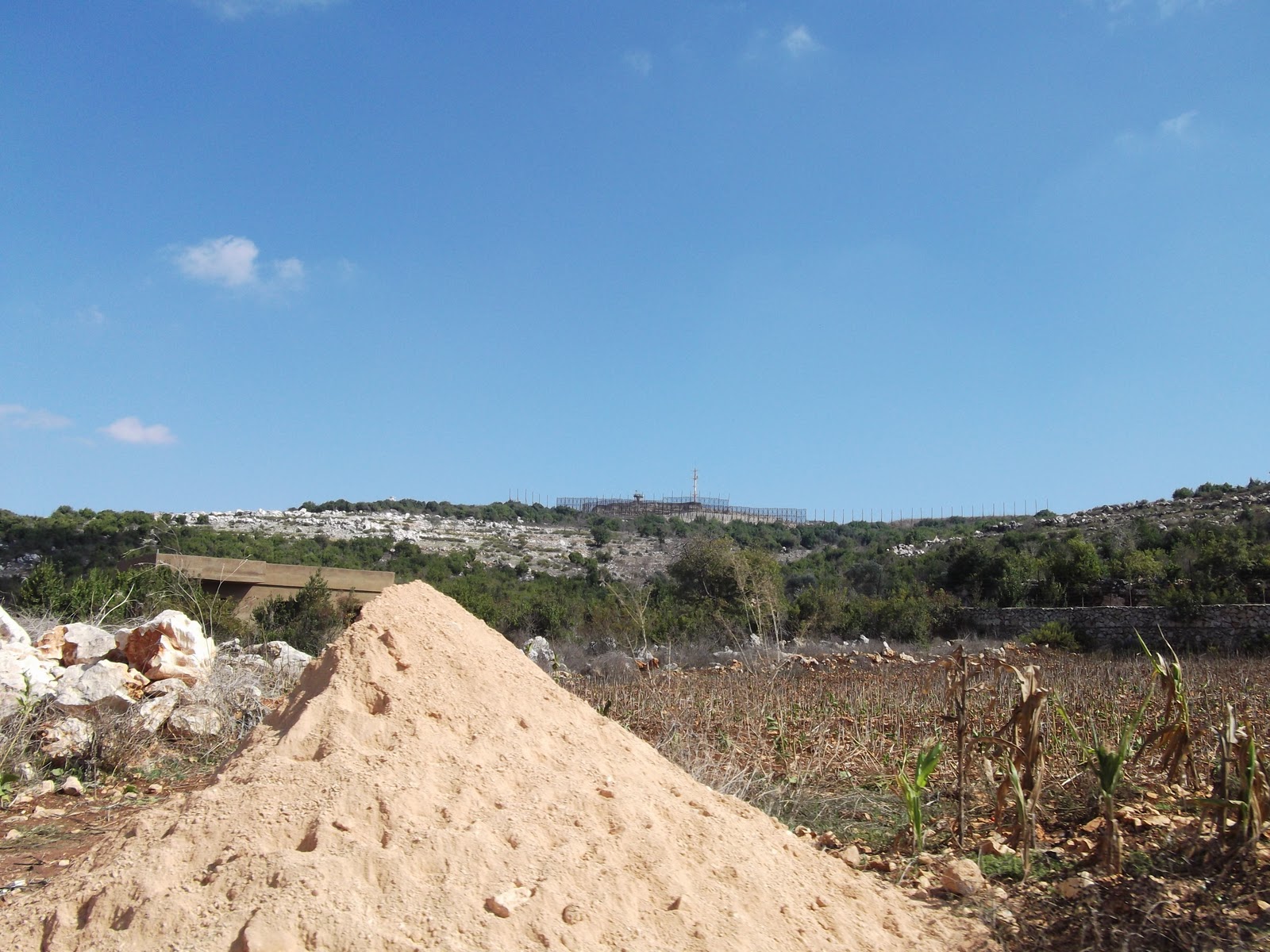
Amazingly, the more we drove east, the more our road and the parallel one in Israel began to converge. We passed Labbouneh, where the kibbutz of Hanita was practically touching the Blue Line; and Btaichiye, opposite the village of Arab al-Aramshe, where three Israeli Arab Bedouin civilians were killed by Hizbullah rocket fire in ‘06. At Boustane, just west of the Nabatieh governorate, we could practically read the number plates of cars in the Israeli village of Zar’it. And still, the calm in the air was preternatural; tantric; catatonic. Can it really have been from this very spot that Hizbullah crossed the border on July 12th, 2006, firing explosives and anti-tank missiles at an IDF jeep convoy, killing eight soldiers and dragging two back into Lebanon alive; in doing so provoking the most destructive Israeli assault on the country since ‘82? Apparently so, and yet aside from a fenced-off compound a couple of kilometres inside Israel, which Ali believably claimed was an IDF base, I could see no one around to stop me doing something similar myself – least of all the UNIFIL patrolmen, who regarded us on the whole with astounding incuriosity, as though to make inquiries about our intentions or indeed to acknowledge our presence at all would be an unpardonable violation of proprieties. 

IDF base in the distance

UNIFIL jeep. Taken by MA


Even the Party of God was nowhere to be seen here. The American writer, Michael J. Totten – of whose book on Lebanon I am no great fan – saw the Blue Line further up to the north-east in ‘05 and posted pictures on his blog of various miscellanea assembled along the border in apparent attempts to intimidate Israelis: wrecked IDF trucks; ‘martyr’ shrines; photos of severed Israeli heads; etc. I have seen similar things myself in Baalbek. But nothing remotely of the kind could be found where we were; indeed, aside from one poster of the late Shiite cleric, Muhammad Fadlallah – bearing the not-too-terrifying inscription, “With my love and blessing” – the only graphic we came across was a white dove painted next to a green cedar on a concrete block. One wouldn’t wish to sentimentalise matters, or to pretend that the Lebanese are pacifists. But it’s useful all the same to have a qualification of the Totten narrative in which the Lebanese side of the border is little but a barbarous carnival of venom and violence.

Israel in the background. Taken by MA


Which brings me, somewhat elliptically, to Qana, roughly ten kilometres north of the Blue Line, which was to be our last stop before rejoining the coastal highway and returning to Beirut. A modest town in many ways, Qana is nevertheless believed by many to be the biblical Cana of Galilee, where Jesus performed his most useful miracle when he supplied the drink at an otherwise boozeless party, thereby delivering the presumably bored guests from further tedium (John 2:1-10). A spiriting distinction, to be sure, but I can’t say I felt much inclined to smile on my visit. For Qana today is a morbid town, known not for miracles but for massacres. The first one occurred during a sixteen-day battle between Hizbullah and Israel in ‘96, when on 18 April, the Israelis deliberately and repeatedly shelled a UN compound that was housing some 850 civilians, killing 106 (over half of them children) in a most unimaginably gruesome manner2. The second came just over a decade later, on 30 July, 2006, when Israeli jets bombed a three-story residential building housing 63 civilians, killing 27 (16 of them children). In both cases, the Israeli government involved itself in a disgraceful series of lies: in the first case claiming that a computer malfunction was to blame, and denying that a pilotless ‘drone’ reconnaissance aircraft had been flying over the compound before the shelling began; and in the second case insisting that Hizbullah combatants had fired rockets from the residential building, thus making it a legitimate military target. In both cases, the Israelis were forced to recant their original claims: in the first case after the discovery of a video clearly filming the ‘drone’ by the UN compound; and in the second after it became clear that eyewitnesses to the attack, including international rescue workers, journalists and human rights observers, were too numerous, and too consistent in their reports to the contrary of the Israeli claim, for the deception to work. In both cases, in other words, the flow of venom and violence was from Israel to Lebanon, not the reverse – a partial vindication, come to think of it, of Ezekiel after all. 

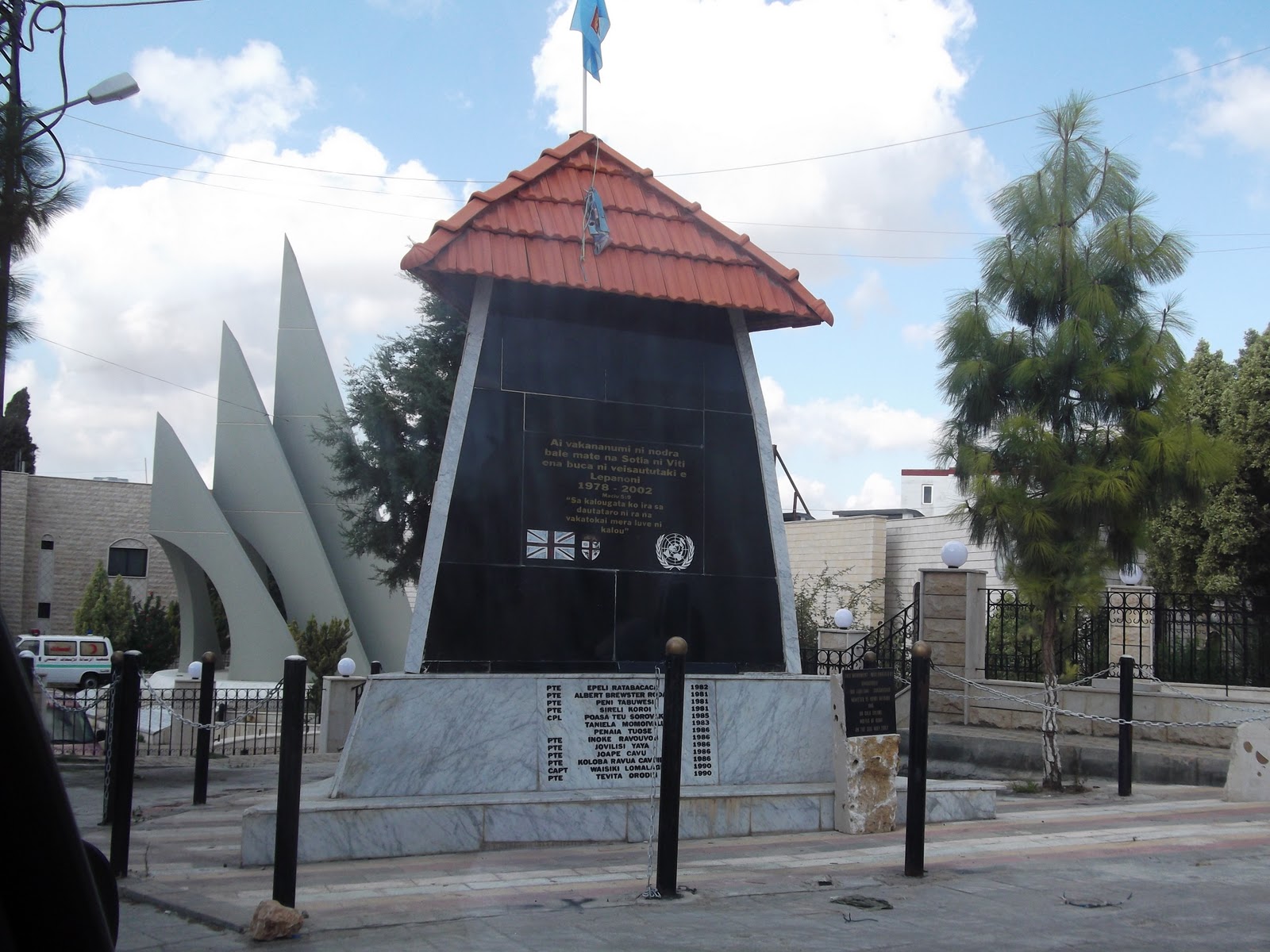
Memorial at the UN compound in Qana


Was it also a partial vindication of Hizbullah, and its claim to be a ‘liberator’ of the land? Certainly there are many who would answer in the positive. And in a way, the question isn’t for me to answer: I may not presume to speak on behalf of my Lebanese companions, for whom the trip we had taken that day would not have been possible just twelve years ago. What it means to stand on one’s national soil, previously stolen by a foreign power is unknown to me. Still, for however little it may be worth, my answer would always be an unhesitating ‘no’. The reason for this was neatly encapsulated in a poster I saw about five minutes south of Naqoura. Impaled on the shore of the resplendent Mediterranean, with the hills of Israel lining the horizon, stood a metal frame displaying the faces of two politicians, neither of them Lebanese: the inaugural Supreme Leader of the Islamic Republic of Iran, Ruhollah Khomeini; and his successor, Ali Khameini. Whether this was an expression of theological solidarity with these most eminent Ayatollahs – as is suggested by the total absence of tributes to the non-clerical President Ahmadinejad - or merely a thank-you for the vast sums of reconstruction funds donated, it points in either case to the long shadow cast by Tehran on Lebanese civil society. 

Khomeini and Khameini, just south of Naqoura


This shadow manifests itself in a number of ways: partly in the trampling of political dissent within the regions of the country which the Party controls, where members of rival factions such as Amal and the Communists are either subjugated or liquidated. It also manifests itself on a national scale, in the acquisition of a huge private arsenal, which the Party uses to suffocate the country’s democracy and hold the entire population hostage to its whims - a humiliation that further involves dragging the government into sordid alliances with grossly unsavoury regimes, most notably the Assad crime family in Damascus and the Putin dictatorship in Moscow (to say nothing of the Iranian theocracy itself). 

But more sinister than any of these is that part of the Iranian shadow that fell on the aforementioned shop owner in Saksakieh. How readily some people appear to forget that the original Hizbullah manifesto, published in the as-Safir newspaper in 1985, called openly and repeatedly for the Lebanese to submit to an “Islamic government” and a “culture [...] based on the Holy Koran, the Sunna and the legal rulings of the faqih [jurist] who is our source of imitation”, clarifying that the faqih in question was “Ruhollah Musawi Khomeini”. And despite much loose talk about the Party ‘softening’ its stance in its amended manifesto of 2009, Nasrallah plainly reaffirmed its “allegiance to the Fakih” and “commitment to the [Islamic] Jurisconsult” when challenged on the point by a journalist at the press conference launching the manifesto. Hizbullah has, in this sense, not removed the Israeli occupation but replaced it. Once again, the essential point is underscored: as long as it’s the mullahs and imams who have the power - or the patriarchs or popes or the rabbis for that matter – then real ‘liberation’ will never be attained. One hopes in Lebanon, as one hopes in every country, that it isn’t too late to realise this, and to act upon it.

1 Maundrell, H., Journey from Aleppo to Jerusalem at Easter A.D. 1697 (1703); as reprinted in Gorton, T.J. & Gorton, A.F., Lebanon: Through Writers’ Eyes (2009), p. 103
2 See esp. Fisk, R., Pity the Nation: Lebanon At War (3rd edition, 2001), pp.669-89