Tuesday, November 8, 2011

Why are we ignoring Syrian calls for intervention?


How Bashar must have smiled. In almost the same breath as Anders Rasmussen, the NATO Secretary General, stood for the first time on free Libyan soil to announce “a new chapter” in the country’s history and the withdrawal of the international forces that made the liberation possible, he went out of his way to assure the Syrian dictator that the action taken against his former counterpart was not even to be considered in his case:

NATO has no intention (to intervene) whatsoever. I can completely rule that out.

This conspicuously blunt revelation immediately raises a series of highly nontrivial questions, among them: who on earth are the beneficiaries of this policy, other than the Assad family and its fascistic proxies throughout the region? Why, if the NATO mission in Libya was a success – as the Secretary General clearly believes it was - should it not merit emulating in Syria? Surely Mr Rasmussen cannot mean to imply that a Syrian life is of less consideration than a Libyan one? And by what possible right does he assume this paternal tone of reassurance? To tell the Syrian people that help is not coming, and to suggest that they should be grateful for it too, is to let them down inexpiably as well as to insult them into the bargain. For shame.

‘But the Syrian people don’t want intervention!’ I hear you pontificate. That may indeed be the received wisdom of Western ‘liberalism’, but a glance at the Arabic media reveals something less conveniently straightforward. As the Lebanese al-Akhbar reported on October 29th, the Syrian resistance is far from resolved on the question of intervention, with a significant and swelling faction decided firmly in its favour. The report cites regime opponents such as the journalist Fahd al-Masri and the veteran activist Haitham al-Maleh as examples of those for whom “military intervention is not just a possibility, it is practically a demand”. Indeed, when interviewed by al-Akhbar two weeks previously, al-Maleh put the case for intervention quite squarely:

We have no other option. This regime is forcing the people to resort to this game. The regime is committing two crimes: killing people, and forcing them to seek protection from international organizations. I called on Arab League Secretary-General Nabil al-Arabi to solve the problem via the League. Otherwise, we have no choice but to turn to international organizations. Give us another option!

It isn’t difficult to see his point. For more than nine months, the world has watched as thousands of Syrian men, women and children have been beaten, gassed, gunned and bombed to their deaths for demanding a freer and more dignified existence. All this time, we have heard it said that Bashar is not his father; that Bashar is a reformer; that the solution lies in ‘dialogue’ and ‘patience’. Yet every promise of restraint has been followed only by more exorbitant murder – indeed, last Thursday, the army violated a ceasefire agreed with the Arab League on Wednesday by shelling the city of Homs with tanks, killing dozens. Other commentators have speculated that the regime will eventually collapse due to soldiers defecting, as was the case in Egypt and Libya. Though the number of defections does appear to be rising, a Syrian activist interviewed by NOW Lebanon last Monday complained that the lack of a Benghazi-style breathing space was the crucial difference in Syria:

“Any soldiers [sic] are afraid to defect right now, because there is no safe zone where they can go and organize to fight the regime. Nobody is protecting them. That is why we are asking for the international community to impose a buffer zone or a no-fly zone where these people can organize,” he said.

Again, the logic appears uncomplicated. Why then does the international community ignore these voices? Is it not a matter of elementary principle that, just as we would not impose intervention on an unwilling population, so we would not hesitate to intervene if that population should turn out to be willing?

Quite apart from such lofty moral considerations, need we be reminded of the practical dividends at stake? The dismantling of the Baathist dictatorship, well described by the Lebanese intellectual Samir Kassir as the synthesis of “the corruption of Soviet republics with a Chinese-style closed police state”1 (it was not by coincidence that Kassir was later blown up in his own car), would remove the principal enabler and arms supplier of Hizbullah, the Islamist militia and mafia that keeps a boot to the throat of secularism and democracy in Lebanon. It would remove a crucial ally of the lunatic theocracy in Iran, further isolating the tyrannical Ayatollahs and possibly even galvanising the moderate ‘Green Movement’ that was so ruthlessly steamrolled after the ‘elections’ in 2009. It could bring relief at last to the sizeable and long-repressed Kurdish minority in Syria, who have provided some of the bravest and most determined resistance to the regime in recent months, and who may even be able to attain a form of self-government in a post-Assad Syria, as they’ve done with much success in post-Saddam Iraq. And it would do away with two of the tiresome myths that give Western foreign policy so much undue bad press: namely, that policy is controlled by the oil lobby (since Syria hardly has any); and that policy is controlled by the Israel lobby (since a post-Assad Syria, with an enfranchised Sunni majority, would very probably find a friend in Hamas). It would, in other words, be a declaration of the West’s seriousness with respect to promoting democracy in the Middle East.

To those who state their preference for the ‘stability’ afforded by Assad’s autocracy over the ‘chaos’ that would be unleashed by his removal, one need only ask: what stability? Entire cities in Syria, including Dar’aa, Hama and especially Homs, are already war zones. Warnings that Islamist militants may launch attacks against religious minorities appear to have come too late: such attacks may already be happening, and the sectarian anxieties that fuel them are exacerbated, not relaxed, by the overwhelmingly Alawite character of the regime in general and the Republican Guard in particular (to say nothing of the staunch support voiced for the dictator by the luminaries of other minorities, such as the Syrian Orthodox church and the Maronite Patriarchate). As for fears that intervention will inevitably be followed by an Iraq-style occupation, we now have the precedent of Libya to attest otherwise.

Which isn’t to say that the case for intervention is bulletproof. The point is rather that Syria is facing ‘chaos’ with or without it. And even supposing, for argument’s sake, that a cost-benefit analysis of intervention is inconclusive at the present moment, two things ought to be made abundantly clear to Assad, and indeed all his fellow despots: that intervention will never be ruled out “absolutely”, and that not one second will be wasted in ruling it ‘in’ should the circumstances demand that we do so. 

1 Kassir, S., Being Arab (2006), p. 20

Thursday, October 27, 2011

William Lane Craig is a crackpot and a bigot


‘New Atheism’ – to annex the term glibly used to describe the age-old intellectual movement rooted in the traditions of Lucretius, Socrates, Spinoza and Hume, inter multa alia – has come in for a spot of abuse this week, resulting from the latest round in the battle of egos between Richard Dawkins and the Christian apologist William Lane Craig. I won’t insult my reader by explaining who the former is, but for those unfamiliar with the latter, Craig is something of a hero in the online Christian community, lionised as their most formidable answer to the atheist heavyweights Christopher Hitchens, Sam Harris, Daniel Dennett, et al. – a status enhanced to the point of near-mythology by Dawkins’ repeated refusal to debate him. 

Previously, Dawkins explained this refusal on the grounds that he does not, as a matter of policy, debate “creationists” or “people whose only claim to fame is that they are professional debaters”. Then, following yet another taunting by Craig earlier this year, he published an article in last Thursday’s Guardian (‘Why I refuse to debate with William Lane Craig’) elaborating that Craig was a “deplorable apologist for genocide”, referring to Craig’s defence of God’s ordering the Israelites to exterminate the men, women and children of the various tribes encountered on the road to the biblical Land of Israel (Deuteronomy 20). These points may be valid, and it is of course Dawkins’ right to debate whoever he wants, yet one can’t help noting that other atheists of stature, including Hitchens and Harris, did not consider the sharing of a podium with Craig to be beneath them in the same way. 

And so it was perhaps inevitable that certain journalists would interpret Dawkins’ evasions as common cowardice. Within days, the Guardian ran a response from one Daniel Came (‘Richard Dawkins’ refusal to debate is cynical and anti-intellectualist’), who said it was “no surprise that Dawkins and [A.C.] Grayling aren’t exactly queuing up to enter a public forum with an intellectually rigorous theist like Craig to have their views dissected and the inadequacy of their arguments exposed”. Peter Hitchens, the Christian brother of Christopher, sneered in his Daily Mail column (‘An Evening without Richard Dawkins’) that while a “serious Atheist philosopher would be able to give [Craig] a run for his money, [Dawkins] would have been embarrassingly out of his depth” had he turned up on the night. And Tim Stanley, an Oxford historian (who I cannot stop myself from adding is writing a biography of Pat Buchanan), penned an article in the Telegraph bluntly titled, ‘Richard Dawkins is either a fool or a coward for refusing to debate William Lane Craig’, in which he posited that “this time, [Dawkins] understood that he was up against a pro [...] Like Jonah, he was confronted by the truth and he ran away”. 

This is tiresome, of course, for Craig is anything but intimidating. He is, instead, a crackpot and a homophobe, on a level comparable with the most fanatical televangelist or Tea Party zealot. In his debate with (Christopher) Hitchens, he proclaimed the literal truth of every letter of scripture, professing belief not just in the more quotidian miracles of the virgin birth and the resurrection but also in the occult arcana of demons, exorcisms and black magic. And in a podcast hosted on his website, he embarked on a loathsome crusade against homosexuality; describing it as “immoral”; “blasphemous”; “incredibly dangerous” and “extremely self-destructive”. To these slurs he added comparisons of homosexuality with both drug addiction and biological deformity:

If [homosexuality] is genetically based, then it's akin to a birth defect, it's like being born with a cleft palate.

To encourage a person to embark on a homosexual lifestyle is like encouraging somebody to start chain-smoking, or mainlining heroin - it's that dangerous.
If there were ever a good reason not to debate Craig, it would be to prevent the lending of legitimacy to disgusting bigotry of this kind. But let us have no fear of confrontation. If so many Christians are prepared to join ranks with this odious man – and so many ostensibly reputable columnists are prepared to defend him in print – then evidently he does need to be debated in public, and denounced and defeated as comprehensively as possible. If Dawkins is unwilling to do this, let it be made known to Craig that there are many others – present company included – ready to take his place.

Friday, October 21, 2011

From Beirut to the Blue Line: A day in south Lebanon

My morning of Friday, 7th of October, began in a way that could fairly be described as untypical: immediately upon rising, I read from the bible. The passage in question was Ezekiel 26: Jerusalem has just been sacked by the Babylonians, and the people of Tyrus have met the news with enthusiasm, on the grounds that they stand to gain new trade as a result of their competitor’s fall. A not-unreasonable, if perhaps ignoble response, one might think – in any case, surely no act of war. God having adopted the Israelites as his ‘chosen’ people, however, and being the short-tempered egomaniac that he is in general, he promises an assault of abominable proportions:

Therefore thus saith the Lord GOD; Behold, I am against thee, O Tyrus, and will cause many nations to come up against thee, as the sea causeth his waves to come up. And they shall destroy the walls of Tyrus, and break down her towers [...] And they shall make a spoil of thy riches, and make a prey of thy merchandise: and they shall break down thy walls [...] And I will cause the noise of thy songs to cease; and the sounds of thy harps shall be no more heard [...] thou shalt be built no more.

Thus began an enmity between the two ‘nations’, more than twenty five centuries ago, that has by no means abated today. Indeed, the very fact of the feud’s engraving in the biblical record has itself been a key – if not the key - guarantor of its longevity. It was with reflections of this kind that I set off later the same morning for the southern Lebanese city of Tyre, as it’s now known, where I planned to lunch and possibly have a drink before continuing via Naqoura to the border with the present-day State of Israel – the ‘Blue Line’, as the UN misleadingly names those hills of dark green with their blood-red history – along which we would drive east until we reached the governorate of Nabatieh before heading back north via Qana to Beirut.

Accompanying me were two bold, but exquisitely feminine Lebanese ladies, as well as one decisively nonfeminine driver, whom I shall call Ali, and of whose identity I shall reveal no more except to say that his status during the 1975-90 civil war would not meet many definitions of the term ‘civilian’. From Beirut we took the coastal highway south; past the airport wall with its artless graffiti (the themes ranging from “Ramzi was here” to “Ramzi + Fatima = Love” to the mysterious but warming “I love you” – a world away from the sass and satire on display in Hamra); past Damour with the beautiful thick green knots of the Chouf mountains rising to the left; past Jiyeh with its beach clubs and its power station, bombed by the Israelis in 2006 to such catastrophic effect; until we reached the first major city of our trip, Sidon (Saida in Arabic: I will stick to the English names for much the same reason as I wrote ‘Jerusalem’ earlier, and not al-Quds, or, indeed, Yerushalayim).

Sidon is one of the great ancient cities of the eastern Mediterranean littoral; a thriving Phoenician metropolis mentioned in the literature of Homer and Herodotus, as well as both the Old and New Testaments (where, in a naked display of Jewish chauvinism, Jesus twice refuses to heal a Canaanite woman, whom he compares to a dog – Matthew 15:21-8), whose population has survived millennia of foreign conquests, be they Assyrian, Babylonian, Egyptian, Greek or Roman (Beirut was always a relatively inconsequential settlement by comparison, not reaching prominence until the 19th century). Today the place retains much of its history, with the ruins of the Crusaders’ Sea Castle and the adjacent Old Souk perched atop the promontory of the port, bejewelled with the winsome lighthouse on the nearby Zeereh Island. The atmosphere is agreeable in other ways, too; for while Sidon is primarily a Sunni city – indeed, it is the hometown of the late Prime Ministers Rafiq Hariri and Riadh es-Solh – the menace of sectarianism is much less palpable than in the northern Sunni heartland of Tripoli, where the residents have even seen fit to erect tributes to Saddam Hussein. Such was my hastily-formed first impression, anyway: with more than half the distance to the border still ahead of us, we lamentably didn’t have time for more meaningful exploration. 

Crusader Sea Castle and Old Souk, Sidon

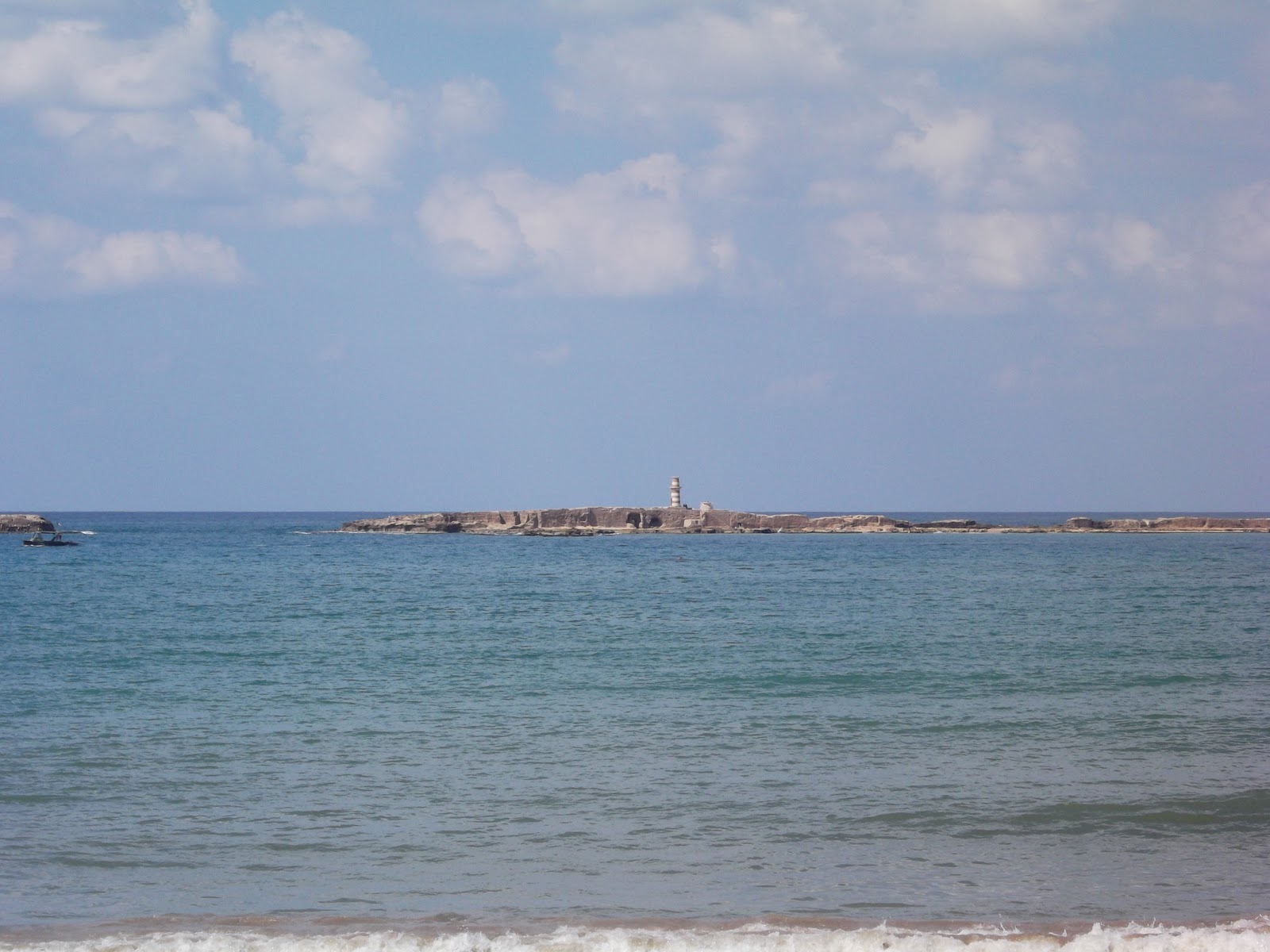
Zeereh Island, Sidon

Saddam Hussein poster, Tripoli


And so we pressed on south, tracing the gentle convexity of the brilliant Mediterranean through al-Ghaziyeh, site of the killing of eleven children and fifteen other civilians by two Israeli air strikes in ’06; and through Saksakieh, where yet another luckless shop owner fell victim to Hizbullah’s perennial war on alcohol when he arrived one morning in July to find his premises burnt to cinders – a casual trashing of a poor man’s livelihood that shows how much Nasrallah’s gangsters really care for the ‘downtrodden’. Just north of the Litani river, we passed Mazraat al-Yahoudieh – ‘the Jewish Farm’ – where the Jews of Deir al-Qamar had fled during the Christian-Druze war of 1848. God knows whether any Jews live there today - the website of the Lebanese Jewish Community Council puts the total size of today’s Jewish population at “less than 200”; a community that once numbered tens of thousands of Lebanese patriots, forced from their land by barbarous minds who could not distinguish between Jew and Zionist. 

The British Foreign & Commonwealth Office advises against “all but essential travel south of the Litani”. This seems to me an arbitrary point of reference, for there is nothing obviously different about the other side. True, the Party of God certainly makes its presence known, littering the streets with its green-and-yellow flags (bearing the AK-47 insignia it shares with the Iranian regime’s death squads); its morbid galleries of fallen ‘martyrs’; and of course its endless veneration of the Dear Leader himself. But the same could also be said of just about every village we passed since Sidon. It’s also true that crossing the Litani takes one closer to Israel; a state rather famed for its preference for bullets over questions in its dealings with unexpected company. But then the Israeli armed forces can, and do, hit any part of Lebanon they like - as the residents of al-Aabde, a small port town by the northern border with Syria, were reminded when fourteen were killed by Israeli air strikes in '06 (“Nothing is safe”, as the IDF Chief Dan Halutz bragged at the time). 

No, the only difference I could discern as we approached the bay of Tyre (Sour) was an amplification of the splendour of the general surroundings; the sea taking on a lighter, glossier sheen; the clouds breaking apart in tufts of cotton. The city itself is a living refutation of biblical ‘prophecy’; for despite the words of Ezekiel (and more than three decades at the frontline of the Arab-Israeli war), Tyre not only still exists but is once more a centre of regional commerce and culture. Seeing the city in 1697, ruined successively by Crusader and Mamluk conquests, the Oxford academic and Anglican priest Henry Maundrell crudely declared a vindication of scripture:

On the north side it has an old Turkish ungarrison’d castle; besides which, you see nothing here, but a mere Babel of broken walls, pillars, vaults, &c. there being not so much as one entire house left. Its present inhabitants are only a few poor wretches [...] subsisting chiefly upon fishing; who seem to be preserv’d ill this place by Divine Providence, as a visible argument, how God has fulfill’d his word concerning Tyre, viz. That it should be as the top of a rock, a place for fishers to dry their nets on, Ezek 26:14.1

How satisfying it is to see this infantilism made laughable, and to find in Tyre today a population of over 100,000 flourishing in very much “entire” dwellings that, moreover, strike an enviable balance between the polish of urban modernity and the ungroomed charm of the seaside. Stopping at a Byzantine villa-turned-resort – where I was able to get that drink after all – we encountered a group of Europeans who told us they’ve been holidaying in Tyre for years, and I can’t say I blame them. From its unique location, protruding so starkly from the mainland, one can see almost as far as Sidon to the north, and to the beginnings of Israel to the south. And should one tire of idling on the beach, the Roman ruins of the Al Mina excavation site, a mere five minute drive away, are the equal of anything to be seen in Byblos (Jbeil) – just as the shawarmas I had in the city centre were the equal of anything on Beirut’s Bliss Street. I left the city much as I had left Sidon; with regret that I couldn’t have stayed longer and with a wish to return for much more extensive investigation in future. 

View north from the Al Fanar resort, Tyre. Taken by MA

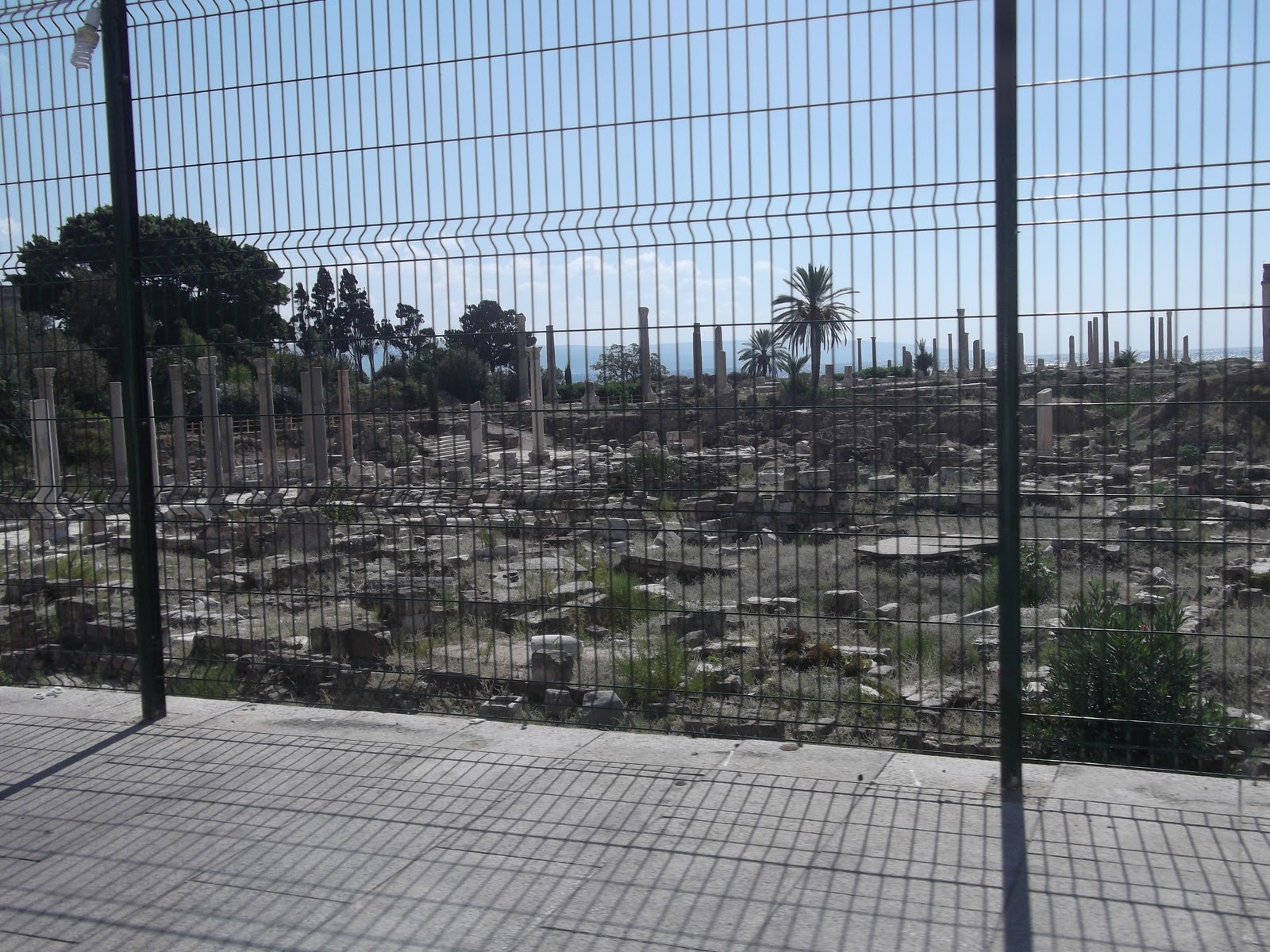
Al Mina Roman excavation site, Tyre


Heading south of Tyre, the road veers inland somewhat, the sea disappearing behind the vast banana plantations that will be disturbingly familiar to those who have seen Ari Folman’s 2008 film, Waltz With Bashir. An ostensible sign of increased danger arrives in the form of an army checkpoint, bearing a stern warning that no “foreigners” may pass without permission from the moukhabarrat, or intelligence agency, in Sidon. My heart plummeted, for I most certainly hadn’t obtained any such permission, and could scarcely imagine the headache that would be involved in doing so. However, by a blessing of fortune that mystifies me to this day, our car was waved through before we had even come to a halt. And so for the next twenty minutes it was us and the bananas, the sighting of other human beings becoming suddenly infrequent. Good pace was made possible by the remarkably fine condition of the roads – newly rebuilt, no doubt, after annihilation in ‘06 – and as the trees cleared and the Mediterranean came once more into view, we soon found ourselves being waved through the checkpoint at the entrance to Naqoura, the small town just two miles from the border that is also the headquarters of the United Nations Interim Force in Lebanon, or UNIFIL. These ‘peacekeeping’ units were initially deployed in response to Operation Litani, Israel’s first invasion of Lebanon in 1978, “for the purpose of confirming the withdrawal of Israeli forces, restoring international peace and security and assisting the Government of Lebanon in ensuring the return of its effective authority in the area”. Given that only the first of these three has been achieved – 22 years later than scheduled, at that, and little thanks to UNIFIL – the poor bastards, despised by Israel and Hizbullah alike, look doomed to be stuck in south Lebanon for quite some time yet. 

Checkpoint south of Tyre
UN base in Naqoura
“From here”, Ali announced as we left Naqoura, “UNIFIL bas”: UNIFIL, and nobody else. And so it proved, as we entered territory that, from 1978 to 2000, was for all practical purposes a part of the Israeli state. To come across a landmine or an unexploded cluster bomb would by no means be unheard of in these deserted plains, and so it was rigidly to the tarmac that we stuck as we began the final stretch, alone but for a UNIFIL jeep a few hundred metres ahead of us. What struck me most about the moment that the road ran out, and we were forced to turn east, was how utterly tranquil the whole scene was. No sniper-topped watchtowers; no rows of tanks; no convoys of helicopters swirling overhead. The border fence itself was the sort of thing a moderately foul-tempered farmer might erect to keep out teenage pranksters, not the frontline between two militarised nations officially at war. The dark green field through which we were driving simply dipped down a slight recess and there, not more than fifty metres away, was a parallel road in Israel. And behind it, not more than five hundred metres away, were the beige walls and red roofs - the same colour scheme I had seen at the Ma’ale Adumim settlement in the West Bank - of the Israeli village of Kfar Rosh HaNikra, a kibbutz and tourist attraction renowned for its grottoes.

UNIFIL jeep
A road in Israel


Israeli village


Amazingly, the more we drove east, the more our road and the parallel one in Israel began to converge. We passed Labbouneh, where the kibbutz of Hanita was practically touching the Blue Line; and Btaichiye, opposite the village of Arab al-Aramshe, where three Israeli Arab Bedouin civilians were killed by Hizbullah rocket fire in ‘06. At Boustane, just west of the Nabatieh governorate, we could practically read the number plates of cars in the Israeli village of Zar’it. And still, the calm in the air was preternatural; tantric; catatonic. Can it really have been from this very spot that Hizbullah crossed the border on July 12th, 2006, firing explosives and anti-tank missiles at an IDF jeep convoy, killing eight soldiers and dragging two back into Lebanon alive; in doing so provoking the most destructive Israeli assault on the country since ‘82? Apparently so, and yet aside from a fenced-off compound a couple of kilometres inside Israel, which Ali believably claimed was an IDF base, I could see no one around to stop me doing something similar myself – least of all the UNIFIL patrolmen, who regarded us on the whole with astounding incuriosity, as though to make inquiries about our intentions or indeed to acknowledge our presence at all would be an unpardonable violation of proprieties. 

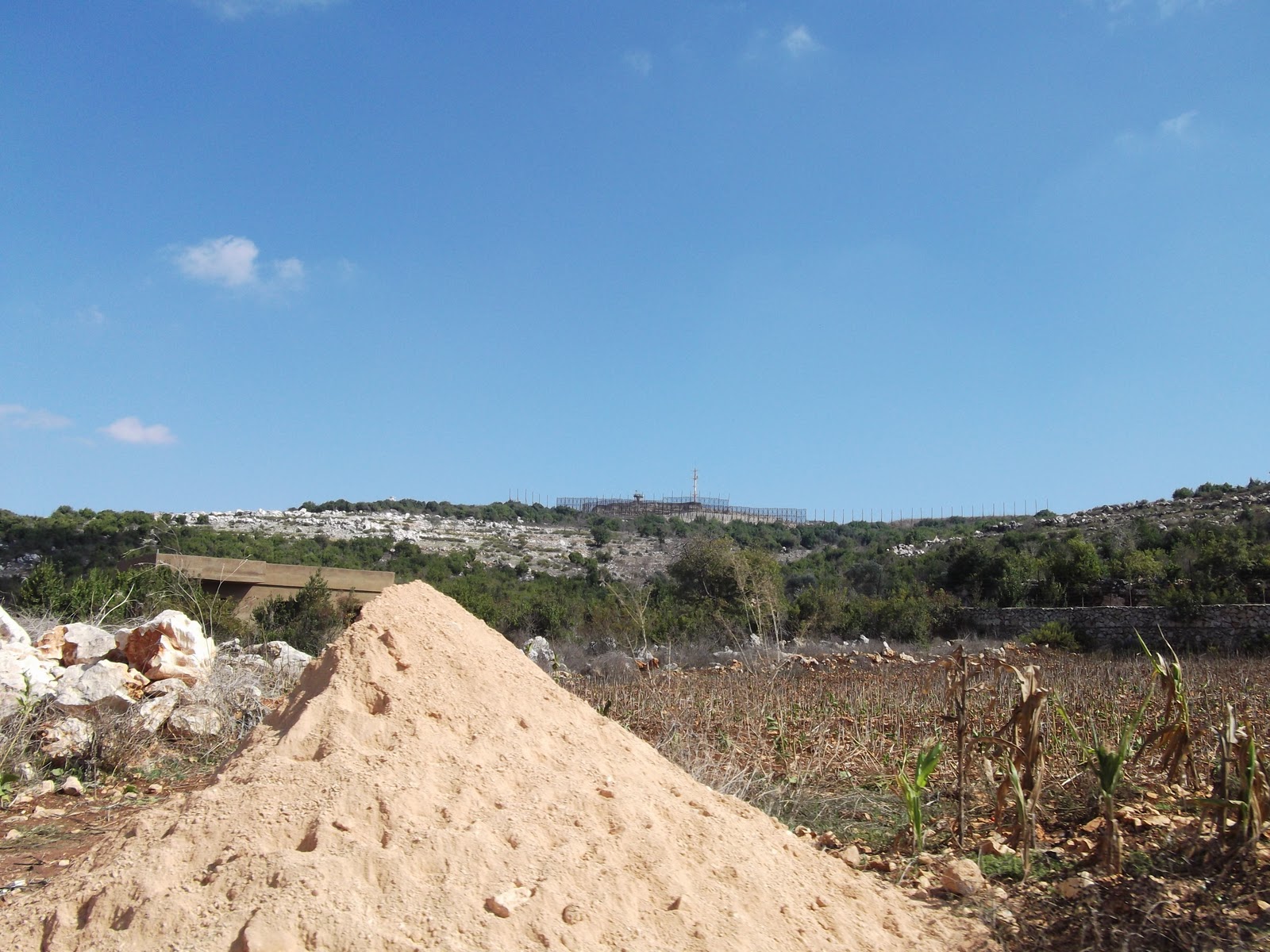
IDF base in the distance

UNIFIL jeep. Taken by MA


Even the Party of God was nowhere to be seen here. The American writer, Michael J. Totten – of whose book on Lebanon I am no great fan – saw the Blue Line further up to the north-east in ‘05 and posted pictures on his blog of various miscellanea assembled along the border in apparent attempts to intimidate Israelis: wrecked IDF trucks; ‘martyr’ shrines; photos of severed Israeli heads; etc. I have seen similar things myself in Baalbek. But nothing remotely of the kind could be found where we were; indeed, aside from one poster of the late Shiite cleric, Muhammad Fadlallah – bearing the not-too-terrifying inscription, “With my love and blessing” – the only graphic we came across was a white dove painted next to a green cedar on a concrete block. One wouldn’t wish to sentimentalise matters, or to pretend that the Lebanese are pacifists. But it’s useful all the same to have a qualification of the Totten narrative in which the Lebanese side of the border is little but a barbarous carnival of venom and violence.

Israel in the background. Taken by MA


Which brings me, somewhat elliptically, to Qana, roughly ten kilometres north of the Blue Line, which was to be our last stop before rejoining the coastal highway and returning to Beirut. A modest town in many ways, Qana is nevertheless believed by many to be the biblical Cana of Galilee, where Jesus performed his most useful miracle when he supplied the drink at an otherwise boozeless party, thereby delivering the presumably bored guests from further tedium (John 2:1-10). A spiriting distinction, to be sure, but I can’t say I felt much inclined to smile on my visit. For Qana today is a morbid town, known not for miracles but for massacres. The first one occurred during a sixteen-day battle between Hizbullah and Israel in ‘96, when on 18 April, the Israelis deliberately and repeatedly shelled a UN compound that was housing some 850 civilians, killing 106 (over half of them children) in a most unimaginably gruesome manner2. The second came just over a decade later, on 30 July, 2006, when Israeli jets bombed a three-story residential building housing 63 civilians, killing 27 (16 of them children). In both cases, the Israeli government involved itself in a disgraceful series of lies: in the first case claiming that a computer malfunction was to blame, and denying that a pilotless ‘drone’ reconnaissance aircraft had been flying over the compound before the shelling began; and in the second case insisting that Hizbullah combatants had fired rockets from the residential building, thus making it a legitimate military target. In both cases, the Israelis were forced to recant their original claims: in the first case after the discovery of a video clearly filming the ‘drone’ by the UN compound; and in the second after it became clear that eyewitnesses to the attack, including international rescue workers, journalists and human rights observers, were too numerous, and too consistent in their reports to the contrary of the Israeli claim, for the deception to work. In both cases, in other words, the flow of venom and violence was from Israel to Lebanon, not the reverse – a partial vindication, come to think of it, of Ezekiel after all. 

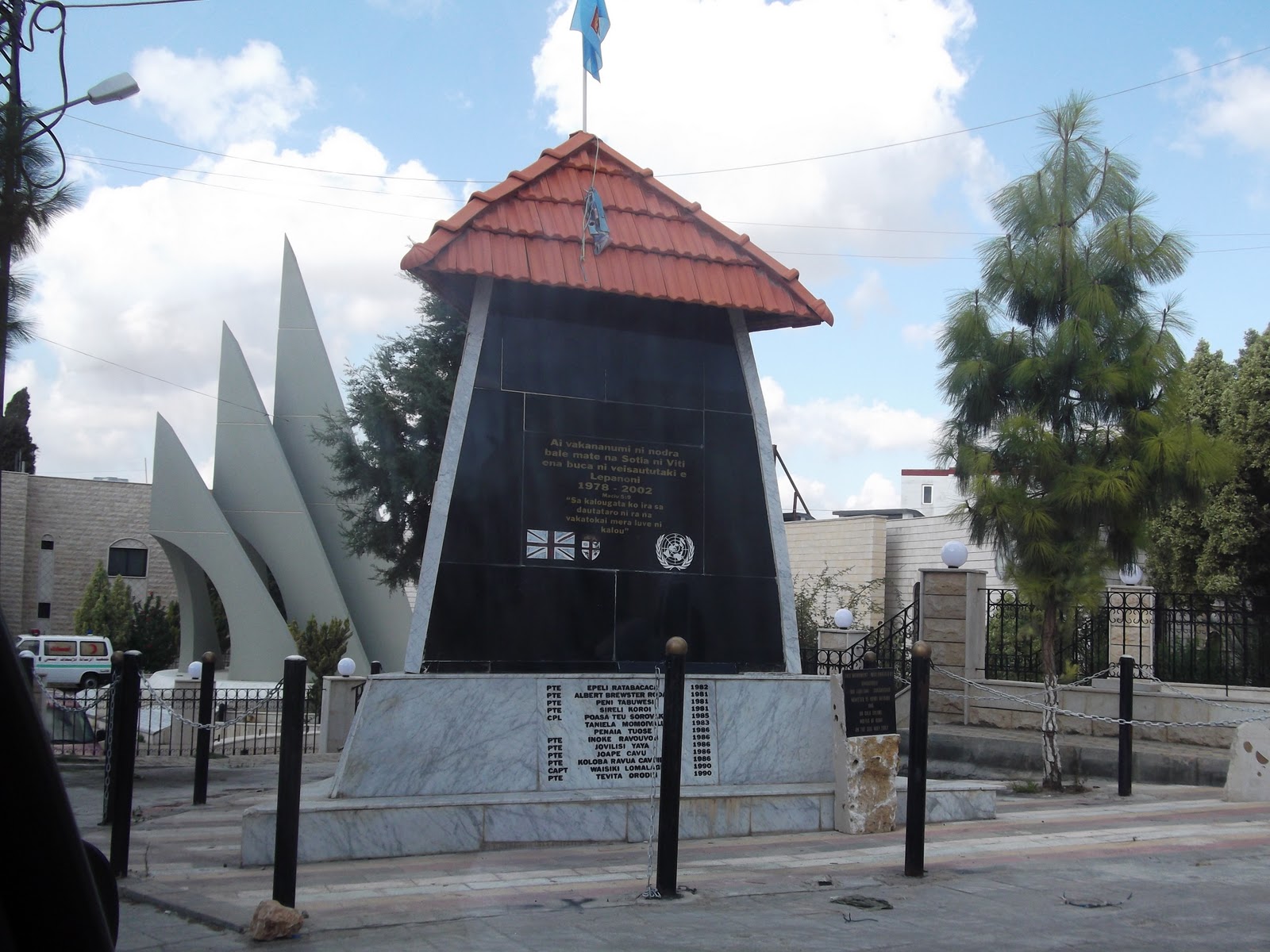
Memorial at the UN compound in Qana


Was it also a partial vindication of Hizbullah, and its claim to be a ‘liberator’ of the land? Certainly there are many who would answer in the positive. And in a way, the question isn’t for me to answer: I may not presume to speak on behalf of my Lebanese companions, for whom the trip we had taken that day would not have been possible just twelve years ago. What it means to stand on one’s national soil, previously stolen by a foreign power is unknown to me. Still, for however little it may be worth, my answer would always be an unhesitating ‘no’. The reason for this was neatly encapsulated in a poster I saw about five minutes south of Naqoura. Impaled on the shore of the resplendent Mediterranean, with the hills of Israel lining the horizon, stood a metal frame displaying the faces of two politicians, neither of them Lebanese: the inaugural Supreme Leader of the Islamic Republic of Iran, Ruhollah Khomeini; and his successor, Ali Khameini. Whether this was an expression of theological solidarity with these most eminent Ayatollahs – as is suggested by the total absence of tributes to the non-clerical President Ahmadinejad - or merely a thank-you for the vast sums of reconstruction funds donated, it points in either case to the long shadow cast by Tehran on Lebanese civil society. 

Khomeini and Khameini, just south of Naqoura


This shadow manifests itself in a number of ways: partly in the trampling of political dissent within the regions of the country which the Party controls, where members of rival factions such as Amal and the Communists are either subjugated or liquidated. It also manifests itself on a national scale, in the acquisition of a huge private arsenal, which the Party uses to suffocate the country’s democracy and hold the entire population hostage to its whims - a humiliation that further involves dragging the government into sordid alliances with grossly unsavoury regimes, most notably the Assad crime family in Damascus and the Putin dictatorship in Moscow (to say nothing of the Iranian theocracy itself). 

But more sinister than any of these is that part of the Iranian shadow that fell on the aforementioned shop owner in Saksakieh. How readily some people appear to forget that the original Hizbullah manifesto, published in the as-Safir newspaper in 1985, called openly and repeatedly for the Lebanese to submit to an “Islamic government” and a “culture [...] based on the Holy Koran, the Sunna and the legal rulings of the faqih [jurist] who is our source of imitation”, clarifying that the faqih in question was “Ruhollah Musawi Khomeini”. And despite much loose talk about the Party ‘softening’ its stance in its amended manifesto of 2009, Nasrallah plainly reaffirmed its “allegiance to the Fakih” and “commitment to the [Islamic] Jurisconsult” when challenged on the point by a journalist at the press conference launching the manifesto. Hizbullah has, in this sense, not removed the Israeli occupation but replaced it. Once again, the essential point is underscored: as long as it’s the mullahs and imams who have the power - or the patriarchs or popes or the rabbis for that matter – then real ‘liberation’ will never be attained. One hopes in Lebanon, as one hopes in every country, that it isn’t too late to realise this, and to act upon it.

1 Maundrell, H., Journey from Aleppo to Jerusalem at Easter A.D. 1697 (1703); as reprinted in Gorton, T.J. & Gorton, A.F., Lebanon: Through Writers’ Eyes (2009), p. 103
2 See esp. Fisk, R., Pity the Nation: Lebanon At War (3rd edition, 2001), pp.669-89

Monday, October 3, 2011

Defining a Massacre: A review of 'Gaza: Stay Human' by Vittorio Arrigoni


Around 200 metres from the hospital lay about 30 bodies, among them women and children, many of whom were still alive. They couldn’t be rescued as the snipers on the roofs shot at anything that moved. Those bleeding bodies in the street were civilians who’d escaped from their homes when they’d caught fire after being shelled. [The] snipers hadn’t hesitated to shoot them, one by one, including the children, once they were framed by the viewfinders on their guns. 

Put the above passage to a panel of seasoned political ‘pundits’ (to use the Hindi word for ‘religious authority’ that we apply with unintended accuracy to that special species of charlatan and bullshit-merchant), and ask them to identify the army that carried out the actions described, and it seems safe to assume their minds would turn to one of the less restrained of the Arab regimes currently involved in the broad-daylight murder of their ‘own’ citizens. Snipers had been deployed to similar effect in Egypt, after all, as they had in Libya – before Qaddafi grew impatient and moved on to yet more lethal firepower. Live rounds continue to be fired at protesters in Bahrain, and only last Saturday, snipers of the Yemeni state assisted troops wielding anti-aircraft missiles in the slaying of at least forty peaceful demonstrators. My own guess (as an aspiring bullshit-merchant myself) would have been the Republican Guard of the Baathist dictatorship in Syria, having watched in April the harrowing footage of Daraa residents trying, directly under the scopes of government marksmen, to salvage the bullet-riddled bodies of civilian men and women from their burgundy puddles in the street. 

Yet the army in question belongs not to any blood-bespattered Arabian tyrant but to the State of Israel, that most precious of American allies and supposed shining example of democratic values in otherwise dark and barbarous waters. The quote comes from Gaza: Stay Human (p. 77), a slender but astonishing account of Israel’s 22-day assault on the Gaza Strip in 2008-9, and the first and sadly final book from the recently murdered Italian journalist and activist, Vittorio Arrigoni, who lived in Gaza from 2008 until his death at the age of thirty-six on April 15th of this year. 

If it appears at all odd that an army so boastful of its ‘purity of arms’ would use high-tech military equipment against unarmed women and children, I assure the reader I am not ‘cherry-picking’ for exceptional cases: I could have plucked something similar from almost any of Gaza’s 118 pages. Indeed, if the above example were any sort of departure from the average, it would be toward the tamer side. And if the comparison between Israel’s attacks in Gaza and Assad’s in Syria is inexact, it’s only because the former were so many multiples more gruesome and homicidal than the latter. 

For Gaza is a bursting reservoir of violence from start to finish; a glistening inventory of gore; an emporium of horror. Sentences such as the following are by no means atypical:

Yesterday at the Jabalia refugee camp an F16 plane dropped some missiles onto an ambulance. (p. 15)

On Sunday, 11th January, at about 3.00am, the F16s bombed the orphanage of the Dar al-Fadila Association [...]. (p. 64)

Once again, yesterday, an ambulance was hit in Gaza City. On the previous day two doctors at the Jabalia refugee camp had died when they were hit by a missile shot from an Apache helicopter. (p. 19)

If the firefighters tried to put out the fires, they’d instantly become the targets of the F16’s machine guns – this already happened yesterday.  (p. 17)

The soldiers actually prevent us from running to the aid of the survivors [...] When the wounded are close to the armoured vehicles they were just attacked by, we, in our Red Crescent ambulances, aren’t allowed anywhere near, as the soldiers take potshots at us. (p. 24)

Indeed, this sort of thing is so common that to apportion each individual case its due and proper outrage becomes impossible: after the first few dozen annihilations of hospitals, schools, orphanages, refugee camps and residential apartment blocks, an element of desensitisation is unavoidable. But nothing can prepare one for things like this:

A child was lying with his skull cracked open, his eyeballs literally hanging out of their sockets, swaying onto his face like those at the end of a crab’s stalks. When we picked him up, he was still breathing. His little brother had a disembowelled chest, and you could distinctly count his white ribs through the tatters of his torn flesh. Their mother pressed her hands on to that eviscerated chest, as if trying to fix what the fruit of her love had managed to create, and which the anonymous hatred of a soldier, obeying orders, had now forever destroyed. (pp. 25-6)

The website of the Israeli Ministry of Foreign Affairs has a section devoted to ‘Operation Cast Lead’, in which it states that “the IDF conducted pinpoint surgical aerial strikes, using precision guided munitions”. It’s the sort of thing the Israelis say rather frequently. The claim has some interesting implications: if true, then the IDF is by far the most sophisticated and accomplished terrorist organisation in modern history; and if false, then the official statements of the Israeli government are lies. As it happens, Arrigoni has his own take on this question:

There’s no such thing as a surgically precise military operation. When the Air Force and the Navy start bombing, the only surgical operations are those tackled by the doctors, unhesitatingly amputating limbs reduced to a pulp. (p. 10)

Perhaps worse than the immediate effects of the bombing, however, are the ones that are slower to manifest, and are not so readily described by statistics and news headlines. Gaza is no mere clinical collation of forensic evidence – it’s an account of what actually happens when you bomb every inch of one of the most densely populated territories on the planet, around the clock, for twenty-two days in a row. For instance, people will stop sleeping: sixty hours in, Arrigoni hasn’t managed a wink, “and the same can be said of any Gazan” (p. 6). There will be other biological irregularities - on the tenth day of bombing, Arrigoni writes, “Many terrified pregnant women are prematurely giving birth right now” (p. 27). The repeated use of white phosphorous munitions prompts a doctor at the Al-Shifa hospital to predict an impending wave of “new cancers and deformed babies” – indeed, so lavish was the distribution of these illegal toxins by the IDF that it worried the residents of the nearby Israeli cities of Sderot and Ashkelon, who “formally asked the Israeli government for clarification regarding the weapons used” (p. 96) in the Strip*. And then, quite apart from the physical damage, there is the incalculable mental trauma, which is unknowable to the outsider and can only be dimly guessed at by stories like the following:
 
A visibly malnourished child crouched in front of his mother’s corpse, already in an advanced state of decay. He had taken care of that body for four days, as if she were still alive. He had dried the blood from her face and dragging [sic] himself through the rubble of what had been their home, bringing her water, bread and tomatoes, which he’d carefully placed next to her head. He thought she was only sleeping. (p. 78)

Arrigoni goes on to explain - as anyone who had come as far as page 78 could have guessed - that “Israeli snipers had prevented the Red Cross from rushing in to bring aid” to the child’s mother, as well as everyone else killed or wounded at Zeitoun over those four days.

No reader acquainted with Israel’s conduct, or misconduct, in previous wars can fail to recognise some old friends in these pages. First, and least surprising, there is the ubiquitous T-word. During the July 2006 bombing of Lebanon, the Israeli justice minister Haim Ramon said, “All those now in south Lebanon are terrorists”. Nearly three decades ago, on September 18th, 1982, when Robert Fisk was wading through the warm bodies of women and children in the Chatila refugee camp on the outskirts of Beirut, an IDF soldier stopped to warn him: “There are terrorists everywhere. Be careful” (Fisk, R., Pity the Nation, p. 370). Never mind that of the c. 1,100 killed in Lebanon in July 2006, nearly 80% were noncombatants**, or that no evidence exists to suggest a single one of the c.1,700 massacred with Israel’s permission at Sabra and Chatila was a militant, the line remained unchanged during Cast Lead: “Everyone [in Gaza] is a terrorist”, said an IDF soldier quoted in a Haaretz article cited by Arrigoni (p. 110). For the record, of the 1,390 Gazans killed during the 22-day siege, “at least 759 were not taking part in the hostilities, among them 318 persons under eighteen years of age”, according to the Israeli human rights organisation, B’Tselem.

Mention of Fisk’s magisterial account of the Lebanon war prompts a second example of old Israeli habits dying hard. Arrigoni recalls a conversation in the Al-Shifa hospital with Tamim, a journalist recovering from the amputation of both of his legs, having been selected as the target of one of Israel’s 2,360 precision-guided air strikes:

He explained how he thinks that Israel is adopting the same, identical terrorist techniques as Al-Qaeda: bombing a building, waiting for the journalists and ambulances to rush in, then dropping another bomb to finish off the latter as well. (p. 49)

Seems far-fetched, I hear you say. Yet here is Fisk describing the moment on June 27th, 1982, when an Israeli shell missed him so narrowly that “the explosion felt as if it was coming out of the back of my head”: 

Ten minutes was all we reckoned we had. The planes usually came back after ten minutes. To finish off the survivors? To catch the rescuers out in the open? We never knew. (Pity, p. 306)

Thus one of the several journalistic triumphs of Gaza is to have added yet more evidence in favour of the view, hysterically denied by the neoconservative bien-pensant, that the consistently high civilian death toll on the receiving end of Israel’s attacks is at least to some extent an intentional outcome of Israeli policy. 

Reportage to one side, Gaza also contains some passages of sharp analysis. Reflecting on the wider effects of Cast Lead just two days after the ceasefire, Arrigoni is among the first to register the swivelling vanes of a fresh Palestinian paradigm:

If Israel’s objective was to isolate and rid the Strip of Hamas by dividing further a people already split by internal diatribes, then Israel has achieved the exact opposite of what it intended. The bombing has in part given Gaza back its national identity. [...] The flowing beards of the Izz Al-Din Al-Qassam Brigades’ Islamists, Hamas’ fighting wing, have fought side-by-side with the scampish, goatee-sporting Marxist guerrilla fighters of the Popular Front for the Liberation of Palestine, and alongside Fatah’s Al-Aqsa Martyrs Brigades. Only time will tell if this newfound unity among the militias is a reflection of unity within civic and political society. (pp. 93-4) 

Well, we know from the Goldstone report that things weren’t as merry as all that, with Fatah people being on multiple occasions detained, beaten and even killed by Hamas authorities during the 22 days. But it’s no less true that in May of this year, meeting in a newly liberated Cairo for the first time in four years, Mahmoud Abbas of Fatah and Khaled Meshaal of Hamas signed a pact of unity that led to the formation of a coalition bloc that might yet govern the first UN-recognised Palestinian state. This is presumably not the return on investment the Israelis had in mind in December 2008 – nor, for that matter, is the loss of Israel’s two most strategic partners in the region, Turkey and Egypt, which the Israeli journalist Gideon Levy has also accredited to the “resounding failure” of Cast Lead. It’s numbing to realise that Arrigoni was killed just one month before the Fatah-Hamas conciliation, and would thus never know how prophetic his words had been.

Just in case that sounds at all saccharine, I ought to state that Arrigoni’s words can be a few other things besides. Sanctimonious, for example. Humourlessly self-congratulating, for another. Did we really need to be told that Arrigoni and his comrades are

[M]ore at ease in the midst of this Gazan hell than relaxing in a metropolitan heaven in Europe or America, where people celebrating the New Year and [sic] aren’t really aware of just how complicit they are with the butchering of all these innocent civilians. (p. 20)

? Or that

Human beings, like myself, like many who vent their indignation, are ready to risk their lives rather than lounge passively in their living rooms watching news bulletins. (p. 57)

? The point is not that Arrigoni isn’t risking his life, or that there aren’t Europeans and Americans who are complicit with Israel’s policies. It’s more, as one cringes to have to spell out, that people generally become less inclined to think a person heroic the more that person tells them how heroic he is. 

Far worse than this stylistic affront, however, is the moral affront of his complete omission of any reference to crimes committed by Palestinians against Israelis. He manages to write his penultimate chapter, titled ‘War Crimes in Gaza’, without mentioning the merest misdemeanour on the Palestinians’ part, despite quoting from Amnesty International’s Operation ‘Cast Lead’: 22 Days of Death and Destruction, which mentions “serious violations of international humanitarian law [and] war crimes” committed by Palestinians; from Physicians For Human Rights – Israel’s Ill Morals: Grave Violations of the Right to Health during the Israeli Assault on Gaza, which talks of the “severe and systematic violation of International Humanitarian Law” that was “the firing of missiles by the Hamas to the south of Israel”; as well as the Goldstone report itself, which describes the Palestinian rocket fire as “an indiscriminate attack on the civilian population of southern Israel, a war crime, and may amount to crimes against humanity”. If it’s true, as Arrigoni claims, that “[a]s a pacifist and non-violent person, I abhor any form of Palestinian attack against Israel” (p. 14), then one wonders why these nontrivial accusations weren’t given a moment’s mention.

Nevertheless, on balance, I feel this shortcoming must be forgiven. For no reasonable human being could read Gaza and earnestly feel that the firing of homemade projectiles at sparsely populated civilian centres is anything like as morally objectionable; as basically repellent as an exorbitantly powerful army launching an all-out military operation, using everything from tanks to navy ships to attack helicopters to fighter jets - not to mention cluster bombs and white phosphorous - on very densely populated civilian targets such as orphanages, hospitals and refugee camps. It’s true that critics of Israel are too often given to throwing heavy words around lightly - terrorism; atrocity; war crime; genocide – but what the Israelis committed in Gaza over those 22 days was a massacre if the word means anything at all. Let it be our tribute to this brave and honourable man to remember that much, and to insist on it. And let it be our tribute to the more than 700 dead innocents to loathe and resist their murderers – whether Israeli or Palestinian – by any and all lawful and democratic means. These are the necessary, if far from sufficient, conditions for our ‘staying human’. 

* For more on this, see Human Rights Watch’s Rain of Fire: Israel’s Unlawful Use of White Phosphorus in Gaza

Tuesday, September 20, 2011

Only Gulf Arabs can deliver a Palestinian state


President Obama’s promise to veto the Palestinian bid for United Nations membership this week was as predictable as it was despicable. Nobody pretends that Security Council recognition can bring tangible relief from the humiliation of life under occupation – still less anything like ‘a lasting peace’ – but even if its significance were to be chiefly ‘symbolic’ (the journalistic mot du jour), that doesn’t seem good reason in itself to oppose it. To recognise the right of Palestinians to a sovereign state on the territories captured from them in 1967 would be a first step in redressing the defining injustice of the post-WWII era, as well as restoring a modicum of dignity to a people who for three generations have known only betrayal and abuse. It would, in other words, have been a matter of elementary moral principle. But if Obama has shown one trait since assuming the Presidency it is an appalling lack of principle. He’s already used his veto, after all, to kill a Security Council resolution merely condemning settlement construction – this despite his saying in Cairo in 2009 that, “The United States does not accept the legitimacy of continued Israeli settlements”. When Netanyahu refused to extend a 90-day pause in the expropriation of Palestinian land - a pause that was anyway never honoured to begin with – Obama didn’t just fail to punish him. He spinelessly arranged, along with his promiscuously unprincipled Secretary of State, for a sordid bribe of $3 billion to be slipped inside Netanyahu’s palm, only to have the spoilt brat slam the door in his face. Apparently not yet insulted enough, in his most recent speech on the Middle East in May of this year, Obama became the first American president to publicly refer to Israel as a “Jewish state”, thus simultaneously erasing what the Israeli historian Ilan Pappé called the ‘forgotten Palestinians’ - the 1.2 million Arab citizens of Israel itself - as well as undermining the Israeli moderate majority who understand that a “Jewish state” cannot also be a democratic one, and who have every intention of living in the latter as opposed to the former. He has, in short, presided over the most ardently Zionist American administration on either side of the aisle in recent history (who now remembers a furious George H. W. Bush withholding $10 billion in loan guarantees from the Irgun thug Yitzhak Shamir in response to renewed settlement expansion?). 

As a Westerner living in the Arab world, the question I get asked perhaps more than any other when the subject of Israel comes up is why – why does the American government continue to so unshakeably and unashamedly stand by a regime that colonises its neighbours’ lands and persecutes its ethnic minorities and has a consistent and meticulously-documented record of launching merciless assaults on civilian infrastructure both inside and outside its borders that often, if not always, implicate it in war crimes and crimes against humanity? As resolutely as one must combat all stupid and loathsome innuendo about clandestine ‘Jewish cabals’ usurping world government, for every answer I suggest to them (historic Cold War alliance; supposed shared ‘Judeo-Christian values’; common Islamist enemy; mistaken view of Israel as democracy; misplaced belief in Israeli ‘purity of arms’; etc.) it remains a simple fact that a well-financed and well-organised group of Israel’s supporters continues to command substantial influence over American policy. The Israel Lobby (it’s emphatically not the ‘Jewish lobby’, since a sizeable chunk of its constituents are in fact messianic Christians, who see in the ethnic cleansing of Palestine a portent of the Second Coming of Christ) doesn’t have quite the stranglehold on the Pentagon imagined by some of its critics – for instance, in their 2007 book The Israel Lobby and US Foreign Policy, Professors John Mearsheimer and Stephen Walt write that for “fifteen years, Israel and the lobby have pushed the United States to [use] military force to destroy Iran’s nuclear facilities” (p. 282), and yet it was not to Iran but Iraq that the Bush administration turned its guns when the ‘war on terror’ was declared – but at least so far as the Holy Land is concerned, the American Israel Public Affairs Committee (AIPAC) and its affiliates are capable of making life very difficult for anyone in Washington who takes a line other than their own (see, for example, this piece by MJ Rosenberg, the foreign policy writer who has worked for both AIPAC and the US Senate). Put simply, the strategic benefits of siding with ‘the lobby’ are many, while the costs are as good as nil.

Which raises the question of why there is no equal and opposite ‘Arab lobby’ feared and revered in the same way. After all, the application of Arab ‘leverage’ on Washington is not without historical precedent. In 1973, after the Nixon administration bolstered the Israeli military during the October War, the Organisation of Arab Petroleum Exporting Countries placed an oil embargo on the USA and implemented production cuts that swiftly quadrupled the global crude price and ended up costing America “some $48.5 billion in 1974 alone (equal to roughly $140 billion in 2000 prices), due to higher petroleum costs and an estimated 2 percent reduction in GDP” (Mearsheimer and Walt, p. 54). 

The embargo was eventually called off (at the request of Anwar Sadat), but its effects were sufficiently punitive that, nine years later, the mere threat of its resumption was enough to prompt action. In Robert Fisk’s Pity the Nation, he describes how, when it became apparent that Israel’s steamrolling of Lebanon in 1982 was to be taken as far as Beirut,

King Fahd of Saudi Arabia warned that his country would withdraw all its investments from the United States at once and impose oil sanctions against the West within hours if the Israeli army was not brought under control. Reagan was at last made aware of the gravity of the crisis and Haig – who has always denied that he gave Israel a ‘green light’ – resigned. (pp. 268-29)

Sure enough, a ceasefire was obtained - even if, in the end, Reagan was unable to prevent Menachim Begin from his carpet bombing of Beirut. 

Next year, Obama will seek re-election in a contest that everybody agrees will be decided by economic credentials. If Saudi – or any of the oleaginous Gulf states, for that matter – had any interest in securing a Palestinian state at the UN, mightn’t they seek to exploit this nontrivial fact? Brent Crude prices have already breached the $100 mark again for the first time since the vertiginous days of 2008. Isn’t it possible that the prospect of a nudge in the upward direction might give Obama some pause for thought? Even if it’s true that the ‘oil weapon’ would no longer be as destructive today as it was in ’73, there are other potential arrows in the Arab quiver. How keen would Obama be, for example, on Saudi dumping its nearly $500 billion holdings of US debt two months after the country lost its AAA credit rating? To what extent would he be pleased to hear that, say, the Abu Dhabi Investment Authority, whose assets have been conservatively estimated at $340 billion, was exiting its American real estate and equity positions (including the 5% of Citigroup it generously bought at the height of the credit crisis) to pursue new opportunities in, I don’t know, China? 

As it happens, some influential Gulf Arabs have caught on to the simple force of such considerations, and have hinted at a resurgence of the Arab lobby of bygone days. Turki al-Faisal, a Saudi prince and former ambassador to the US, wrote in June in an op-ed in the Washington Post that 

In September, the kingdom will use its considerable diplomatic might to support the Palestinians in their quest for international recognition. American leaders have long called Israel an “indispensable” ally. They will soon learn that there are other players in the region — not least the Arab street — who are as, if not more, “indispensable.”

As he elaborated:

There will be disastrous consequences for U.S.-Saudi relations if the United States vetoes U.N. recognition of a Palestinian state. It would mark a nadir in the decades-long relationship as well as irrevocably damage the Israeli-Palestinian peace process and America’s reputation among Arab nations. The ideological distance between the Muslim world and the West in general would widen — and opportunities for friendship and cooperation between the two could vanish.

This was a theme repeated in a New York Times op-ed earlier this month, in which al-Faisal warned that a veto at the UN would mean that 

Saudi Arabia would no longer be able to cooperate with America in the same way it historically has. With most of the Arab world in upheaval, the “special relationship” between Saudi Arabia and the United States would increasingly be seen as toxic by the vast majority of Arabs and Muslims, who demand justice for the Palestinian people.

How did we get to here? If it’s nauseating to be lectured on “justice” by a senior emissary of a monarchical Wahhabi police state that is itself crushing the democratic aspirations of Bahrainis this very minute (we can be sure that if the Palestinians were Shia, there would be no lofty talk from Riyadh about their “quest” for freedom), then it’s a mark of how contemptible the 2009 Nobel Peace Laureate’s handling of ‘the Conflict’ has been that such an unsavoury character can appear genuinely courageous and principled next to him. For Christ’s sake, you know you’ve lost your way when you make the Saudis look good. Yet as long as Obama continues to consign the ‘peace process’ to the cemetery, it will remain the case that only Gulf Arabs have the power to deliver a Palestinian state. May they do so with all speed.

Sunday, September 11, 2011

Why are the Republicans snubbing their one (semi-)sane candidate?


With enemies like these, Obama has very little need of friends. The ballistic rise of the reptilian governor of Texas, Rick Perry, to leading candidate for the Republican presidential nomination in barely a month on the campaign trail confirms a number of invaluable lessons for any other GOP hopefuls aiming to mount a last-minute dash for the White House. First and foremost, be a Christian fundamentalist, with unshakeable conviction in the absolute inerrancy of scripture; by no means excluding the biblical account of human ‘creation’. With commensurate fanaticism, oppose all tax increases of any kind, whilst at the same time making loud complaints about the fiscal deficit and, indeed, creating a multi-billion dollar budget shortfall in your own state. Be utterly contemptuous of the intellectual in general and the scientific in particular. Praise capital punishment – indeed, if you happen to be the governor of a state which murders its criminals, boast warmly about the number of deaths for which you have personally been responsible. Declare undying ideological fraternity, or filiality, with Ronald Reagan, even while in fact advocating positions on anything from taxation to illegal immigration that are leagues to the right of anything the senile statesman ever signed into law. Finally, just to distinguish yourself, find a niche subject about which to make a statement of forehead-smacking fatuity, such as referring to the social security system that sustains the welfare of 54 million retired, disabled or otherwise dependent Americans as a “Ponzi scheme”. 

Such has more or less been the template for all the major GOP candidates this year – from Perry to the Mormon fruitcake Mitt Romney to the fantastically ignorant Michele Bachmann (whose campaign is at least, or at last, showing signs of decline). Yet against this orthodoxy of cultism and crackpottery, there sounds a lone voice of what bears an alarming resemblance to something almost like reason. The voice belongs to the former governor of Utah and ambassador to both Singapore and China, Jon Huntsman, a polished and erudite speaker whose composed and cool-headed manner has already been compared to that of the incumbent Democrat. With his soundbite-friendly description of himself as a ‘centre-right candidate for a centre-right country’, Huntsman appears to be the only Republican candidate of the lot to realise – as surely all educated Republican voters have been growling into their Journals since Sarah Palin announced that homo sapiens cohabited the earth with dinosaurs – that the anti-intellectual demagogy of the Tea Party and its affiliates is not only a shameful spectacle of stupidity in itself but moreover the greatest contributing factor to the utter unelectability of most GOP candidates in the eyes of every ‘moderate’ voter:

When we take a position that isn't willing to embrace evolution, when we take a position that basically runs counter to what 98 of 100 climate scientists have said, what the National Academy of Science has said about what is causing climate change and man's contribution to it, I think we find ourselves on the wrong side of science, and, therefore, in a losing position.

One is fondly reminded of Dr Francis Collins, the eminent geneticist and evangelical Christian who wrote in his book The Language of God: A Scientist Presents Evidence for Belief to the effect that Christians only do themselves harm by rejecting evolution, and the sooner they grow up and repudiate the pathetic pseudo-science of ‘intelligent design’, the immediately more credible will be their standing not only in the scientific community, but in the broader community of educated persons. 

Nor is this by any means the limit of Huntsman’s appeal as a candidate. In an election that everyone seems to agree will be decided on matters economic, Huntsman brings formidable credentials. Indeed, he can claim to rival Rick Perry’s much-touted ‘economic miracle’ in terms of job creation; Utah having led the country in exactly that respect during his gubernatorial tenure (by one method of counting). A profile in Vogue further elucidates the highlights of that period:

In office, he took progressive stands on immigration and the environment, signing on to a Western-states agreement to reduce carbon emissions. His big emphasis was on economic growth and job creation. Cutting the state income tax from 7 to 5 percent helped fuel business investment that by 2007 brought Utah’s jobless rate down to 2.3 percent—the lowest in its history. The resulting bonanza in revenue allowed the state not only to avoid spending cuts but to make investments, such as raising pay to attract better teachers. The kind of intelligent long-term planning that the Pew Center for the States cited in listing Utah as one of the three most well-managed states in the country helped boost Huntsman’s approval rating above 90 percent. Reforming antediluvian liquor laws and using his state’s natural wonders as a backdrop for his motorcycle rides didn’t hurt either. In 2008, he was reelected by a wide margin.

That Huntsman could simultaneously reduce income taxes and carbon emissions, while also making it easier for a guy to get a glass of bourbon in a hotel room, illustrates well his admirably – perhaps better say refreshingly – human brand of conservatism. That he is also a polyglot who has (like the current President) lived for several years outside the United States is surely not to be overlooked lightly, either.

Of course, he is hardly without shortcomings. He’s laden with much of the standard 'pro-life', anti-homo reactionism that any self-styled proponent of the ‘family values’ contingent might be expected to carry (though it is, I suppose, to his credit that he’s unopposed to gay civil unions). On foreign policy he is especially discouraging: objecting, for instance, to American participation in the NATO intervention in Libya – which was, I need hardly remind my reader, a strictly humanitarian operation, solicited not just by the Arab League but also by brave defectors from the Libyan regime itself, for the protection of the long-suffering victims of one of the Middle East’s cruellest and most obstinate despotisms. Huntsman, apparently, thinks this a wasteful allocation of American resources, and does not believe the saving of innocent Libyan lives to be “core to [America’s] national security interest” – this despite the believable claim made in February by the former Libyan justice minister that the murder of 189 American citizens on Pan Am Flight 103 in 1988 was done on Qaddafi’s direct orders. This agoraphobic isolationism naturally does not extend to the American-Israeli ‘special relationship’, Huntsman’s support of which is as staunch as it is unqualified. In 2009 he managed to visit Israel with a delegation of the America-Israel Friendship League – an outfit that last caught my attention when they excoriated President Obama for daring to request that Netanyahu stop expanding illegal Jewish settlements in Arab East Jerusalem – and to be interviewed on camera about his experience of the country without once mentioning the occupation or, indeed, the Palestinians at all. (I ought to say that, dismal as this is, it’s infinitely preferable to the undisguised Christian Zionism of the current front-runner, who says without embarrassment that “I’m a big believer that [Israel] was given to the people of Israel a long time ago, by God, and that’s ordained”.)

Incidentally, of Huntsman’s flaws, I find that I don’t consider his religious faith a cause for especial concern. For while he is ostensibly a Mormon, his religion is plainly not that of Mitt Romney’s. As the aforementioned Vogue report explains: 

People tend to see Mormonism as a binary, you-are-or-you-aren’t question, but Jon Huntsman is something more like a Reform Jew, who honors the spirit rather than the letter of his faith. [...] [His parents] were mostly what Utahans call “Jack Mormons”—people with positive feelings about the Latter-Day Saints church who don’t follow all of its strictures. “We blend a couple of different cultures in this family,” he says.  

You’d never hear a phrase like that from Romney, who has raised his sons as Mormons and sent them on missions. Nor would you see Tagg, Matt, Josh, Ben, or Craig Romney in a hotel bar, sipping a glass of wine, as you might see one of Huntsman’s adult children. The difference in attitudes between the two Mormon candidates is encapsulated in the football rivalry between Brigham Young, where Romney went to college, and the University of Utah, where Huntsman went (before transferring to the University of Pennsylvania). BYU is an institution grounded in Mormon theocracy. The University of Utah is a state school that happens to have a lot of LDS students. 

Even if, like me, you find the ‘spirit’ of the racist, misogynistic and all-round lunatic cult of Joseph Smith to be no more attractive than the ‘letter’, you will, I hope, take real comfort from the bacchic indulgences of the junior Huntsmans, as contrasted with teetotalling ‘Tagg’ and the Romney gang (indeed, the old question of which candidate the voters would rather ‘have a beer with’ appears in this case to have only one possible answer). 

Which brings us to the greater question of why so few voters seem to want anything at all to do with Huntsman (approximately 1% of Republicans support his candidacy at the time of writing). Is it his tenure as ambassador to China under the despised Obama administration? His unequivocal acceptance of (I decline to say ‘belief in’) evolution and man-made global warming? Distrust of Mormonism amongst an intractably sectarian Protestant base? Or is it that his eloquence and equanimity fail to excite a crowd more accustomed to crass sloganeering and pulpit-thumping populism? Whatever the answer, it’s to be lamented that the GOP has snubbed the closest thing they had to a sane contender, not only because of the unthinkable implications should Obama lose next year, but for the extra work he might have been compelled to put in for his own party had Huntsman been given the chance to confront him. Instead, we non-Americans will continue to wait in vain alongside our American counterparts for our ‘change’.