 |
| Aqaba, with Sinai on horizon (Alex Rowell) |
The bus
ride from the Jordanian capital to the southern port city of Aqaba is long
enough to get a dedicated cigarette break half-way through. Having nearly asphyxiated
to death the night before on a plethora of substances inhaled (largely though
not entirely at second-hand) in Amman’s fine Dionysian establishments, I declined
to join my fellow passengers outside on the flat, grey-beige rock plains of
Jordan’s western desert. I did, however, have reason beside a hangover to feel
a marked jump in the blood pressure: a sudden first glimpse, just a few hundred
metres away, of the old Hejaz railway; built by the Ottomans to ship pilgrims
from Constantinople to Mecca, and later blown apart by Arab nationalists fighting
alongside a certain Thomas Edward Lawrence.
It’s
probably healthy for Brits in the Arab world to avoid Lawrencian aspirations, if
only for the cruel fate to which he eventually delivered the good men who had given
him their trust and respect (to say nothing of their blood). Yet one cannot
avoid – or at any rate, I couldn’t avoid – a shiver as we rolled past the Petra
and Wadi Rum he had so admired, nearing the destination whose very name seems
to have bewitched and tormented him.
The
conquest of Aqaba was the first major victory for the Arab Revolt against the
Ottomans in World War I, and certainly the greatest personal one for Lawrence. In
his memoir, Seven Pillars of Wisdom, he writes early on of the
Importance of Akaba [sic], the only Turkish port left in the Red Sea, the nearest to the Suez Canal, the nearest to the Hejaz Railway, on the left flank of the Beersheba army […]1
The city proceeds
to dominate the next hundred or so pages as he agonises over how best to take
it and salivates over the glories it will bring (“in so vital a matter as Akaba
we could not afford a mistake”; “Akaba spelt plenty in food, money, guns,
advisers”; “I still saw the liberation of Syria happening in steps, of which
Akaba was the indispensable first”; “We had one objective only, the capture of
Akaba”2).
The problem
the Arabs faced was that a naval approach would swiftly succumb to formidable
Ottoman defences embanked in the spiky mountains just a couple of miles inland
(aqaba in Arabic – عقبة – means “obstacle”, thus the self-deprecating
Jordanian joke about their country being one whose only port is an obstacle,
and whose sea is dead). Lawrence’s audacious solution was to take a 600-mile
detour through the desert, attacking the Ottomans by land from the east. It
proved successful – “The
enemy had never imagined attack from the interior, and of all their great works
not one trench or post faced inland”3 – and on July 6, 1917, the
Ottomans surrendered with no casualties on either side.
 |
| The forbidding mountains behind Aqaba, within which the Ottomans built their defences (Alex Rowell) |
Lawrence’s
description of entering the city reads like Hunter S Thompson recalling a heavier-than-average
weekend:
For months Akaba had been the horizon of our minds, the goal: we had had no thought, we had refused thought of anything beside. Now, in achievement, we were a little despising the entities which had spent their extremest effort on an object whose attainment changed nothing radical either in mind or body.
In the blank light of victory we could scarcely identify ourselves. We spoke with surprise, sat emptily, fingered upon our white skirts; doubtful if we could understand or learn whom we were. Others’ noise was a dreamlike unreality, a singing in ears drowned deep in water. Against the astonishment of this unasked-for continued life we did not know how to turn our gift to account. Especially for me was it hard, because though my sight was sharp, I never saw men’s features: always I peered beyond, imagining for myself a spirit-reality of this or that: and to-day each man owned his desire so utterly that he was fulfilled in it, and became meaningless.4
I wager
that few visitors to Aqaba today feel quite so strongly about their arrival, but
much remains of the “unassailable base”5 that the Arabs then made of
the city, whence they proceeded to support Allied forces in the Sinai, Palestine
and eventually Syria. The Mamluk-era fortress, for example, next to which Emir
Faisal (later King Faisal of Iraq) made his home, is perhaps nowadays the city’s
preeminent tourist attraction. Equally striking, though, is the 130-metre-tall
flagpole erected in the adjacent Revolution Square, undoubtedly visible from
the nearby Israeli and Egyptian resorts of Eilat and Taba, respectively, on the
other side of the Gulf of Aqaba. Unique
(as far as I know) among such structures, it bears not the Jordanian flag but
the old flag of the Arab Revolt – the same flag that briefly flew in Damascus
and Beirut until the 1920 Battle of Maysalun crushed the grand dream of the Arab
nation once and for all.
 |
| Aqaba fortress (Alex Rowell) |
 |
| The Arab Revolt flag, 130m above Revolution Square to the west of the fortress (Alex Rowell) |
Indeed, if
Aqaba is a relic of Arab nationalism, it is a distinctly bittersweet one, given
that the city today is more suggestive of Jordan’s accommodation with the Balfour
Declaration. While tourists might marvel at the sight of Jordan, Israel and
Egypt all at once (with Saudi Arabia just around the corner), this certainly
wasn’t what Faisal’s men had in mind in 1917.
Recall that
the Brits made no fewer than three simultaneous, and mutually incompatible,
promises of Arab land during the war: the first to Faisal’s father, Sharif
Hussein of Mecca, in 1915; the second to themselves and the French in 1916; and
the third to the World Zionist Organization in 19176.Of the three,
only the last remains implemented today, and nowhere more so than in Aqaba,
where Israeli weekenders sunbathe scarcely a kilometre away, secure in the
knowledge that neighbouring Arab governments are bomb-scanning their own
citizens to protect them. It’s a rather different story on the Gazan and
Lebanese borders.
Not that
the Israelis can rest entirely easy. At least five rocket attacks on Eilat have
been reported in the last three years, all of them seemingly fired by jihadists
in the Sinai, possibly though not necessarily in coordination with Hamas. Extremely
inaccurate, they have so far failed to actually hit any Israelis – indeed the
only death in the recent series occurred in 2010 when one missed Israel
altogether, landing by the Intercontinental Hotel in Aqaba, killing a Jordanian cab driver.
 |
| Israeli resort of Eilat as seen from Aqaba (Alex Rowell) |
Eilat was
hit by a “successful” suicide bombing in 2007, though, when a 21-year-old from Gaza killed himself along with 3
Israelis in a bakery. And in the heady days of Abu Musab al-Zarqawi – the Jordanian
warlord and founder of al-Qaeda in Iraq (AQI) – a barrage of rockets launched
from Aqaba itself killed a Jordanian soldier after missing the two US navy ships they’d been aimed at.
That was eight years ago, and Zarqawi has since been killed by the Americans,
but the emergence now of the AQI spinoff Jabhat al-Nusra next door in Syria is
starting to put the wind up a few Jordanians who believe they’ve seen this film before.
Not an
entirely sleepy neighbourhood, in other words, but as I say this is not because of any ill-will between Amman and Tel Aviv. Quite to the contrary, the
Knesset’s chief antagonists – Islamists and Palestinians – are, to lesser
extents, the Hashemite monarch’s too. It’s perhaps more accurate, then, to say Aqaba
(and Jordan as a whole) represents not so much the defeat of the Arab Revolt as
the severe downsizing and tribalisation of it: King Abdullah II, after all, being
the great-great-grandson of Sharif Hussein (as well as the great-grandnephew of
Emir Faisal). Ironic as the giant flag in Revolution Square might seem in that
light, it also serves a nobler, if unintended purpose: reminding the visitor that
the Arabs’ title to the surrounding land came first, and was only dishonourably revoked by callous British imperial duplicity.
Postscript: My girlfriend protests that I kill
the joy of our weekend holidays by turning them exclusively into
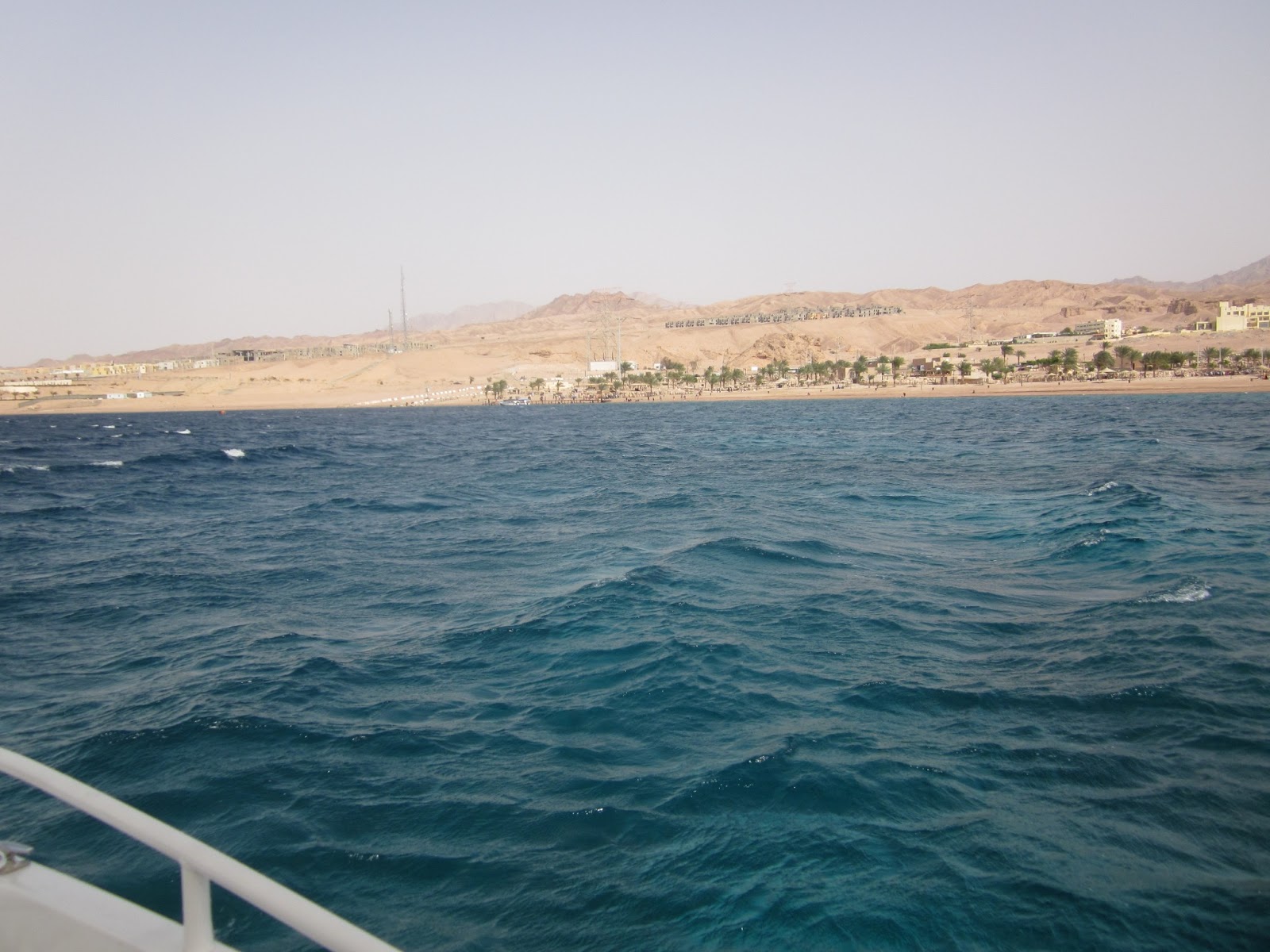
historical-political essays. I ought to add, then, that the sea at Aqaba could
not be less “dead”, with its dozen or so easily accessible coral reefs, complete with
dolphins, turtles, sharks, eels, and kaleidoscopic galaxies of fish. A scuba
dive or at least a snorkel is a must while you’re there. A stroll along the
waterfront by the old port – where glass bottom (or indeed “glass baton”) boat
rides can be acquired – is also good fun.
 |
| For 25JD ($35), a boat like this will take you snorkelling for an hour around innumerable coral reefs (Alex Rowell) |
1 Lawrence, T.E., Seven Pillars of
Wisdom: A Triumph (1922), 2008 Vintage Classics paperback edition, pp. 172-3
2 Ibid., respectively: p. 180; p. 281;
p. 282; p. 297
3 Ibid., p. 317
4 Ibid., p. 322
5 Ibid., p. 321
6 For an excellent history of this,
see Eugene Rogan, The Arabs: A History (2012), Penguin revised second paperback edition, chapter 6


