Showing posts with label al-Qaeda. Show all posts

Sunday, July 16, 2017

An autobiography of Syria's revolution

[Originally published by Now Lebanon on 17/8/2016]

Can it really be three years this month since the enormous sarin attack on Damascus’ East Ghouta? Events move at such dizzying pace in Syria that a massacre in the morning is already forgotten by nightfall, while last week’s atrocity is ossified history. The British novelist Martin Amis says we each become different people with every decade that passes. If so, we’re only 50% at most of who we were when demonstrations broke out across Syria in March 2011, and for many of us our perceptions of what happened have since undergone equally pronounced transformations.

It’s bad enough that we forget details; worse is the way facts registered at the time get clumsily fused with information (and misinformation) acquired later on. We now know, to take an example at random, that Al-Qaeda was actively involved – albeit on a microscopic scale – in the armed insurrection from as early in the day as August 2011. Even those who are still perfectly certain Assad is a heinous war criminal can now increasingly be heard contemplating the state of the rebel movement today and asking: was there ever really a ‘moderate’ Free Syrian Army? And, while we’re at it, just how democratic was the initial civilian uprising, anyway?

If you’ve ever caught yourself even momentarily entertaining such revisionism, Burning Country: Syrians in Revolution and War will make for deeply embarrassing reading. One opens its pages and steps into the spring of 2011 and suddenly it’s all there once again, just as it was: the “crowds of hundreds of thousands – men and women, adults and children,” dancing the dabke to the beat of the dirbakkeh; Christians in Homs’ Hamidiyeh throwing rice affectionately onto mostly-Muslim demonstrators in the streets below their balconies, chanting “Muslims and Christians, we all want freedom” (it rhymes in Arabic) and “One, one, one, the Syrian people are one.”

In fact, the authors Robin Yassin-Kassab and Leila al-Shami recreate the scene in much higher-definition than one watched it at the time. Among many things that make this the Syria book we’ve all been waiting for is the incredibly extensive and eclectic dramatis personae interviewed and quoted in its pages. Here we meet Sunni Marxist rappers organizing demonstrations with Alawite anarchists in Tartous; atheist supporters of the Free Syrian Army; and Christian women protesting in Damascus’ “conservative Muslim neighborhood” of Maydan wearing “skimpy top[s];” inter alia. Many interviews have in fact been conducted inside Syria, where the Syrian-British authors have traveled repeatedly since 2011. The result is the most vivid ground-level account of the revolution through the eyes and mouths of its own protagonists yet compiled in English.

Not, however, that this is remotely a sentimental stroll down memory lane or nostalgic lament for the golden days. Committed revolutionaries that they are, Yassin-Kassab and Al-Shami are also analysts of the first rank, and they set about diagnosing where it all went wrong with a remarkably Orwellian power of facing unpleasant facts. Where the opposition has erred, the authors are unsparing. Ahrar al-Sham, the “largest” rebel brigade and also the “most extreme” save for ISIS and the group formerly known as Jabhat al-Nusra, is rebuked for its slaughter of Alawite civilians, and described as “undoubtedly led by jihadist extremists who oppose the revolution’s original democratic aims.” Jaysh al-Islam, kingpin of the rebel-held Damascus suburbs, is taken to task for its Islamist authoritarianism, best exemplified by its “likely abduction and perhaps murder” of the human rights lawyer and activist Razan Zaitouneh (along with her husband and two colleagues), a figure of peerless importance in the secular, democratic, grassroots opposition, and the dedicatee of the book. The political opposition in exile is pasted for its failure to sufficiently reach out to Alawites, Kurds, and other minorities in the crucial early days when it might have made the difference.

Some perspective, however, is called for here. Bashar al-Assad’s regime remains primarily, overwhelmingly, incomparably at fault for the disaster Syria has become. In his 1993 book Cruelty and Silence, the Iraqi dissident Kanan Makiya wrote that as much as he willed every moment of every day for the fall of the Saddam regime, he feared the profound damage done to Iraqi society by decades of Baathist totalitarianism would all but guarantee a nightmare of sectarian bloodletting in its wake. He could just as easily have been writing about Assad’s Syria. Yassin-Kassab and Al-Shami demonstrate ably how a great portion of the opposition’s faults bear the genetic imprint of regime parentage.

Take religious sectarianism. While today often unthinkingly seen (by Arabs no less than Westerners) as a permanent, ineradicable feature of Middle Eastern society since time immemorial, the authors argue persuasively it is chiefly the bastard child of the region’s utterly unscrupulous contemporary regimes. Syria, they write, was “set on a secular trajectory similar to Europe’s” in the 1960s, when left-of-center politics dominated and the hijab (for example) was worn by fewer women than ever.

That all met a swift death with the advent of the Assads père et fils, whose approach to governance combined colonial divide-and-rule strategy with the mobster’s tactics of blackmail and extortion. It wasn’t just that Alawites were showered with socioeconomic patronage and other inducements to purchase their sympathies. Sunnis, while forbidden on pain of death from joining the Muslim Brotherhood, were permitted and even encouraged to become Salafists, the better to convince both Alawites and Western governments that the Assads – ever the arsonists and firemen at one and the same time – were all that stood between them and baying masses of fanatic lynch mobs.

At its most flagrant, this took the form of grooming fighters to join Al-Qaeda in Iraq after the 2003 invasion, facilitating their training and transport to the border. The regime’s direct collaboration with the group that would go on to spawn both ISIS and Jabhat al-Nusra continued until at least 2009, according to a Guardian investigative report. Famously, Assad also released a legion of violent Islamist prisoners from their cells in 2011 (at the very moment he was arresting, torturing and murdering non-violent secularists), including Ahrar al-Sham’s Hassan Abboud, Jaysh al-Islam’s Zahran Alloush, “as well as founding members of Jabhat al-Nusra [and] important figures in ISIS,” write the authors.

More generally, the complete lack of free speech, civil society, independent media, apolitical education, and cultural space stretching back four decades drained the air of the oxygen necessary for healthy communal coexistence. “What Syria needed was a national conversation about historical fears and resentments aiming towards greater mutual understanding,” write the authors of the pre-2011 state often dubbed the ‘Kingdom of Silence.’ “Instead people discussed the other sect in bitter secret whispers, and only among their own.” Baathist monopolization of politics had a further ruinous effect – in one of their most original insights, the authors note, “The elimination or co-optation of the left removed one of religion’s natural competitors.” (To this day, the godless whisky-guzzlers of the Lebanese Communist Party stand as the last remaining obstacle in certain Shiite towns and villages to Hezbollah’s Islamization.)

The wonder, given all this, is that the revolution was ever as democratic and pluralist as it was, and that so many Syrians were so readily able to break, spontaneously and entirely of their own accord, with a lifetime’s worth of conditioning. That their experiment – carried out in unfathomably dangerous conditions – was too often met not with encouragement and support from the democratic world but with ambivalence and even hostility is one of the great tragedies of the 21st century. In the final chapter, the authors write with cold contempt of all the segments of the so-called international community that failed Syria, from the UN to Western politicians to establishment pundits to dishonorable journalists to far-right nationalists to fatuous hard-left pseudo-anti-imperialists.

The lessons, as world leaders inch closer by the day to a long-term (re-)accommodation with Assad, should need no spelling out. It’s not just that he’s incapable of unifying the country, in the preposterous euphemism of diplomats, or that the ‘stability’ he would supposedly usher in would come at a rather unsavory humanitarian price. He isn’t merely not the solution; he is the walking, breathing personification of the problem; the radix malorum of the entire catastrophe. He’s the ‘devil we know,’ all right, and he’s an agent not of stability but of cataclysmic instability. ‘We’ may have already forgotten what the revolution was about – or that a revolution happened at all – but the millions of Syrians who continue to live day and night at the capricious pleasure of Assad’s homicide machine certainly haven’t, and won’t. By reminding us of this, and how we got to where we are, Yassin-Kassab and Al-Shami plainly illuminate for us the necessary path ahead.

Burning Country: Syrians in Revolution and War by Robin Yassin-Kassab and Leila al-Shami was published by Pluto Press in January 2016.

Sunday, March 1, 2015

ISIS, Nusra and "Khorasan": What's the difference?

[Originally posted at NOW]

NOW profiles the various jihadists now under American bombardment in both Iraq and Syria.

The Islamic State of Iraq and al-Sham (ISIS) jihadist faction – or “The Islamic State,” as it has called itself since declaring the establishment of a caliphate spanning eastern Syria and western Iraq in June – has been the target of over 190 American air strikes on the Iraqi side of the border since US President Barack Obama launched what has officially become a campaign to “degrade and ultimately destroy” the group on 7 August.

On Tuesday, that campaign expanded for the first time into Syria, where a coalition led by the US, but also including five Arab states, has since launched aerial and naval missile attacks on over 16 ISIS positions at the time of writing. In a surprise additional move, the US also carried out 8 strikes on what the military called the “Khorasan Group,” a shadowy entity said to be an external Al-Qaeda cell embedded among units of Al-Qaeda’s official Syrian subsidiary, Jabhat al-Nusra. Despite the US’s implied distinction between so-called “Khorasan” members and regular Nusra Front fighters, it’s unclear to what extent that has held up on the ground, with some reports citing Syrian rebels and activists to the effect that the sites hit were well-known Nusra bases.

In the hopes of mitigating some of the inevitable confusion between the three groups, NOW spoke to analysts and experts to clarify their various similarities and differences.

ISIS v Nusra

The broad outlines of the ISIS phenomenon have been made familiar to millions in recent months, as the group’s atrocities and dramatic territorial advances have dominated headlines around the world. With just a few hundred men, they chased an estimated 30,000 troops out of Iraq’s northwestern Ninawa Province in a matter of hours in June. They’ve released gruesome footage of their fighters casually beheading Western civilian hostages, each time revealing another captive next in line to be murdered. Other broadcasts include graphic videos of wild killing sprees carried out on the streets of Iraq, and mass executions of prisoners of war. As a result of their excommunication from Al-Qaeda by Ayman al-Zawahiri, in February, they are often described as the jihadists “too extreme” even for the masterminds of the 9/11 attacks.

But is Nusra any different? Strange as the notion of ‘moderate’ jihadism may seem, it is sometimes argued that the Al-Qaeda franchise is at least comparatively pragmatic, and there is ostensibly some evidence to support the case. In contrast to ISIS’s beheading of journalists James Foley and Steven Sotloff, in August Nusra freed an American journalist, Peter Curtis, whom they had held for nearly two years. In early September, the group also freed 45 Fijian UN peacekeepers taken hostage in the Syrian Golan Heights.

And in Lebanon, whereas ISIS beheaded two Lebanese soldiers captured in recent clashes with the Lebanese Army in the border town of Arsal, Nusra freed five captives it had itself taken during the battle, though it has since shot one dead and threatened to kill a second.

Analysts told NOW the key distinction between the two factions was one of method – as opposed to ideology or long-term objectives – with Nusra seeking to maintain positive relations with other rebel groups and local actors, whereas ISIS seems almost to relish conflict with them.

“In Syria, they have had two very different approaches,” said Daveed Gartenstein-Ross, Senior Fellow at the Foundation for Defense of Democracies and author of Bin Laden’s Legacy: Why We’re Still Losing the War on Terror. “ISIS has never played well with others. Prior to its dramatic advance into Iraq in June, it basically exclusively took territory from other rebel groups, as opposed to from Assad. Whereas, on the other hand, Nusra was very well embedded with other rebel groups.”

In part, Gartenstein-Ross told NOW, this was a result of “lessons learned” from Al-Qaeda’s prior experience in Iraq, where it lost ground after 2007 by “alienating” its erstwhile allies. While Al-Qaeda concluded it “needed to work better with other people […] ISIS drew a very different lesson.”

As far as ideology goes, “there’s not an enormous amount of difference,” said Gartenstein-Ross. “They’re different tactically and strategically, but ideologically Nusra is part of Al-Qaeda, and Al-Qaeda is dedicated to reestablishing the caliphate. They reject the legitimacy of ISIS’s caliphate declaration, but if you look at their goals and eschatology, they’re really on the same page.”

The Khorasan wildcard

The general perception of ISIS as the world’s most dangerous jihadist outfit has been complicated recently by US intelligence claims of the existence of an external, elite Al-Qaeda cell sent personally by Zawahiri to join Nusra militants inside Syria, not to fight the Bashar al-Assad regime, but to plot spectacular, mass-casualty attacks on civilian targets in the West. This cell, dubbed the “Khorasan Group” in reference to the antiquated name used by Al-Qaeda for the region in which its members were previously based (including Iran, where the cell’s Kuwaiti leader, Muhsin al-Fadhli, was quietly hosted by the ruling regime) was said by Washington to pose a more “direct” threat to the West than ISIS. Or, rather, it was, until the “individuals plotting and planning” the attacks were “eliminated” Tuesday by US air strikes, in the words of Pentagon spokesman Rear Admiral John Kirby.

While American claims about the “Khorasan Group” are impossible to verify independently, Gartenstein-Ross told NOW they tallied with previous activities undertaken elsewhere by Al-Qaeda, such as in Yemen, where the Saudi bomb maker and Al-Qaeda in the Arabian Peninsula (AQAP) member Ibrahim al-Asiri is believed to have developed the explosives used in numerous operations, such as the attempted Christmas Day 2009 blowing up of a passenger jet in Detroit.

At the same time, there is skepticism about the veracity of the US’s claims regarding “Khorasan” among some within the Syrian opposition, who see them as a pretext to weaken Nusra itself, which was designated a “terrorist” entity by the US in 2012.

“We have no idea who these people are,” said Qurai Zakarya, an opposition activist and survivor of the Assad regime’s August 2013 chemical weapons attack outside Damascus. “Throughout all my work in Syria, I never heard about them. And other activists are saying the same.”

“Ever since we heard about them in the news, we’ve been trying to find out who they are and so far we have no answer. Nobody knows anything about them.”

Myra Abdallah contributed reporting.

Tuesday, May 13, 2014

Is Lebanon Winning Against Al-Qaeda?

[Originally posted at the Carnegie Endowment for International Peace's Sada journal]

Despite its weak and fragmented state, Lebanon has had evident success against al-Qaeda, though it may be too soon to declare “mission accomplished.”

In the first two months of 2014, Lebanon appeared to be descending rapidly, almost inexorably, into a mire of alarming bloodshed and instability. An unprecedented wave of al-Qaeda-linked attacks on civilians was accelerating, adding 34 deaths to the more than 50 men, women, and children that such attacks had killed in the second half of 2013. And then, almost without anyone noticing, the attacks ceased. April 2014 was the first month to witness no explosion since October 2013. Even before then, a slowdown had been detectable—from five suicide bombings in February 2014 to two in March, the latter confined to the Syrian border region. Hassan Nasrallah, the leader of Hezbollah, stated confidently in an April interview that “the risk of [further] explosions has diminished very significantly.” While this was a plainly political statement—aimed at retroactively justifying his group’s controversial military intervention in the neighboring Syrian war on the side of President Bashar al-Assad—it appears to have held up so far, and has been echoed by the head of the Lebanese army.

How, then, did a weak and fragmented state like Lebanon manage to prevail against al-Qaeda? The principal reason was that al-Qaeda’s Lebanese franchisees, Jabhat al-Nusra and the Abdullah Azzam Brigades, united Lebanon’s most powerful actors against them. Foremost among these actors is Hezbollah, which, in addition to its paramilitary manpower and hardware, also maintains its own intelligence-gathering and telecommunications networks that allowed them to keep close tabs on the two groups. Jabhat al-Nusra and the Abdallah Azzam Brigades made hostility to Hezbollah their raison d’être, branding it a heretical “Party of Satan” (playing on its name, which means “Party of God”) and stating after every attack that they would continue until the party’s militants withdrew from Syria. Then there are the state forces, which also run multiple and sizeable intelligence-gathering operations. The general outline of the response to the attacks, then, consisted of a manhunt carried out by state security forces in tandem with Hezbollah, based on their combined intelligence, with the blessing of the political establishment and its international backers, including the United States.

This manhunt involved both arrests and targeted killings. In March 2014, a militant wanted for involvement in at least one of the car bombings in Beirut’s southern suburbs was gunned down in a Lebanese army ambush in the mountainous outskirts of the town of Arsal, near the Syrian border. Less clear were the circumstances of the October 2013 killing of a suspect wanted in connection with two car bombings, whose vehicle was reportedly targeted by rocket fire in a remote area, also near Arsal. While state media described it simply as an “armed ambush,” Hezbollah was also accused. Similar mystery surrounded the death in custody of Majid al-Majid, the internationally wanted Saudi leader of the Abdallah Azzam Brigades, credited with masterminding a double suicide attack on Beirut’s Iranian embassy in November 2013. His demise in December, just nine days after his arrest by Lebanese army intelligence, was officially attributed to natural causes—but the Brigades blamed Hezbollah, who in turn pointed the finger at Riyadh.

State authorities also made swift progress on other fronts. A jihadist cleric from Arsal arrested in January 2014 reportedly informed the army of the identity of one Naim Abbas, a Palestinian refugee who became Lebanon’s most wanted suspect and was arrested the following month. Abbas was charged with overseeing two suicide bombings in Beirut’s southern suburbs and reportedly revealed the locations of several explosive-laden vehicles, which were subsequently intercepted by the army. Various other associates of Abbas were also arrested.

As the arrests and indictments mounted, a clearer picture began to emerge of how the militants operated. Prosecutors identified a network linking the Palestinian refugee camp of Ain al-Hilweh in the southern city of Sidon with the eastern border town of Arsal. A common denominator in more than one attack was the fugitive Lebanese cleric, Sheikh Ahmad al-Assir, who went into hiding after his militiamen fought a bloody battle with the army and Hezbollah in Sidon in June 2013. At least three suicide bombers claimed in video testimonies to have fought alongside Assir’s men in the clashes.

It was Arsal, however, that Hezbollah officials repeatedly branded as the principal gateway for extremists entering Lebanon from Syria. Three kinds of checkpoints were set up around the town—two manned by the army, and one by Hezbollah gunmen (aptly symbolizing the partnership between the two). Though the latter checkpoints became notorious for harassment and even violence against passers-through, and were eventually removed, the system did have some success as a barricade against attacks—both of the two most recent suicide bombings took place at these checkpoints.

Undergirding all these efforts was the carte blanche given to the army and Hezbollah by the political class, including the patrons of the Sunni community. This in turn was encouraged by influential regional and international powers, including the United States, which has reportedly been sharing intelligence with the Lebanese authorities since July 2013; this was apparently instrumental in the arrest of Naim Abbas. “What happened proves once again that the security situation in Lebanon is directly related to the political situation,” said Riad Kahwaji, head of the Institute for Near East and Gulf Military Analysis. “Whenever we have political agreement, the security situation suddenly becomes very good.”

With that said, the “mission accomplished” attitude struck by Nasrallah and the army commander may yet prove premature, as well as counterproductive. For while Hezbollah may tout its recent advances in Syria’s Qalamoun region on the Lebanese border as a “grand victory” against “terrorism,” this will only harden the hostility felt toward the Shia group by the many Lebanese Sunnis who continue to see the Syrian rebel cause as a just struggle against tyranny. While the country’s Sunnis are on the whole a moderate community, any inflammation of sectarian animosity can only be a boon to the extremist minority, which has grown in numbers and resources as a result of the Syrian war—particularly after Hezbollah’s intervention there.

That Hezbollah has given no indication it intends to withdraw any time soon—and is, indeed, believed to be eyeing new offensives in Aleppo and Daraa—means a fundamental underlying cause of the jihadists’ proliferation is set to remain for the foreseeable future. Moreover, it remains possible that Hezbollah’s displacement of Syrian rebels, including al-Qaeda-linked militants, from Qalamoun has in fact had the effect of drawing them across the highly porous border into Lebanon. New reports of Jabhat al-Nusra conducting kidnappings in Arsal, following a series of skirmishes between Syrian gunmen and the Lebanese army in the area, suggest this process may already be underway. In which case, Lebanon’s al-Qaeda problem may not have been resolved so much as merely interrupted.

Wednesday, February 19, 2014

[Infograph] Vehicle explosions in Lebanon since 2011

[Originally posted at NOW, with accompanying infograph]

Since the outbreak of the Syrian crisis in early 2011, Lebanon has witnessed a multifarious deterioration in security, as tensions between domestic supporters and opponents of the Bashar al-Assad regime have sporadically broken out into armed clashes, assassinations, rocket attacks and roadside bombings.

Moreover, since October 2012, the violent fallout from the civil war next door has increasingly taken the form of deadly vehicle explosions, including suicide bombings. These attacks have recently increased in frequency, with five in the first five weeks of 2014 alone, compared to eight in 2013 and one in 2012. Many of the latest bombings have been claimed by extremist Islamist groups with links to al-Qaeda, such as Jabhat al-Nusra in Lebanon, who have declared their intention to continue targeting predominantly Shiite civilian population centers until Lebanese Hezbollah fighters withdraw from Syria; a demand the pro-Assad group has repeatedly rejected. All in all, a total of 123 people have been killed so far by 14 explosions.

Above are two graphics illustrating the timing, location, and outcome of each of these vehicle explosions. Should more occur in the future, NOW will update the graphics accordingly.

Tuesday, February 11, 2014

Yazan Halwani, Beirut graffiti virtuoso, detained by gunmen

[Originally posted at NOW]

It hasn’t been an easy few weeks for Yazan Halwani, the artist who has, at the astonishing age of just 20, distinguished himself as arguably Beirut’s foremost graffiti talent. His striking renditions of Lebanese and Arab cultural icons from Fayrouz to Samir Kassir to Mahmoud Darwish to Ali Abdallah (a well-known homeless man who perished on Bliss St. last winter), often accompanied by intricate geometric and calligraphic embellishments, have in a short space of time been consecrated as landmarks on the city’s already-vibrant walls.

But that didn’t stop a group of philistine hooligans from inexplicably defacing two of his works in Hamra last month, erasing the faces of Darwish and Abdallah. Halwani has vowed to repaint and then cover them with acrylic glass (and, incidentally, says he would be happy to accept donations in this regard via his Facebook page).

And the thuggery continued Sunday, when a combination of hostile militiamen and armed Internal Security Forces personnel detained him, along with a television crew, for two and a half hours as they perused the journalists’ film and generally intimidated everyone, “shouting insults” and proudly “referring to themselves as ‘ze3ran’” (gangsters), according to a statement Halwani posted online.

It’s the sort of run-in with petty fascism that’s unfortunately become quite common for Beirut’s graffiti artists. (In 2012, at least three were arrested, with one, Semaan Khawam, even being charged for “disrupting public order.”) At a time when cars are exploding on a weekly basis, al-Qaeda has officially opened its first-ever local franchise, and the country’s second-largest city is in a state of near-permanent warfare, one might have thought the authorities would have more pressing concerns.

Sunday, February 2, 2014

Assir's media return buoys supporters, frightens others

[Originally posted at NOW]

ABRA, Lebanon – A first-time visitor to the Bilal bin Rabah mosque complex today in Abra, east of Sidon, might never guess there were several days of intense rocket and machine gun clashes here just over seven months ago, killing 18 Lebanese Armed Forces (LAF) soldiers and around 40 gunmen loyal to the mosque’s imam, Sheikh Ahmad al-Assir.

The once-devastated apartment block housing the mosque, which had entire wall panels blown out when NOW saw it after the June 2013 fighting, has now been immaculately repaired and restored, a “For Rent” banner hanging from one balcony indicating that it is inhabitable once again. Long gone, of course, are the young men standing guard outside with AK-47s hanging by their sides. (Those who weren’t killed or arrested have, like Assir himself, gone into hiding.) Gone too are the heavy-duty barriers installed by the sheikh on the side-streets leading up to the mosque complex, as well as a protective metal roof constructed above the mosque’s entrance. Some new shops have opened up in the adjacent small square; others have closed down. The whole block has the eerie air of the scene of an historic and infamous crime, mopped up and painted over but still evidently raw in the memories of those who witnessed it.

Thus when NOW asked local residents Friday about their thoughts on Assir’s recent reappearance in the media, many who still supported him would only say so in lowered voices. “Inshallah (God willing) he’ll return,” murmured one adolescent worker in a bakery before returning to the oven. Others would reveal their sympathies only in roundabout or implicit ways. A few, however, remained as outspoken as ever – seeing perhaps that NOW were journalists, the driver of one passing car raised his fist out the window and shouted, “Sheikh al-Assir, God protect you!”

For such people, the reemergence of the sheikh on social media networks has evidently been a great boon. Having not used his Twitter account since August 2013, Assir surprised followers with a new message on 14 January, and has since posted over 25 times. The messages generally address current events in Lebanon and Syria, peppered with Qur’anic citations and the derogatory references to “Safavids” (Shiites and/or Persians) and “Hizb al-Lat” (a pun on “Hezbollah” implying idolatry) that are the hallmark of hardline Sunni Islamism. On Syria, he sarcastically says the siege of the Yarmouk camp is the “true picture of the support of Iran and [Hezbollah] and Assad for the Palestinians and their cause,” and laments that “the world” cares more about “the mujahideen” in Syria than the regime’s “planes dropping barrel bombs, and chemical weapons, and slaughter with knives.” He also calls for the release of kidnapped Christian priests and nuns, “[even though] many Christian clergymen and politicians stood with Assad and justified his criminality against our people.” On Lebanon, he says the “main reason” for the recent wave of explosions is “[Hezbollah’s] criminality in Syria,” defending March 14, the Future Movement, and President Michel Suleiman from accusations of responsibility. At the same time, he accuses Future leader MP Saad Hariri of providing “cover” for the continuing presence of the army (labeled a “tool” of Hezbollah) in Abra, and mocks March 14’s recently-launched “civil resistance” campaign, the “first result” of which was “the approval of a unity cabinet with [Hezbollah] covering their criminality in Lebanon and Syria.”

As before, it is this posture as an uncompromising defender of “the Sunni people” (Ahl al-Sunna) that appeals to Assir’s supporters. “[Some] still say they don’t feel secure anymore [after his disappearance],” a butcher near the mosque told NOW. “They say he used to protect this area.”

Yet the violent legacy of his movement has also left many in the neighborhood fearful of his reemergence, particularly in the wake of rumors tying him to extremist groups. A Twitter account said to belong to one of his wives wrote on 16 January that efforts were underway to make Assir the head of the Lebanese branch of Jabhat al-Nusra, the Al-Qaeda offshoot that has claimed two deadly suicide bombings in Lebanon* since the announcement of its formation in December 2013 and is believed to have around 170 fighters based in Sidon’s Ain al-Hilweh refugee camp. Also in December, one LAF soldier was killed and three wounded in dual attacks on army checkpoints in Sidon, including one close to Assir’s mosque. And on Friday, concerns of possible further attacks in Sidon, including car bombings, prompted authorities to implement new security measures in the city.

“He could be affiliated with any extremist group, in my opinion, because the people who don’t know God tend to bond together. […] May God take his soul,” said a baker near the mosque (at which point his younger apprentice indignantly retorted, “May God protect him!”).

“Most of us were relieved when Assir left, as though a rock were lifted off our chests,” said the manager of a nearby money transfer outlet. “I can’t tell what his possible affiliations are, but I fear he’s affiliated to a group that is worse than Jabhat al-Nusra or the Islamic State of Iraq and al-Sham, like Al-Qaeda itself.”

“His return to the media spotlight definitely caused tension, because we here still have a feeling that things aren’t okay and something is being prepared,” the manager told NOW. “His supporters still show up at the mosque, which is why I have a feeling something might happen, especially after his latest statements.”

All interviewees requested anonymity due to the sensitivity of the subject.

* Since the time of publication, Jabhat al-Nusra has claimed a third suicide bombing, killing 4 in Hermel.

Thursday, January 23, 2014

Galloway's attack on Nawaz plumbs new depths of hypocrisy

[Originally posted at NOW]

I have twice had the honor and pleasure of interacting with Maajid Nawaz; first when he was kind enough to sign my copy of his remarkable memoir, Radical, at the 2012 Edinburgh Book Festival; and second when I interviewed him by phone shortly afterward in NOW’s own pages. On both occasions the winsome charisma and quick intelligence for which he’s renowned were in full evidence.

We didn’t agree on everything – he is a believing Muslim who opposed any kind of intervention in Syria – but these facts, if anything, only make it more outrageous that he should have become the target this week of a takfir campaign launched by Islamist fascists after his tweeting of a cartoon along with the words: “This [...] is not offensive & I’m sure God is greater than to feel threatened by it الله أكبر منه.” The former Hizb ut-Tahrir zealot turned counter-Islamist democracy activist, who recently succeeded in convincing the head of the anti-Muslim ‘English Defence League’ skinhead mob to step down, has now received “credible” death threats, and has felt compelled to issue a statement of “regret.”

Loathsome as this assault is, it’s perhaps only to be expected from the Islamists, who are at least open about their utter rejection of “godless” liberalism and “man-made” democracy. In a sense, their behavior here is fitting, even reassuring (to discover anew that one has made an enemy of the theocratic far-right is, or ought to be, a source of satisfaction). Much less stomachable, however, was the solidarity offered to the scrofulous thugs by MP George Galloway, who took it upon himself to tweet:

“No Muslim will ever vote for the Liberal Democrats anywhere ever unless they ditch the provocateur Majid [sic] Nawaz, cuckold of the EDL.”

It’s just astounding what the man gets away with. Bad enough that Galloway – who is actually a sectarian Roman Catholic, who argues against Scottish independence because the resulting peninsula would contain too many Protestants – supposes himself eligible to speak on behalf of “Muslims.” Far worse that, in so doing, he equates all “Muslims” with the crackpot fringe minority represented by Nawaz’ would-be-murderers (precisely the sort of vile smear that was, incidentally, the stock-in-trade of the EDL).

Yet it’s his rancid hypocrisy that most churns the gut. Galloway has spent the best part of the last three years defending Bashar al-Assad, whose merciless regime has slaughtered tens of thousands of Muslim civilians, as an enlightened and secularist bastion against the “takfiri fanatics” and “beasts” of the Syrian opposition. America, he now tells us, is “in bed with al-Qaeda.” But whenever Galloway is back home, it’s precisely the brethren of those very same takfiris and fanatics who are his dearest comrades. Indeed, he’s even dabbled in the takfir business himself, slandering his Muslim rival in a recent by-election as a hopeless alcoholic, and thundering thuggishly that “God KNOWS who is a Muslim. And he KNOWS who is not […] I, George Galloway, do not drink alcohol and never have. Ask yourself if the other candidate in this election can say that truthfully.”

Then again, there’s a warped sort of consistency here (and not just because, before Galloway started disliking al-Qaeda, he was lauding them as a “resistance” force in Iraq). Much like America’s televangelist millionaires, one never quite knows whether ‘Gorgeous George’ sincerely believes the things he says, or if he’s just doing too well for himself to stop now. There’s reason to think it’s the latter; in other words that he’s found a highly lucrative niche as the go-to propagandist for whichever mass-murderer is the international community’s bogeyman-of-the-day.

For example, a 2007 British parliamentary inquiry found “strong circumstantial evidence” that Galloway received hundreds of thousands of dollars from the Saddam Hussein regime; money siphoned out of the UN Oil-for-Food Programme that was, incidentally, supposed to buy relief for Iraqi civilians rendered destitute by years of international sanctions.

And since becoming an MP again in 2012, Galloway has been forced to disclose some other fascinating sources of income, including at least $119,000 a year for his twice-monthly show on the staunchly pro-Assad al-Mayadeen TV station here in Beirut, as well as “several £20,000 ($33,000) payments for presenting programmes on Press TV,” the Iranian state channel, from which platform he memorably declared last year’s chemical weapons attack outside Damascus to have been the work of al-Qaeda in cahoots with Israel (and then lied about it in parliament). No doubt impressed with what they saw, and realizing the potential value of his services, the Putin regime has since given him a weekly slot on their RT channel, in return for as-yet-untold sums.

But at the same time, there’s also reason to believe that what he says comes largely from genuine conviction. He certainly goes above and beyond the call of duty of a mere mercenary. His record on LGBT rights, for instance, is notoriously shady – he both denies that Iran executes gays and says the ones it does execute are either rapists or pedophiles. Rape itself, as it happens, is something he’s willing to pardon as long as the right people are doing it – commenting on the Julian Assange allegations, Galloway shrugged that “not everybody needs to be asked prior to each insertion.” And his support for censorship has been expressed repeatedly and unambiguously: “Of course in this country there’s freedom of speech, but it cannot be an unlimited freedom of speech and other freedoms must trump it, including the freedom not to be terrorized in your own home, not to have your prophet insulted, your religion insulted.”

Perhaps these too are purely cynical statements, calibrated solely to win votes and fatten pockets. But I’m tempted to think Galloway is also one of those authoritarians still lurking on the ostensible left for whom the very idea of liberal democracy is a bourgeois abomination. There’s far more “revolutionary” excitement, after all, in the Castros and Chavezes and Saddams of the world, whose despotism, no matter how bloody, can always be excused for the good of the cause (even when “the cause” is nothing more than petty dynastic perpetuation). Ultimately, for Galloway no less than the Islamists, Nawaz’ original sin was committed the moment he put down the black-and-white flag of the caliphate, and turned his back on totalitarianism tout court. It’s incumbent on all who wish to live neither in Stalinist nor Salafist serfdom to offer their full support to Nawaz, and their full contempt to his adversaries.

Tuesday, January 7, 2014

Lebanon, where jihadists may roam

[Originally posted at NOW]

On Saturday, what appeared to be a claim by the Islamic State of Iraq and al-Sham (ISIS), perhaps the most terrifying jihadist group in the world at present, to have carried out Thursday’s suicide bombing in Beirut’s southern suburbs began circulating online. Assuming it’s genuine – and at least one analyst is skeptical – this would be the first confirmed ISIS attack on Lebanon, and likely not the last: the statement added the bomb was but “the first small payment of the heavy cost which awaits these immoral criminals [Hezbollah].”

This is obviously troubling for all sorts of reasons, not least being the timing. It comes scarcely two weeks after the leader of Jabhat al-Nusra, the official Syrian al-Qaeda subsidiary and ISIS’ most formidable rival in the theocracy stakes, told Al Jazeera that his men too have now arrived in Lebanon, where they will “protect the Sunnis” from the “Party of Iran.” That announcement coincided with the release of a video showing the mujahideen of the all-new ‘Jabhat al-Nusra in Lebanon’ franchise launching ten Grad rockets at Hermel, accompanied by a press release now helpfully published on the group’s Twitter account.

A coincidence, possibly. But Abu Muhammad al-Jolani’s 50-minute interview on the Arab world’s premier TV station put Nusra back in the limelight at a time when ISIS was making an increasingly catastrophic job of hearts-and-minds management in northern Syria (the further bungling of which would lead to this weekend’s extraordinary wave of attacks by numerous rebel brigades on ISIS positions across the country). The urge to one-up Nusra’s ballistic theatrics would only have been natural. Strikingly, Saturday’s ISIS statement even concluded with exactly the same quote from the Qur’an as did the Nusra one; selected – presumably not at random – from a chapter titled al-Munafiqun (“The Hypocrites”.)

In other words, Lebanon may soon become (if it isn’t already) an open arena of intra-jihadist showmanship and competition, in which ISIS, Nusra, the Abdallah Azzam Brigades, and any other takers outbid one another’s bona fides in the currency of civilian blood. Of course, in strictly military terms, this wouldn’t make a great deal of sense – Syria is still the battle that matters, and the road to Damascus doesn’t run through Dahiyeh any more than the path to Jerusalem went through Jounieh. Yet for the purposes of things like raising funds, attracting recruits, and general branding, jihadists still have a toxic sort of incentive to murder a lot more Lebanese civilians.

Back in August, a few days after the first in what has now become a series of deadly car bombs in Beirut’s southern suburbs, I suggested there were three necessary (if not sufficient) measures to prevent such a senseless descent into sectarian slaughter: full cooperation between feuding security agencies; containment by Sunni powers of the extremists among their ranks; and the immediate and full withdrawal of Hezbollah from Syria.

Five months later, we’ve seen almost nothing to suggest progress on the first two fronts. As for the third, consider what the Party of God’s Sheikh Nabil Qaouq had to say yesterday on the subject: “No matter what the size of crimes and car bombs reached, we will not change our position in Syria.” That is a challenge, I fear, that Lebanon’s new jihadist arrivals will be only too happy to take up.

Tuesday, December 24, 2013

Jabhat al-Nusra: Now in Lebanon?

[Originally posted at NOW]

The Syrian al-Qaeda franchise leader’s claim to have established a formal presence in Lebanon might not be entirely true, say analysts, but is still ominous nonetheless.

The recent assertion by the leader of Jabhat al-Nusra, the official Syrian franchise of al-Qaeda, that the militant group has now formally established a presence in Lebanon appears to have confirmed fears – already fuelled by over a dozen deadly attacks and explosions, including suicide bombings – that the violent extremism engulfing Syria poses a growing danger to its small western neighbor.

Just days before Abu Muhammad al-Jawlani made his claim during his first-ever interview, videos circulated online showing a group calling itself “Jabhat al-Nusra in Lebanon” firing Grad rockets at the northeastern Beqaa town of Hermel, resulting in three injuries. And on Monday, unconfirmed reports emerged of Hezbollah ambushing and killing dozens of Jabhat al-Nusra gunmen in a border region east of Baalbek.

Despite these incidents, however, security analysts told NOW Jabhat al-Nusra’s presence in Lebanon likely took the form of only a few, geographically scattered individuals, rather than a physical base or a unified battalion.

“I doubt that Jabhat al-Nusra, or any terrorist organization, really has an official representation in Lebanon,” said Nizar Abd al-Qader, a former Lebanese army general. “Though I feel that in some places there are probably some individuals who sympathize with it or have been fighting along with them in certain battles, either in Iraq or Syria.”

“This needs to be verified. Jawlani’s statement is not enough,” concurred Riad Kahwaji, founder and CEO of the Institute for Near East & Gulf Military Analysis (INEGMA), who nevertheless added that it would be unsurprising if it turned out to be true.

“Lebanon to start with is a country with a very weak central government. It also borders Syria, and we have today over a million Syrian refugees in Lebanon. So I would not be surprised if a few of them were with Jabhat al-Nusra or sympathized with them.”

One likely source of Jabhat al-Nusra support is the Palestinian refugee camp of Ain al-Hilweh in the southern city of Sidon, according to Abd al-Qader. Sidon was the scene of deadly twin attacks on army checkpoints earlier this month by Lebanese and Palestinian militants. It also saw a two-day-long gun and rocket battle in June between the army and partisans of the Islamist cleric Sheikh Ahmad al-Assir, who is himself now rumored to be in Ain al-Hilweh. The camp has been known in the past to host fugitive militants from a variety of Islamist factions, including al-Qaeda affiliates.

Indeed, one prominent Islamist in the camp confirmed to NOW that there exist supporters not just of Jabhat al-Nusra, but of Syrian opposition groups of all stripes, though he too stressed that these were individuals rather than organizations.

“I am certain that we don’t have an official presence of Jabhat al-Nusra in the camp,” said Sheikh Jamal Khattab, leader of the Islamic Mujahid Movement. “No group has pledged allegiance (bay’aa) to Jabhat al-Nusra. But yes, people are sympathetic to them because of their achievements against the regime in Syria. There are even non-Islamists in the camp who support them for this reason.”

Another key reason for this comparative popularity, and the resultant decision by Jabhat al-Nusra to move into Lebanon, is Hezbollah’s military intervention in Syria, analysts and Khattab agreed.

“Hezbollah decided to intervene and be a major player in Syria, and therefore Jabhat al-Nusra has expanded and is now spreading into Lebanon. It’s natural to find combatants from Syria getting involved in the Lebanese scene as well. You can’t expect to go to a troubled place and not bring the trouble back home with you,” said Kahwaji.

And perhaps the great concern, said analysts and Khattab, was that this “trouble” would not be easily contained or banished.

“The Tripoli and Dahiyeh and Iranian embassy bombings prove that the battle already started in Lebanon,” said Khattab.

“It is extremely difficult to deal with individuals acting like guided smart missiles. Suicide attackers are elusive, they live among the people, and when their sympathizers are growing, they become even harder to combat or preempt,” said Kahwaji.

“This is what we have right now. This is one of the major negative consequences of Hezbollah’s intervention in Syria.”

Luna Safwan contributed reporting.

Thursday, November 21, 2013

Who are the Abdullah Azzam Brigades?

[Originally posted at NOW]

I wager that not too many people who aren’t unusually interested in militant Islam had heard of the Abdullah Azzam Brigades when the group’s spokesman took to Twitter to claim the twin suicide bombings that killed 23 people outside Beirut’s Iranian embassy yesterday. Who, then, are these supposedly al-Qaeda-affiliated jihadists?

The short answer is that nobody really knows. The slightly longer answer is that “Abdullah Azzam” may be more of a brand name than a single, identifiable organization (rather like al-Qaeda itself, in that respect). Abdullah Azzam himself was a Palestinian contemporary of Osama bin Laden’s, or rather a mentor of his. It was as Azzam’s guest than Bin Laden first arrived in Afghanistan shortly after 1979 to wage jihad against the Soviets – a campaign for which Azzam remained an important proselytizer and recruiter throughout the 1980s. By the time of his 1989 assassination in Peshawar, al-Qaeda as we know it today had already taken shape in embryonic form.

While some sources, including the US State Department, cite the founding year of the Brigades as 2009, attacks by groups calling themselves the “Abdullah Azzam Brigades” have been carried out across the Arab world for almost a decade. These include the 2004 truck bombings of the Hilton in Egypt’s Taba; the 2005 car bombings of hotels in Sharm al-Shaikh; the 2005 launching of rockets at US warships in Jordan’s Aqaba; and the 2009 launching of rockets at Israel from south Lebanon in the name of a sub-faction, the Ziad al-Jarrah battalion (named after the Lebanese national who was among the 19 hijackers on 9/11). They also took credit for the 2010 bombing of a Japanese oil tanker in the Strait of Hormuz. More recently, they have claimed responsibility for a roadside bomb targeting a Hezbollah convoy in Lebanon’s Beqaa Valley this July and the firing of four rockets at Israel from south Lebanon in August, having previously denied conducting a similar rocket attack in December 2011 and bombing an Italian UNIFIL patrol in May 2011. Adding to the general murkiness is that yesterday’s attacks were carried out by the previously-unknown ‘Hussein bin Ali’ sub-faction, named (sarcastically?) after the grandson of the Prophet whose death in the Battle of Karbala was commemorated by Shiites just last week during Ashura.

Like almost all Islamist groups, the Brigades’ principal focus has shifted to Syria since the outbreak of the war. According to Jihadology’s Aaron Zelin, the Brigades have been actively engaged in the fighting there since at least August 2012, though they don’t appear to have anything like the prominence of other jihadist outfits like the Islamic State of al-Sham or Jabhat al-Nusra.

Nonetheless, there have for some time been indications that the group might attempt an ‘operation’ such as yesterday’s. In the summer of 2012, they released a “Message to the Shia of Lebanon,” imploring members of the sect to abandon the “criminal” Hezbollah and Amal leadership and cease their alliance with the “oppressive” Assad regime that threatened the “Sunni people,” warning that the “consequences” of siding with Damascus would “intensify upon you.” Similarly, after the roadside bomb in July the Brigades released a statement warning it was but one of “a series of attacks [to come] against Hezbollah that will include every part of Lebanon.”

Few took these threats seriously at the time. But after yesterday, when the group’s spokesman pledged that such “operations in Lebanon will continue” until the “withdrawal of [Hezbollah] from Syria” and the release of the Brigades’ members from Lebanese jails, Lebanon’s security agencies may well start paying them much closer attention henceforth.

Wednesday, November 20, 2013

Suicide slaughter at Iranian embassy

[Originally posted at NOW]

NOW reports from scene of blasts, which analysts say are likely linked to Syria developments.


There was still a bloodied body squirming on the ground when NOW arrived at Jerusalem Street Tuesday morning, surrounded by rescue workers frantically trying to lift the semi-conscious man onto a stretcher. The Lebanese army, in tandem with plain-clothed security forces including some wearing yellow armbands bearing the Hezbollah logo, had sealed off an adjacent fifty-meter stretch of the street outside the Iranian embassy in Beirut’s predominantly Shiite Jnah suburb, where earlier two suicide bombers had detonated over 50kg of explosives, killing 23 and wounding over 150.

In the minutes following the explosions, television stations aired disturbing footage of charred corpses sprawled before blazing rows of cars, the air thick with clouds of black smoke. By the time NOW arrived, the fires had been doused, but pools of blood still dotted the street, dyeing the countless shards of glass blown out of hundreds of windows from the surrounding apartment blocks. At least a dozen cars lay mangled and squashed. The residences nearest the blast had entire chunks of their balconies ripped off even five stories above the ground.

As the crowd of aid workers, journalists, and onlookers gradually thinned, residents headed indoors to begin the task of repairing their homes, and the sound of glass fragments being swept up could be heard for several blocks. “I heard both explosions very well, they were very powerful,” said one young man with a broom, who declined to give his name. Asked who he thought carried out the attack, he replied, “The terrorists, of course,” a generic reference to the various Sunni jihadi outfits opposed to Hezbollah in Lebanon as well as its ally, the Bashar al-Assad regime in Syria.

Indeed, the attacks were later claimed by exactly such a group, the Abdullah Azzam Brigades, an al-Qaeda affiliate whose spokesman said on Twitter that such “operations in Lebanon will continue” until the “withdrawal of [Hezbollah] from Syria” and the release of the Brigades’ members from Lebanese jails. The group has previously taken credit for a roadside bomb targeting a Hezbollah convoy in the Beqaa Valley in July and a series of rocket launches at Israel in August.

Accordingly, some analysts told NOW the Jnah bombings were likely linked to recent developments in Syria, particularly the ongoing battles in the strategic Qalamoun region, one town of which was captured by Syrian regime forces Tuesday after three days of intense fighting.

“Recent Syrian government gains around Damascus, Aleppo, and in the northern Qalamoun have resulted in a further escalation in sectarian sentiment among Syria’s insurgent opposition,” said Charles Lister, analyst at IHS Jane’s Terrorism and Counterinsurgency Centre. “The apparent involvement of one or both of Hezbollah and Iranian military personnel in recent military gains makes the targeting of those actors’ assets abroad much more likely. As such, attacks like this one are likely to continue on a sporadic basis.”

Others, however, saw in the attacks a message intended more for Iran than Syria.

“My opinion is that it’s not related to Qalamoun. This is bigger than the Syria issue,” said Qassem Qassir, a Lebanese analyst specializing in militant Islamist movements. “These explosions targeted the Iranian embassy on the eve of the negotiations with Iran on the nuclear file. It’s clear that this is a message to Iran and to the role of Iran in the region as a whole. If the negotiations reach an agreement, we are going to witness a lot of changes in terms of the relationship between Iran and world powers,” which the attacks aimed to forestall, Qassir told NOW.

Qassir also treated the Abdullah Azzam Brigades’ claim of responsibility with caution. “I don’t know, I don’t have any information on this. They took responsibility, but any Islamist group could be part of this plan.”

Assuming the Brigades’ claim is accurate, however, Lister told NOW it could bolster the relatively little-known group’s profile, further fuelling the level of violence in Lebanon.

“A ‘spectacular’ attack like this will be highly likely to encourage further recruitment into the group’s cause. This attack is a significant escalation – after months and months of speculation, an al-Qaeda-linked group has now underlined its involvement in the Syria-related Lebanese theatre. Short-term stability in Palestinian refugee camps” – from which the Brigades primarily recruit – “could feasibly suffer, as could the situation in already unstable towns such as Arsal on the Syrian border.”

Indeed, signs of greater pressure on Arsal – the key remaining crossing point for anti-regime militants between Lebanon and Syria – have already manifested in the hours following Tuesday’s bombings. In the late afternoon, regime warplanes launched air-to-surface missiles at the nearby village of Akabat al-Moubayda. Casualty figures were unavailable at the time of publishing.

Maya Gebeily contributed reporting.

Saturday, November 16, 2013

(Don't) Stop the War: Agnes meets the pseudo-pacifists

[Originally posted at NOW. Since the time of publication, Mother Agnes' name has been dropped from the conference speakers list]

Later this month, Bashar al-Assad’s favorite nun, Mother Agnes-Mariam, is set to receive perhaps the most significant legitimization of her career, when she will speak in Britain alongside the former chairman of the Labour Party, Tony Benn, current Labour MPs Diane Abbott and Jeremy Corbyn, and more than half a dozen writers, including Guardian columnists Jonathan Steele, Seumas Milne, Tariq Ali, and Rachel Shabi, at an event sponsored by the Stop the War coalition.

Indeed, to judge from the event’s write-up on the STW website, Syria will take center-stage at the ‘International Anti-War Conference’, making Agnes something of a guest-of-honor: the description begins by cheering the “historic setback for the organizers of the War on Terror” engineered by Russia in September. Though the conference will also include such sessions as “Imperialism, war and resistance” and “The new scramble for Africa,” the main event will surely be “The Syrian war in context.”

Below, NOW imagines how that panel might kick off:

Jonathan Steele: Many thanks to all of you for coming to what I hope will be our most enlightening panel, on what is perhaps the most important and dangerous conflict facing the world today. Of course, we all know the mainstream media has been totally one-sided on the so-called Syrian “uprising,” and what’s needed more than ever is to put this war in its proper context, free from nefarious state-sponsored propaganda.

Mother Agnes-Mariam: You have to understand, all Free Syrian Army fighters are terrorists.

Steele: That’s a great place to start, thank you Mother Agnes. It’s a great irony that, while one of the most perfidious lies of the War on Terror propagated by Orientalist imperialism is that all Muslims carrying guns are “terrorists,” this has in fact turned out to be entirely accurate in Syria.

Tariq Ali: Some things are true even if George Bush believes them.

Steele: Indeed.

Seumas Milne: If I could just jump in here, on that point, what’s been especially depressing for me to watch is the decline of al-Qaeda in Iraq from a resistance force, as I described them in 2011, to a reactionary, counter-revolutionary one in Syria.

Ali: Hamas, too. Don’t forget they’ve become terrorists now as well.

Milne: Right, yes. The very Palestinian cause itself is threatened as never before by imperialism.

Steele: Is anti-Zionism the new Zionism?

Milne: We should have called one of our sessions that. Next year.

Steele: We could invite Galloway.

Milne: Definitely. But back to the point, obviously propaganda-wise what we’ve seen in Syria fits a familiar pattern. Just as the number of Stalin’s victims has long been inflated by capitalist agitprop, so the alleged crimes of President Assad have been hugely exaggerated, if not outright fabricated. And this is something I know Mother Agnes has often spoken very courageously about.

Agnes: Yes. Whether it’s the Houla massacre, or the chemical weapons attack in East Ghouta, there’s never been any evidence of Syrian government responsibility.

Owen Jones: I’ve said that too.

Milne: Me too.

Steele: We’ve all said that. It’s disgraceful how so-called journalists rely on YouTube videos for their reporting nowadays.

But I think more broadly the problem is a fundamental refusal to understand that Assad is not the problem in Syria. As I’ve often written, it’s the rebels themselves who are responsible for the continued violence.

Agnes: Assad is a merciful man. Let me give you a personal example. When I negotiated the handover of hungry civilians from Moadamiyah to government forces last month, not all of them were arrested.

Milne: Remarkable. Even though they were Sunnis.

Agnes: Yes.

Milne: And people have the gall to say Assad’s government is sectarian.

Steele: They use the same smear on Hezbollah, even though Sayyid Nasrallah has made it very clear that his fighters are in Syria to save Sunnis as much as Shiites.

Milne: And what do they get in return? Human hearts eaten out of corpses. I mean we’ve all seen that YouTube video.

Agnes: Can I just say, it’s so nice to be here in Britain. I deeply regret that, during his recent visit to Syria, I wasn’t able to meet with the head of your National Party, Nick Griffin.

Steele: [Coughs] Coffee break! Anyone fancy a coffee break?

Monday, August 19, 2013

Post-Dahiyeh denial

[Originally posted at NOW]

The attack was the first of its kind (Reuters/Mohamed Azakir)

“At my favorite Mar Mikhael resto. Owner says place kept full since last explosion as Lebanese decided NOTHING will stop them loving life. :)”

So read a tweet on my Twitter timeline Saturday night. Though clearly intended as a much-needed boost to the spirits after an appalling and horrifying tragedy, it only compounded the unease I’ve felt for Lebanon since Thursday’s attack.

The significance of what happened in Dahiyeh doesn’t seem to have sunk in. Have the Lebanese grown so accustomed to the sight of black smoke rising above their neighborhoods that they no longer differentiate between one blast and another – no longer try to discern what the latest disfiguration of the skyline might mean, or portend?

Certainly it seemed so when, in the hours following the blast, politicians across the board rushed to confidently declare it the handiwork of Israel. They must have felt almost as ridiculous as they sounded when none other than Hassan Nasrallah – not normally the kind of guy to give the Zionists the benefit of the doubt – later accused what everyone knew were the more likely culprits.

It’s precisely this that makes the Ruwais attack – the deadliest car bomb since the civil war – a first of its kind. To put it frankly (and to shy from sectarian terminology here would only be another indulgence of self-delusion): this is the first time in Lebanon’s history that a bombing has been carried out by religious extremists purely for the purpose of murdering civilians from a rival sect. For all its infamous faith-based frictions, the country has never before witnessed anything comparable to the outright jihadist slaughter that has so devastated Iraq, and is now in the process of devastating Syria. (Indeed, as Michael Young noted not long ago, Sunni-Shia violence in Lebanon is in fact a very recent phenomenon, having no real precedent prior to 2008.) And yet, if the claim of the ‘Aisha, Mother of the Believers Brigade’ to have carried out Thursday’s attack is true, then this most terrifying brand of violence has indeed now arrived.

What’s worse, there is every reason to believe it’s here to stay for the foreseeable future. When Nasrallah addressed the nation the following evening, he had a unique opportunity to conciliate his antagonists. Instead, he took the option of maximum provocation; declaring an open-ended fight to the death, arrogantly pledging to double the number of his fighters in Syria and boasting that he himself would kill opponents of the Assad regime if it came to that. Rather than admit the slightest contrition for his complicity in a war in which – it must be conceded – all sides have committed atrocities, he portrayed his cause as one of unblemished virtue, in which not an inch of compromise or restraint was acceptable.

The manner in which these sentiments will have been received by al-Qaeda and its many imitators is only too easy to imagine, and the discoveries of things like cars packed with a quarter of a ton of explosives are evidently going to become increasingly frequent. The US State Department now believes Abu Bakr al-Baghdadi, leader of the Iraqi al-Qaeda franchise that is still killing hundreds of Shia every month, has relocated his operational headquarters to Syria. How difficult will it be for his mujahideen to cross Syria’s almost non-existent western border and set up shop in the Levant’s weakest state?

It’s probably still possible for Lebanon to halt its national descent into sectarian carnage, but it will require a radical change of course from everyone. First, the country’s feuding security agencies should agree that, whatever their differences on other matters, they will cooperate fully with one another as far as these kinds of attacks are concerned. Second, Sunni powers must use all the leverage at their disposal to contain the extremists among their ranks, including ceasing whatever financial and political patronage they provide to armed groups. Finally, at the risk of stating the utterly obvious, Hezbollah should immediately and completely withdraw from Syria.

Wednesday, August 7, 2013

Why al-Qaeda does not threaten Lebanon, yet

[Originally posted at NOW]

The alleged detection by U.S. intelligence agencies of what some officials say are the most serious al-Qaeda attack plots since September 11, 2001, has led to the closure until August 10th of nineteen American embassies across the Middle East.

The measure was described by the State Department as one taken “out of an abundance of caution.” Yet, despite a precedent for attacks on the U.S. embassy in Lebanon, as well as reports that the CIA warned Lebanese officials just last month of plans for impending attacks by al-Qaeda-linked groups in the country, the U.S. facility in Awkar, northeast of Beirut, was one of very few in the region to remain open this week.

In a statement sent to NOW via email, the U.S. embassy said it “does not discuss the specifics of our security operations. The Embassy has not changed its operating hours as a result of the travel advisory.” It declined to confirm whether reports that a team of senior U.S. specialists would travel to Lebanon to bolster embassy security were true.

According to analysts, one possible reason the embassy has stayed open is that it is already deemed sufficiently secure.

“Some of the U.S. facilities are more secure than others,” said Daveed Gartenstein-Ross, author of Bin Laden’s Legacy and Senior Fellow at the Foundation for Defense of Democracies. “It could be that some posts are more vulnerable to specific methods of attack. For example, if the method of attack is believed to be, say, a car bomb, then certain facilities are better insulated against car bombs.”

Others argue the primary reason is that there simply isn’t a significant threat from al-Qaeda in Lebanon, despite brief episodes of al-Qaeda-linked violence such as the 2007 war between Fatah al-Islam and the Lebanese army in Nahr al-Bared.

“All that we hear about al-Qaeda [in Lebanon] is a bunch of nonsense,” said Riad Kahwaji, founder and CEO of the Institute for Near East & Gulf Military Analysis (INEGMA). “In Lebanon there was never, ever a record of al-Qaeda successfully establishing itself. We have a record of al-Qaeda attempting, sending teasers, to see whether they can have a base here, but they never did. So Lebanon is not regarded as a country where al-Qaeda has strong capabilities,” he told NOW.

This, Kahwaji believes, is for two key reasons.

“First, Lebanon has a lot of intelligence activities; a lot of foreign [intelligence] services are established. Second, the Sunni community doesn’t really share the ideologies of al-Qaeda. They know from the Fatah al-Islam experience [about] the links [they] have with Syrian intelligence. [Al-Qaeda] was never accepted as one of their own.”

Gartenstein-Ross concurs that the nature of the Sunni community in Lebanon has been resistant to al-Qaeda infiltration.

“Given Lebanon’s own awful experience with civil war, part of it could be that the Sunnis just aren’t too eager to let al-Qaeda in. They’ve seen what al-Qaeda’s done in other countries; they have terrible experiences of what could happen to their country, so perhaps given that history, al-Qaeda’s narrative just isn’t that appealing.”

Even so, in light of the war raging in neighboring Syria – in which al-Qaeda subsidiaries such as The Islamic State of Iraq and the Levant (ISIS) are heavily involved – certain analysts fear al-Qaeda’s influence is on the rise in Lebanon. Such fears are compounded by the participation of an estimated few hundred Lebanese Sunnis in the war – including jihadists, as seen most recently in the suicide bombings in Homs province Friday carried out by two brothers from Tripoli – and the porousness of the Lebanese-Syrian border.

“I fully agree […] that right now given what’s going on in Syria I have concerns that you may at some point see a greater al-Qaeda presence within Lebanon,” Gartenstein-Ross told NOW.

“But they have a strong incentive not to carry out an attack [in Lebanon] in that if they do, the porousness of the border is going to decline, which makes Lebanon a less appealing place for them to utilize.”

Kahwaji, by contrast, feels the prospects for an increased al-Qaeda foothold in the country are highly limited.

“It’s not easy. Lebanon is a small country, it’s not Iraq with its vast geography, or Libya, or Yemen, where you can go and disappear in the remote desert […] The intelligence for the Lebanese army, for Lebanese security [authorities], for the other agencies, are all over the place and therefore [militants] get picked up easily, so it’s not a safe ground for them.”

“Also they need to find communities that will share their thoughts and agree to give them safe haven. You can find a village or two that could have this sentiment, but that’s it.”

“It’s not safe and it never will be safe for al-Qaeda to operate in Lebanon.”

Sunday, March 17, 2013

Aqaba, where the Arab nation was once thinkable

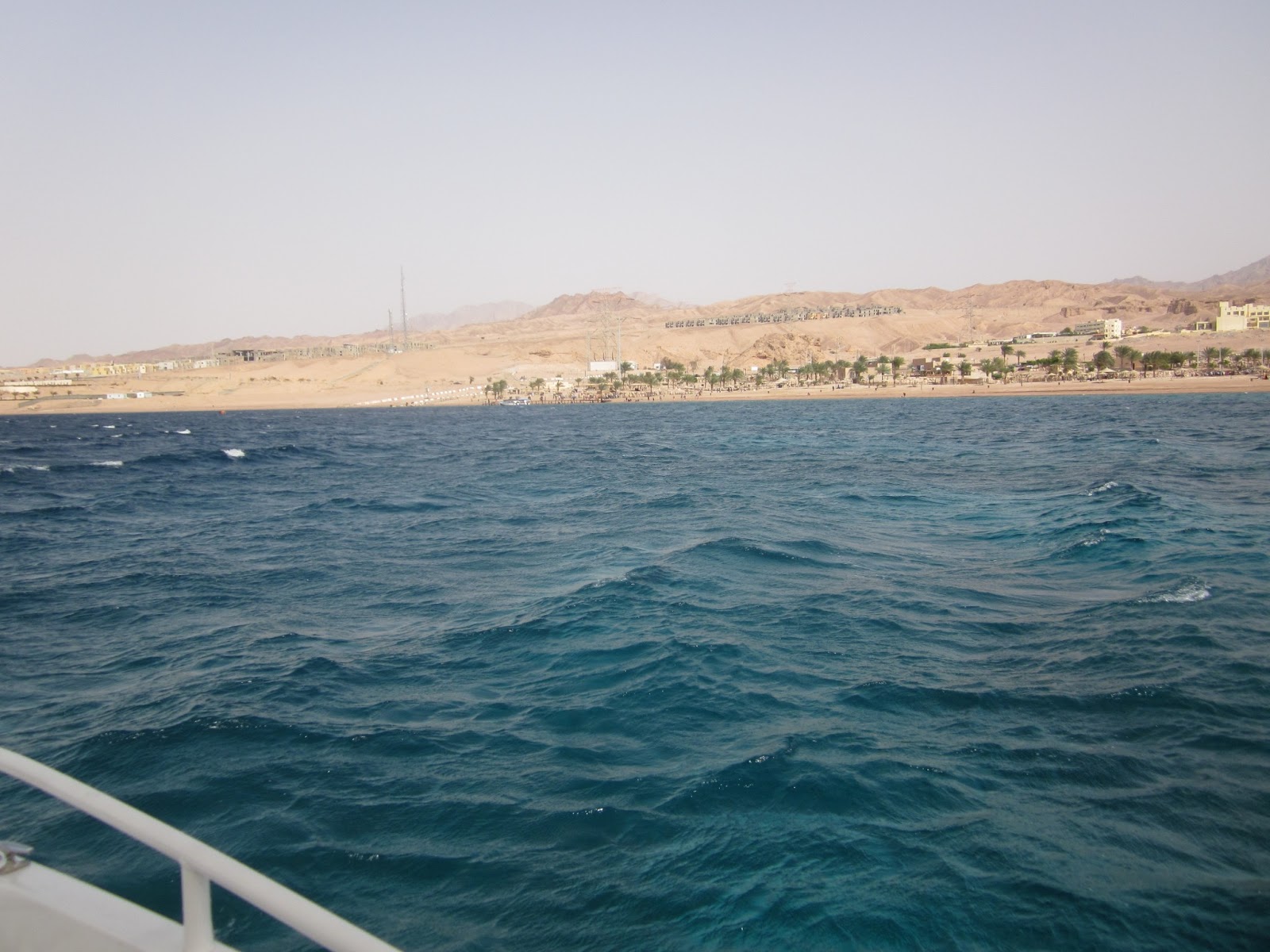
Aqaba, with Sinai on horizon (Alex Rowell)

The bus ride from the Jordanian capital to the southern port city of Aqaba is long enough to get a dedicated cigarette break half-way through. Having nearly asphyxiated to death the night before on a plethora of substances inhaled (largely though not entirely at second-hand) in Amman’s fine Dionysian establishments, I declined to join my fellow passengers outside on the flat, grey-beige rock plains of Jordan’s western desert. I did, however, have reason beside a hangover to feel a marked jump in the blood pressure: a sudden first glimpse, just a few hundred metres away, of the old Hejaz railway; built by the Ottomans to ship pilgrims from Constantinople to Mecca, and later blown apart by Arab nationalists fighting alongside a certain Thomas Edward Lawrence.

It’s probably healthy for Brits in the Arab world to avoid Lawrencian aspirations, if only for the cruel fate to which he eventually delivered the good men who had given him their trust and respect (to say nothing of their blood). Yet one cannot avoid – or at any rate, I couldn’t avoid – a shiver as we rolled past the Petra and Wadi Rum he had so admired, nearing the destination whose very name seems to have bewitched and tormented him.

The conquest of Aqaba was the first major victory for the Arab Revolt against the Ottomans in World War I, and certainly the greatest personal one for Lawrence. In his memoir, Seven Pillars of Wisdom, he writes early on of the

Importance of Akaba [sic], the only Turkish port left in the Red Sea, the nearest to the Suez Canal, the nearest to the Hejaz Railway, on the left flank of the Beersheba army […]1

The city proceeds to dominate the next hundred or so pages as he agonises over how best to take it and salivates over the glories it will bring (“in so vital a matter as Akaba we could not afford a mistake”; “Akaba spelt plenty in food, money, guns, advisers”; “I still saw the liberation of Syria happening in steps, of which Akaba was the indispensable first”; “We had one objective only, the capture of Akaba”2).

The problem the Arabs faced was that a naval approach would swiftly succumb to formidable Ottoman defences embanked in the spiky mountains just a couple of miles inland (aqaba in Arabic – عقبة – means “obstacle”, thus the self-deprecating Jordanian joke about their country being one whose only port is an obstacle, and whose sea is dead). Lawrence’s audacious solution was to take a 600-mile detour through the desert, attacking the Ottomans by land from the east. It proved successful – “The enemy had never imagined attack from the interior, and of all their great works not one trench or post faced inland”3 – and on July 6, 1917, the Ottomans surrendered with no casualties on either side.

The forbidding mountains behind Aqaba, within which the Ottomans built their defences (Alex Rowell)

Lawrence’s description of entering the city reads like Hunter S Thompson recalling a heavier-than-average weekend:

For months Akaba had been the horizon of our minds, the goal: we had had no thought, we had refused thought of anything beside. Now, in achievement, we were a little despising the entities which had spent their extremest effort on an object whose attainment changed nothing radical either in mind or body.
In the blank light of victory we could scarcely identify ourselves. We spoke with surprise, sat emptily, fingered upon our white skirts; doubtful if we could understand or learn whom we were. Others’ noise was a dreamlike unreality, a singing in ears drowned deep in water. Against the astonishment of this unasked-for continued life we did not know how to turn our gift to account. Especially for me was it hard, because though my sight was sharp, I never saw men’s features: always I peered beyond, imagining for myself a spirit-reality of this or that: and to-day each man owned his desire so utterly that he was fulfilled in it, and became meaningless.4

I wager that few visitors to Aqaba today feel quite so strongly about their arrival, but much remains of the “unassailable base”5 that the Arabs then made of the city, whence they proceeded to support Allied forces in the Sinai, Palestine and eventually Syria. The Mamluk-era fortress, for example, next to which Emir Faisal (later King Faisal of Iraq) made his home, is perhaps nowadays the city’s preeminent tourist attraction. Equally striking, though, is the 130-metre-tall flagpole erected in the adjacent Revolution Square, undoubtedly visible from the nearby Israeli and Egyptian resorts of Eilat and Taba, respectively, on the other side of the Gulf of Aqaba.  Unique (as far as I know) among such structures, it bears not the Jordanian flag but the old flag of the Arab Revolt – the same flag that briefly flew in Damascus and Beirut until the 1920 Battle of Maysalun crushed the grand dream of the Arab nation once and for all.

Aqaba fortress (Alex Rowell)

The Arab Revolt flag, 130m above Revolution Square to the west of the fortress (Alex Rowell)

Indeed, if Aqaba is a relic of Arab nationalism, it is a distinctly bittersweet one, given that the city today is more suggestive of Jordan’s accommodation with the Balfour Declaration. While tourists might marvel at the sight of Jordan, Israel and Egypt all at once (with Saudi Arabia just around the corner), this certainly wasn’t what Faisal’s men had in mind in 1917.

Recall that the Brits made no fewer than three simultaneous, and mutually incompatible, promises of Arab land during the war: the first to Faisal’s father, Sharif Hussein of Mecca, in 1915; the second to themselves and the French in 1916; and the third to the World Zionist Organization in 19176.Of the three, only the last remains implemented today, and nowhere more so than in Aqaba, where Israeli weekenders sunbathe scarcely a kilometre away, secure in the knowledge that neighbouring Arab governments are bomb-scanning their own citizens to protect them. It’s a rather different story on the Gazan and Lebanese borders.

Not that the Israelis can rest entirely easy. At least five rocket attacks on Eilat have been reported in the last three years, all of them seemingly fired by jihadists in the Sinai, possibly though not necessarily in coordination with Hamas. Extremely inaccurate, they have so far failed to actually hit any Israelis – indeed the only death in the recent series occurred in 2010 when one missed Israel altogether, landing by the Intercontinental Hotel in Aqaba, killing a Jordanian cab driver.

Israeli resort of Eilat as seen from Aqaba (Alex Rowell)

Eilat was hit by a “successful” suicide bombing in 2007, though, when a 21-year-old from Gaza killed himself along with 3 Israelis in a bakery. And in the heady days of Abu Musab al-Zarqawi – the Jordanian warlord and founder of al-Qaeda in Iraq (AQI) – a barrage of rockets launched from Aqaba itself killed a Jordanian soldier after missing the two US navy ships they’d been aimed at. That was eight years ago, and Zarqawi has since been killed by the Americans, but the emergence now of the AQI spinoff Jabhat al-Nusra next door in Syria is starting to put the wind up a few Jordanians who believe they’ve seen this film before.

Not an entirely sleepy neighbourhood, in other words, but as I say this is not because of any ill-will between Amman and Tel Aviv. Quite to the contrary, the Knesset’s chief antagonists – Islamists and Palestinians – are, to lesser extents, the Hashemite monarch’s too. It’s perhaps more accurate, then, to say Aqaba (and Jordan as a whole) represents not so much the defeat of the Arab Revolt as the severe downsizing and tribalisation of it: King Abdullah II, after all, being the great-great-grandson of Sharif Hussein (as well as the great-grandnephew of Emir Faisal). Ironic as the giant flag in Revolution Square might seem in that light, it also serves a nobler, if unintended purpose: reminding the visitor that the Arabs’ title to the surrounding land came first, and was only dishonourably revoked by callous British imperial duplicity.

Postscript: My girlfriend protests that I kill the joy of our weekend holidays by turning them exclusively into historical-political essays. I ought to add, then, that the sea at Aqaba could not be less “dead”, with its dozen or so easily accessible coral reefs, complete with dolphins, turtles, sharks, eels, and kaleidoscopic galaxies of fish. A scuba dive or at least a snorkel is a must while you’re there. A stroll along the waterfront by the old port – where glass bottom (or indeed “glass baton”) boat rides can be acquired – is also good fun.

For 25JD ($35), a boat like this will take you snorkelling for an hour around innumerable coral reefs (Alex Rowell)

1 Lawrence, T.E., Seven Pillars of Wisdom: A Triumph (1922), 2008 Vintage Classics paperback edition, pp. 172-3
2 Ibid., respectively: p. 180; p. 281; p. 282; p. 297
3 Ibid., p. 317
4 Ibid., p. 322
5 Ibid., p. 321
6 For an excellent history of this, see Eugene Rogan, The Arabs: A History (2012), Penguin revised second paperback edition, chapter 6