Showing posts with label Jordan. Show all posts

Thursday, July 17, 2014

The language barrier: How Islamists outshine Arab secularists

[Originally posted at NOW]

A little over a year ago, I visited a Jordanian friend in Amman. Determined atheists that we both are, as the Black Label bottle steadily drained our conversation turned, as it often would, to the evergreen subject of the woefully elevated positions of the region’s Parties of God in all their forms and guises.

“Man, let me show you something,” he suddenly said, reaching for the TV remote. “This is why the secularists can’t beat the Islamists today.” Flicking to one of at least a dozen available Islamic channels, we listened as a shrouded televangelist expounded on the boundless splendors of the pious path. “Just listen to the guy’s fusha [classical Arabic],” my friend said in sincere admiration. “It’s effortless.” And so it was – without the slightest stutter or pause, our imam filled the room with the music of 7th-century Arabian vocabulary, every single letter adorned with precisely the correct diacritical flourish. Picture someone mellifluously chatting in the tongue of Shakespeare and you’ll get something of the oratorical effect.

“Now compare that with these guys,” said my friend, switching to a political talk show featuring two beardless Jordanians in suits. Clearly ill-at-ease in the fusha they were compelled (by widely-observed custom) to speak on air – which is likely the only time they speak it – the contrast in style was disastrous. In awkward monotone, they would punctuate every other word with an “uhhh” as they frantically scanned their limited mental lexicons for the formally proper noun or adjective. “It doesn’t matter that what they’re saying is a thousand times more enlightening than the Islamist propaganda,” my friend said. “Who could listen to this for more than thirty seconds?”

That thought came rushing back to me on Saturday when I watched another Islamist, the fugitive cleric-cum-militiaman Ahmad al-Assir, mount an 11-minute-long diatribe against the “liberals” (what contempt he put into the word) of Lebanon’s moderate Sunni Future Movement. Secure in his amply-demonstrated fusha proficiency, Assir actually reverted to colloquial dialect to land his most personal jab, directed at Future leader Saad Hariri, “who doesn’t know how to string two words together in Arabic.” It’s a reference to the former prime minister’s famously shaky fusha, most memorably demonstrated in a calamitous 2009 parliament address. But Assir wasn’t trying to score literary points: he meant to undermine Hariri’s religious, and ultimately political, legitimacy as the representative of Lebanon’s Sunnis. It was an assertion of the supposed authenticity, the unshakeable Arabness, of Islamism compared to effete and decadent liberalism.

Older generations of Arab nationalist intellectuals championed the revival and protection of Arabic out of fear that “the nation” and its culture were losing ground to an ascendant West. Today, the new and graver danger is of young Arab minds being seduced by hyper-articulate jihadists, to whose rhetorical charms even this British kafir is not entirely invulnerable.

Among other things, this makes all the more necessary the secular Arabic literary heritage, from the classic pre-Islamic mu`allaqat through such brilliant medieval reprobates as Abu Nuwas to modern giants like Mahmoud Darwish. Indeed, there’s reason to believe a thread running through the entire oeuvre of the permanently clean-shaven Darwish, who never hid his dislike of Hamas and lamented those who “don’t know the difference between the mosque (al-jam`) and the university (al-jam`a),” was an unspoken determination to claim Arabic (and specifically classical Arabic, the clerics’ home ground) for an avowedly secular renaissance, or nahda. (The contribution of those who manage to turn these works into music and other art forms – Marcel Khalifé being perhaps the most obvious example – is also invaluable, not least because of the profanity of music in and of itself in the Wahhabist worldview. One recalls Khalifé’s farcical 1999 blasphemy trial.) Unless and until that is achieved, the Islamists will continue to exploit the appearance of an intellectual – and even cultural – superiority that is of course entirely and dangerously illusory.

Thursday, October 24, 2013

10 Questions for Brown Moses

[Originally posted at NOW]

NOW talks to the pioneering blogger of Syria’s armed conflict.

Eliot Higgins, better known as Brown Moses, is a British blogger who attained international recognition in early 2013 when his analysis of publicly-available YouTube videos led to the unearthing of a classified Saudi operation to arm Syrian rebels through Jordan with weapons purchased from Croatia. His blogging subsequently assisted Human Rights Watch in compiling evidence of cluster bomb use by the Syrian regime, and is now often cited in leading international newspapers. In April, Higgins helped NOW identify the brigade that launched the first lethal Syrian rebel rocket attack on Lebanese soil. After raising funds from private donors including the Avaaz activism platform, Higgins launched Arabic versions of his blog and Twitter account in June.

NOW: How would you summarize the Syrian conflict at present?

Eliot Higgins: Pretty much a meat-grinder for both sides, with no end in sight.

NOW: What in particular are you researching at the moment?

Higgins: Aside from working on a new website, I'm currently on the lookout for evidence of a new, larger fuel-air explosive bomb that might have been used in the conflict recently.

NOW: Earlier this month, there were reports of preparations for an imminent battle between rebels and the regime and/or Hezbollah along the Lebanese-Syrian border near Arsal. Have you seen any video evidence to this effect?

Higgins: Not so much video evidence, but there's plenty of reports of both sides preparing for fighting commencing at any moment.

NOW: Have you learnt any Arabic since you began covering Syria? You must have picked up some words here and there.

Higgins: Mostly I've learnt to recognize place names, and the names of various groups in Syria. As with anyone following Syria, the first word you learn is takbeer, followed by Allahu and akbar.

NOW: Some journalists, e.g. Patrick Cockburn, have criticized the practice of treating YouTube videos as evidence in reporting on Syria. How easy would it be to produce a fake atrocity video that would fool you?

Higgins: I think it's important to stop thinking about videos from Syria as individual and separate pieces of evidence, but in many cases a video is just part of a body of evidence, and a lot of my work is about exploring the evidence that might surround a video.

NOW: What aspects of the Syrian conflict do you feel are most overlooked or poorly covered in the mainstream media?

Higgins: I think there's a huge amount of things really. It's a very complex conflict, and only a small amount of it gets any sort of in-depth reporting. This is in part because of the difficulties faced by reporters on the ground in Syria.

NOW: What are the most shocking, moving, and/or amazing videos you’ve seen from Syria?

Higgins: Apart from the many horrific injuries and deaths, I'd say videos where people are handling UXO [unexploded ordnance], for example, one where a small group of children start kicking an unexploded 240mm mortar, or the various videos showing them handling unexploded cluster bombs. Some of the DIY weapons I've seen have been quite impressive, such as the Hell Cannon, or the Molotov cocktail launcher (that didn't seem to catch on).

NOW: What is the most frustrating part of your work?

Higgins: Videos and channels constantly being deleted from YouTube. Fortunately there are some organizations systematically archiving all the videos for future reference.

NOW: If the Syrian conflict ended tomorrow, what would you do instead?

Higgins: Well I started the blog writing about the UK phone hacking scandal, and it looks like that's going to be big news again, so that would keep me busy.

NOW: Have you ever been/would you ever come to Lebanon?

Higgins: I've never been, and I certainly have nothing against going to Lebanon.

Thursday, July 4, 2013

What's really wrong with Aaron David Miller?

[Originally posted at NOW]

Last week, readers of Foreign Policy were treated to another installment of the “distinguished scholar[ship]” of Aaron David Miller (he of the recent ‘Tribes With Flags’ notoriety), this time entitled, ‘What’s Really Wrong with the Middle East?’ 

So breezily are the facts distorted, so woefully are the points missed, and so cheerfully are the region’s more than three hundred million people insulted that it prompts the arresting question: What’s really wrong with Aaron David Miller?

The piece comprises Miller’s diagnosis of the “top five” reasons for the “jumble of violence, sectarianism, and incompetence” that have been the real fruits of an Arab Spring that was supposed to be the “big transformative moment.” These are, in order: the mistreatment of women, the lack of secularism, excessive conspiracy theorizing, “narcissism” (yes), and lack of leadership.

In addition to the many generic, or what might be called orthodox, ways in which the overall argument is wrong-headed, there are some particularly egregious bits of mendacity and nastiness that are worth highlighting.

First is his callous jab at the Lebanese, all of whom (in their narcissism) “think what happens in Beirut is on the minds of U.S. policymakers from morning till night.” Perhaps I’m ill-trained in the hard-nosed, cut-the-crap school of “realism” in which Miller affects to excel, but I feel those Lebanese who have taken serious risks (and paid serious prices) to stand against the menaces of Syrian Baathist totalitarianism and its murderous proxies deserve something better than the scorn of those they were led to believe were their friends.

Second, and speaking of the Damascene dictatorship, it’s simply contemptible of Miller to pretend that “America’s loss and lack of credibility” is what prevents it from providing meaningful assistance to the Syrian opposition (who also, evidently, have an inflated impression of how much attention is paid to their sacrifices in Washington). Instead, it’s perfectly obvious that it is the Americans’ failure to lift a finger in defense of the revolution that is eroding what was left of their credibility – as the cartoonists of Kafranbel have been trying to tell everyone for two years now.

Things only get worse when he turns to the Holy Land dispute, complaining of being “really tired of Israeli peaceniks […] and of Arabs” asking America to work toward peace (his patience for Israeli hawks, apparently, has not yet waned). His message for these irritating supplicants is as crass as it is dishonest:

“Here's a news flash: the cavalry isn't coming. Maybe if this sinks in, the locals will do more for themselves. But I doubt it.”

A pretty straightforward reason why this won’t “sink in” is because, for one party, the cavalry in fact arrived a very long time ago, and is showing no signs of disappearing soon (indeed, its ranks grow with each passing year). An administration that has used its veto power to protect Israel at the UN Security Council, upped the annual military aid package to an unprecedented $4bn a year for ten years, while throwing hundreds of millions of additional dollars at programs like the Iron Dome and David’s Sling missile defense systems can hardly be said to have washed its hands of the Middle East quite yet.

Nor has the “cavalry” exactly neglected other areas of the region. Miller is, of course, perfectly right that many of the Arab world’s greatest villains are fellow Arabs, but when the young men and women of Bahrain took to the streets in 2011 to peacefully challenge their despot, it was with American-made bullets and tear gas canisters that their efforts were quite literally shot down. Since then, while Martin Luther King-quoting human rights activists have been rounded up and tortured before being sentenced to life imprisonment, Obama has responded by selling the Khalifa regime $53 million in arms.

Which is why it isn’t at all “ironic,” as Miller claims, that the “authoritarian monarchs” of Jordan and the Gulf have proved to be “the most durable.” Their durability, while partly sustained by popular will, is also quite openly guaranteed by American policy, with Bahrain being merely the most brazen example. It isn’t just the massive weapons sales to Islamist autocrats across the Gulf, including an eye-watering $60bn consignment of fighter jets, attack helicopters and missiles to Saudi Arabia. Whether it’s bloggers in the UAE and Jordan, poets in Qatar, or clerics belonging to the wrong sect in Saudi, Gulf regimes crush every conceivable form of dissent without ever incurring tangible reproach from Washington.

Indeed, if I were to propose a real irony, it would be that the poorest performers of all Arab nations on Miller’s criteria of women’s rights, secularism, and religious fundamentalism are precisely the US’ most cherished allies and business partners.

Friday, May 10, 2013

A chance for Zaatari's children

[Originally posted at NOW]

This is the second in a two-part series based on NOW’s visit to Jordan’s Zaatari camp for Syrian refugees on May 5, 2013. Read the first article, ‘Zaatari’s mukhabarrat wars,’ here.

Three refugee children from Nawa, near Daraa, in Zaatari camp (NOW/Alex Rowell)

ZAATARI CAMP, Jordan – Just meters behind the Jordanian military checkpoint that forms the entrance to the world’s largest Syrian refugee camp, small, expressionless children wait to pounce on new arrivals, offering to help with luggage and, failing that, simply begging for money.

“Just one dinar,” said Abd al-Rahman, a bony 12 year-old from Homs, tugging at NOW’s forearm. “My father was killed in Syria. I have to work to feed my mother and brothers.”

Walk further down the main road, which doubles as a bustling shopping boulevard, and the children are everywhere – pushing wheelbarrows, carrying cardboard boxes on their shoulders, and selling anything from phone cards to foreign currency to live chickens.

It was a sizzling hot afternoon in the rocky plains of Jordan’s northern desert, and as NOW ventured deeper into the camp, the irradiating sunlight bounced off the tarmac, compounding the blinding effect of the dust kicked up by the blasting winds. “I’m so thirsty. I need water,” said Abd al-Rahman, patting his lips, who did not leave NOW’s side until a dinar ($1.40 USD) was handed over.

According to the UN Refugee Agency (UNHCR), as of last month some 57% of registered Zaatari refugees were under 18. That amounts to over 90,000 children in the camp, many without one or both parents and condemned, for the most part, to lives of manual labor.

As such, some aid organizations are trying to create alternatives for Zaatari’s youth and prepare them for an eventual post-camp future. At present, there are two schools in the camp offering free, basic education for all (the “Bahrain School” and the imaginatively-titled “School No. 2”). But Mohammed Hadid, the Jordanian project coordinator of the Finnish government-funded Finn Church Aid (FCA) NGO, seeks to provide much more.

In his portable cabin office in a fenced-off gravel plot on the west side of the camp, Hadid explains the various types of training his organization has offered refugees since opening in December 2012.

“First of all, there is literacy training. For now this is limited to Arabic, but we hope in the coming weeks to add English too. Second is vocational skills – we asked the young men and women what they wanted to be trained in, and we will start accordingly. The men mostly chose electrician training, and the women chose sewing. Third, we provide physical exercises – circus acrobatics, gymnastics and juggling for now, with football and others in the next few months,” he told NOW.

The courses are open for all refugees between the ages of 15 and 24, and run five days a week. So far, Hadid says he’s attracted around 150 regular attendees, and though the number is growing, he faces a number of social and cultural challenges in boosting enrollment.

“It’s a very sensitive age bracket,” he told NOW. “For men, they feel a pressure to work and earn money for their families. As for women, this is seen as the time to get married, so many are reluctant to leave the house for fear of unwanted male attention.”

Accordingly, Hadid is often compelled to personally meet families in order to win their trust. “We have no choice but to go tent to tent, explaining what it is we do and trying to convince parents that this is in the best interests of the children.” In keeping with the general cultural conservatism of the refugee population, all courses are gender-segregated.

Those who do show up speak highly of the experience. 18-year-old Muhammad Rublan, from Daraa, currently takes the gymnastics course. “I love it, it’s bringing a real positive energy,” he told NOW. “In Syria, we never heard of this type of sport.”

The exercise also provides a welcome relief from the hardship of camp life. “In Zaatari we have no jobs, we have no activities to do during the day. This sport is a stress relief that keeps us active.”

As an added benefit for camp residents, FCA hires staff exclusively from the refugee population. Instructors are paid 10JD ($14) per five-hour working day, while two security guards and a cleaner get an hourly rate of 1.5JD ($2.10 USD) – no fortune, but certainly enough to make a difference when compared to the 2-4JD ($2-6 USD) that, depending on size, goes to whole families per day in cash assistance from UNHCR.

One such employee is Anwar Abu Jaysh, a Daraa refugee in his mid-twenties, who has worked for FCA as an Arabic-English translator for a month.

“I liked the idea very much when I heard about it,” said Abu Jaysh in English – a language he learned during childhood years spent in the United Arab Emirates. “It means I’m able to help other refugees while also earning money for myself.”

Abu Jaysh has even mulled the idea of starting his own organization one day. “Some of the very young children are often behaving badly. When there’s a demonstration, for example, you’ll see kids as young as four or five throwing rocks at people. I would like to make a project for these children too.”

Yet, for the dozen young boys gathering by the entrance to the FCA grounds as we speak, such mischief seems far from the mind. “They’re about to start one of the physical circuits,” explains Hadid. With a gesture to a security guard, the gate opens and they sprint noisily toward a large activity tent, where an instructor greets them atop a unicycle. However grueling the rest of their day may be, for this moment, at least, they look happy.

Yara Chehayed contributed reporting from Beirut.

Wednesday, May 8, 2013

Zaatari's mukhabarrat wars

[Originally posted at NOW]

Graffiti in the camp of the 'Free Syria' flag, with text reading, "Syria, don't worry, we're returning" (NOW/Alex Rowell)

This article is the first in a two-part series based on NOW’s visit to Jordan’s Zaatari camp for Syrian refugees on Sunday, May 5, 2013.

ZAATARI CAMP, Jordan – When the refugees climbed on top of the portable cabin office of the Jordan Health Aid Society and began stamping their feet, the frail walls shaking with each loud bang, the aid workers cooped inside did little but grin in sheepish embarrassment. “Everything’s fine,” one said to NOW with apparent confidence. “It’s always like this.”

Outside, however, the refugees themselves were decidedly less placid, drenched with sweat from the punishing heat and shouting incoherently at the window of the neighboring office, that of the UN Population Fund (UNFPA). “You’re a journalist? Take photos!” shouted one at NOW. Moments later, a man clinging onto the metal bars of the window saw NOW and yelled, “No photos, no photos!” Hands then pulled NOW back to the fringes of the hundred-strong-crowd, which continued to swarm the cabin for over two hours.

The riot was but one of the increasing number now taking place in the Syrian refugee camp every week, fuelled by the combination of chronic underfunding and ballooning overpopulation (built for 60,000 inhabitants, Zaatari now houses over 160,000, with hundreds of new arrivals every night). While Sunday’s demonstration was essentially peaceful, some in the past have turned violent – on April 19, ten Jordanian policemen were reportedly injured in clashes with 100 refugees, eight of whom were arrested and charged with “unlawful assembly.” Leaked video footage appears to show Jordanian security forces attacking refugee homes with projectiles and batons.

Pretexts for such demonstrations vary by the day, from the perceived underperformance of aid organizations to sheer street gossip – one in February, for example, was sparked by rumors of Jordanian police sexually harassing refugee women.

“It can be about anything,” said an aid worker who requested anonymity due to the sensitivity of the topic. “I could point to a random person in the street and shout, ‘Shabbih [Syrian regime agent]!’ and it could cause a riot.” For some, it seems, the protests are just something to do; a bit of excitement in an otherwise hard daily grind.

Yet refugees also told NOW of another source of the unrest – the infiltration of Syrian regime mukhabarrat [secret police], sent into the camp to keep tabs on Free Syrian Army (FSA) opponents, disrupt Jordanian efforts to maintain security, and foment disorder in general.

“The mukhabarrat have bases here in the camp,” said Ahmad, a refugee from Daraa in his mid-twenties. “Mostly they just collect information, but sometimes they attack people. There was an FSA general living in the camp, for example, who they assassinated.” They are also believed to have started some, though not all, of the tent fires that have claimed a handful of lives.

Not that refugees’ woes end there. “We actually have three kinds of mukhabarrat here,” said Ahmad. “There is the regime one, which we call shabbiha; there is the Jordanian one; and now we even have an FSA one too. We definitely didn’t need that,” he laughs bitterly.

Camp residents are visibly and apparently uniformly anti-regime – the “Free Syria” flag flies on every street, covers the walls of shops and is spray-painted on blank surfaces. Yet Ahmad told NOW the behavior of some “FSA mukhabarrat” has bred resentment.

“We are all with the revolution. But some [of the FSA] are stealing from other refugees, and turning corrupt. It’s as if they forgot about the revolution and are just interested in themselves. They became like the regime,” he told NOW.

Facilitating these practices is an improvised system of government within the camp that sees each street controlled by an unofficial leader, or za’eem. According to the aid worker quoted earlier, these leaders are notoriously corrupt – charging commission from residents of ‘their’ street who find employment, and buying influence with confiscated aid vouchers. Perhaps inevitably, there is a degree of overlap between these leaders and the competing mukhabarrat outfits.

Nor is the Jordanian gendarmerie particularly popular, as stories abound of its heavy-handed rule. “The other day, they accused a boy of stealing a caravan, and they beat him up,” said Ahmad. “Imagine – one boy stealing an entire caravan! Where would he hide it? Would he put it in his pocket?”

At the police station near the camp’s main entrance, the gendarmerie loiter by a couple of APCs, carrying meter-long batons. Though they were friendly with most refugees walking past, NOW witnessed one being manhandled into an office, the gendarme swearing at him and telling him to “shut up” when he spoke. He had been accused, NOW learned, of assaulting a Jordanian national.

In spite of these frictions, Ahmad said there was a degree of cooperation between the gendarmerie and the FSA. For example, when the FSA general was assassinated by the regime mukhabarrat, he says, the Jordanians caught the perpetrators and handed them over to the FSA. What, NOW asked, did the FSA do with them?

“Oh, they killed them.”

Interviewees’ names have been changed at their request, in the interests of their safety.

Sunday, March 17, 2013

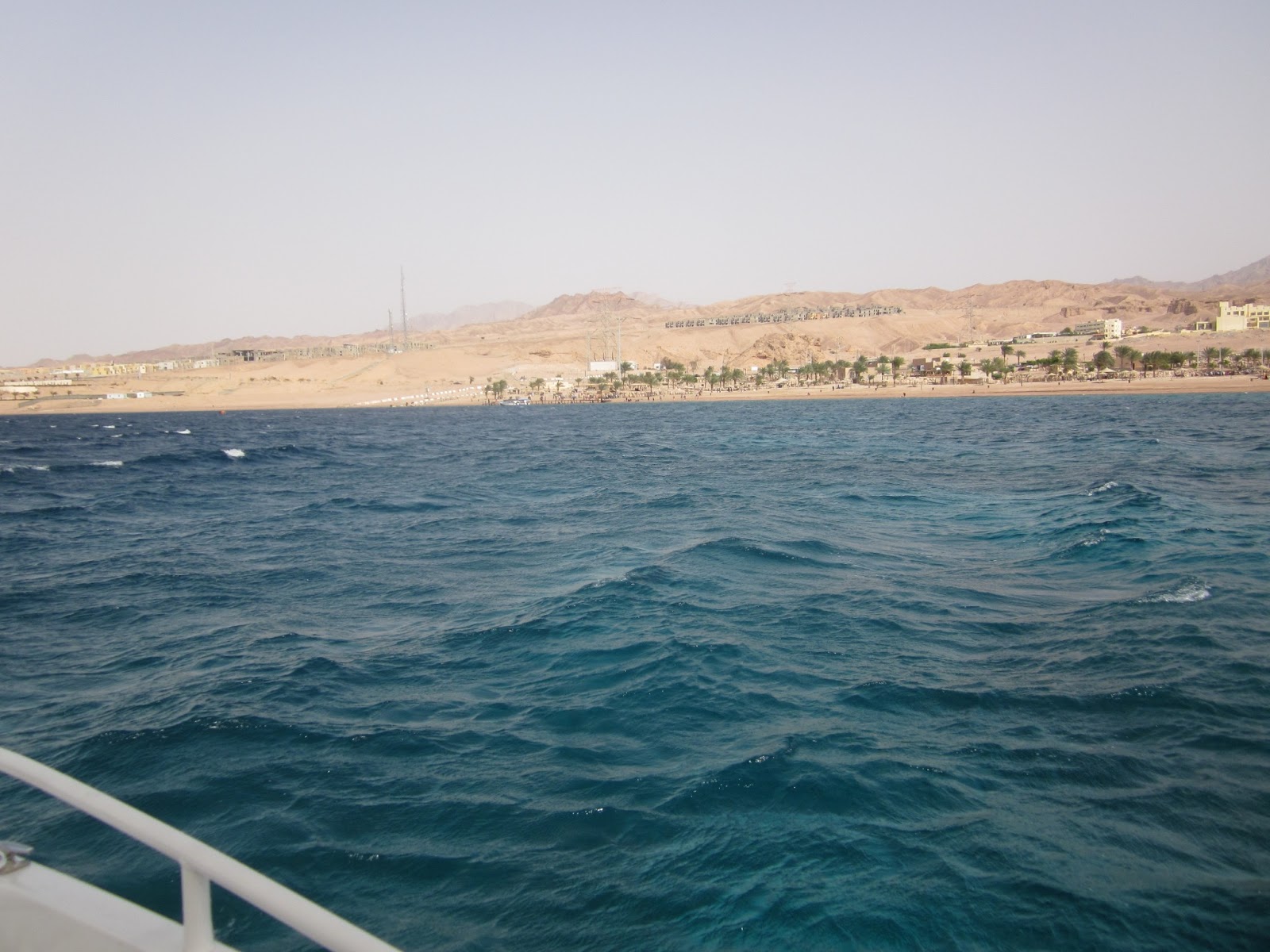
Aqaba, where the Arab nation was once thinkable

Aqaba, with Sinai on horizon (Alex Rowell)

The bus ride from the Jordanian capital to the southern port city of Aqaba is long enough to get a dedicated cigarette break half-way through. Having nearly asphyxiated to death the night before on a plethora of substances inhaled (largely though not entirely at second-hand) in Amman’s fine Dionysian establishments, I declined to join my fellow passengers outside on the flat, grey-beige rock plains of Jordan’s western desert. I did, however, have reason beside a hangover to feel a marked jump in the blood pressure: a sudden first glimpse, just a few hundred metres away, of the old Hejaz railway; built by the Ottomans to ship pilgrims from Constantinople to Mecca, and later blown apart by Arab nationalists fighting alongside a certain Thomas Edward Lawrence.

It’s probably healthy for Brits in the Arab world to avoid Lawrencian aspirations, if only for the cruel fate to which he eventually delivered the good men who had given him their trust and respect (to say nothing of their blood). Yet one cannot avoid – or at any rate, I couldn’t avoid – a shiver as we rolled past the Petra and Wadi Rum he had so admired, nearing the destination whose very name seems to have bewitched and tormented him.

The conquest of Aqaba was the first major victory for the Arab Revolt against the Ottomans in World War I, and certainly the greatest personal one for Lawrence. In his memoir, Seven Pillars of Wisdom, he writes early on of the

Importance of Akaba [sic], the only Turkish port left in the Red Sea, the nearest to the Suez Canal, the nearest to the Hejaz Railway, on the left flank of the Beersheba army […]1

The city proceeds to dominate the next hundred or so pages as he agonises over how best to take it and salivates over the glories it will bring (“in so vital a matter as Akaba we could not afford a mistake”; “Akaba spelt plenty in food, money, guns, advisers”; “I still saw the liberation of Syria happening in steps, of which Akaba was the indispensable first”; “We had one objective only, the capture of Akaba”2).

The problem the Arabs faced was that a naval approach would swiftly succumb to formidable Ottoman defences embanked in the spiky mountains just a couple of miles inland (aqaba in Arabic – عقبة – means “obstacle”, thus the self-deprecating Jordanian joke about their country being one whose only port is an obstacle, and whose sea is dead). Lawrence’s audacious solution was to take a 600-mile detour through the desert, attacking the Ottomans by land from the east. It proved successful – “The enemy had never imagined attack from the interior, and of all their great works not one trench or post faced inland”3 – and on July 6, 1917, the Ottomans surrendered with no casualties on either side.

The forbidding mountains behind Aqaba, within which the Ottomans built their defences (Alex Rowell)

Lawrence’s description of entering the city reads like Hunter S Thompson recalling a heavier-than-average weekend:

For months Akaba had been the horizon of our minds, the goal: we had had no thought, we had refused thought of anything beside. Now, in achievement, we were a little despising the entities which had spent their extremest effort on an object whose attainment changed nothing radical either in mind or body.
In the blank light of victory we could scarcely identify ourselves. We spoke with surprise, sat emptily, fingered upon our white skirts; doubtful if we could understand or learn whom we were. Others’ noise was a dreamlike unreality, a singing in ears drowned deep in water. Against the astonishment of this unasked-for continued life we did not know how to turn our gift to account. Especially for me was it hard, because though my sight was sharp, I never saw men’s features: always I peered beyond, imagining for myself a spirit-reality of this or that: and to-day each man owned his desire so utterly that he was fulfilled in it, and became meaningless.4

I wager that few visitors to Aqaba today feel quite so strongly about their arrival, but much remains of the “unassailable base”5 that the Arabs then made of the city, whence they proceeded to support Allied forces in the Sinai, Palestine and eventually Syria. The Mamluk-era fortress, for example, next to which Emir Faisal (later King Faisal of Iraq) made his home, is perhaps nowadays the city’s preeminent tourist attraction. Equally striking, though, is the 130-metre-tall flagpole erected in the adjacent Revolution Square, undoubtedly visible from the nearby Israeli and Egyptian resorts of Eilat and Taba, respectively, on the other side of the Gulf of Aqaba.  Unique (as far as I know) among such structures, it bears not the Jordanian flag but the old flag of the Arab Revolt – the same flag that briefly flew in Damascus and Beirut until the 1920 Battle of Maysalun crushed the grand dream of the Arab nation once and for all.

Aqaba fortress (Alex Rowell)

The Arab Revolt flag, 130m above Revolution Square to the west of the fortress (Alex Rowell)

Indeed, if Aqaba is a relic of Arab nationalism, it is a distinctly bittersweet one, given that the city today is more suggestive of Jordan’s accommodation with the Balfour Declaration. While tourists might marvel at the sight of Jordan, Israel and Egypt all at once (with Saudi Arabia just around the corner), this certainly wasn’t what Faisal’s men had in mind in 1917.

Recall that the Brits made no fewer than three simultaneous, and mutually incompatible, promises of Arab land during the war: the first to Faisal’s father, Sharif Hussein of Mecca, in 1915; the second to themselves and the French in 1916; and the third to the World Zionist Organization in 19176.Of the three, only the last remains implemented today, and nowhere more so than in Aqaba, where Israeli weekenders sunbathe scarcely a kilometre away, secure in the knowledge that neighbouring Arab governments are bomb-scanning their own citizens to protect them. It’s a rather different story on the Gazan and Lebanese borders.

Not that the Israelis can rest entirely easy. At least five rocket attacks on Eilat have been reported in the last three years, all of them seemingly fired by jihadists in the Sinai, possibly though not necessarily in coordination with Hamas. Extremely inaccurate, they have so far failed to actually hit any Israelis – indeed the only death in the recent series occurred in 2010 when one missed Israel altogether, landing by the Intercontinental Hotel in Aqaba, killing a Jordanian cab driver.

Israeli resort of Eilat as seen from Aqaba (Alex Rowell)

Eilat was hit by a “successful” suicide bombing in 2007, though, when a 21-year-old from Gaza killed himself along with 3 Israelis in a bakery. And in the heady days of Abu Musab al-Zarqawi – the Jordanian warlord and founder of al-Qaeda in Iraq (AQI) – a barrage of rockets launched from Aqaba itself killed a Jordanian soldier after missing the two US navy ships they’d been aimed at. That was eight years ago, and Zarqawi has since been killed by the Americans, but the emergence now of the AQI spinoff Jabhat al-Nusra next door in Syria is starting to put the wind up a few Jordanians who believe they’ve seen this film before.

Not an entirely sleepy neighbourhood, in other words, but as I say this is not because of any ill-will between Amman and Tel Aviv. Quite to the contrary, the Knesset’s chief antagonists – Islamists and Palestinians – are, to lesser extents, the Hashemite monarch’s too. It’s perhaps more accurate, then, to say Aqaba (and Jordan as a whole) represents not so much the defeat of the Arab Revolt as the severe downsizing and tribalisation of it: King Abdullah II, after all, being the great-great-grandson of Sharif Hussein (as well as the great-grandnephew of Emir Faisal). Ironic as the giant flag in Revolution Square might seem in that light, it also serves a nobler, if unintended purpose: reminding the visitor that the Arabs’ title to the surrounding land came first, and was only dishonourably revoked by callous British imperial duplicity.

Postscript: My girlfriend protests that I kill the joy of our weekend holidays by turning them exclusively into historical-political essays. I ought to add, then, that the sea at Aqaba could not be less “dead”, with its dozen or so easily accessible coral reefs, complete with dolphins, turtles, sharks, eels, and kaleidoscopic galaxies of fish. A scuba dive or at least a snorkel is a must while you’re there. A stroll along the waterfront by the old port – where glass bottom (or indeed “glass baton”) boat rides can be acquired – is also good fun.

For 25JD ($35), a boat like this will take you snorkelling for an hour around innumerable coral reefs (Alex Rowell)

1 Lawrence, T.E., Seven Pillars of Wisdom: A Triumph (1922), 2008 Vintage Classics paperback edition, pp. 172-3
2 Ibid., respectively: p. 180; p. 281; p. 282; p. 297
3 Ibid., p. 317
4 Ibid., p. 322
5 Ibid., p. 321
6 For an excellent history of this, see Eugene Rogan, The Arabs: A History (2012), Penguin revised second paperback edition, chapter 6

Thursday, March 7, 2013

Jordan's multiplying Syria woes

[Originally posted at NOW]

While the international community often singles out Lebanon as the principal victim of so-called “spillover” from the armed conflict in Syria, less discussed but arguably no less dramatic are the transformations the two-year-long war is effecting on its southern neighbor, Jordan.

Like Lebanon, the Hashemite Kingdom has officially pursued a policy of neutrality in the Syrian conflict, calling for a “diplomatic and peaceful solution to the problem.” Yet despite such caution, the war next door threatens to cripple the already-burdened country with a plethora of serious humanitarian, security, and socioeconomic strains.

These are perhaps most evident in the now-notorious Zaatari refugee camp, erected last summer in the desert east of the city of Mafraq, near the Syrian border. Originally intended for 60,000 Syrian refugees, it now houses over 146,000 in fabric tents, with thousands of new arrivals every week.

Living conditions inside are very poor, with poverty rife and scant access to basic food, water, and healthcare needs, according to an aid worker in the camp NOW met in Amman over the weekend. Between 7 and 10 babies are born inside the camp every day – sometimes dying just days later. Infectious diseases such as polio and malaria are on the rise, and reportedly spreading beyond the camp’s borders. So desperate are some families for money, said the aid worker, that they are selling their daughters as brides for as little as JD100 ($140) and even prostituting them for JD10 ($14).

Accordingly, frustration among residents is increasingly leading to organized protests and even violence, sometimes met with responses from Jordanian security forces. Tensions and fears are further stoked by Syrian mukhabarrat, or regime informants, who are widely believed to have infiltrated the camp.

Yet Syria’s shadow over Jordan extends far beyond Zaatari, and not just because there are an additional 270,000 refugees elsewhere in the country (projected to total 1 million by year-end). The refugee issue aside, the conflict presents a significant potential security threat to the Kingdom, according to Jumana Ghneimat, editor-in-chief of Al-Ghad newspaper.

“The situation here is very sensitive and very dangerous,” Ghneimat told NOW. “There are Salafist groups here in Jordan that are going to Syria. About 300 Jordanian Salafists are fighting in Syria now. This is a big problem for Jordan that could repeat the Iraq scenario. If you remember, Jordanian Salafists went there and then returned and made many problems here in 2005,” a reference to the series of hotel bombs in Amman that killed some 60 people, and were later claimed by al-Qaeda in Iraq, led by the Jordanian Abu Musab al-Zarqawi.

“So maybe when they’re finished in Syria they’ll come back here and conduct new operations,” said Ghneimat. A leading Syrian opposition brigade, Jabhat al-Nusra, was designated a terror organization by the United States for its alleged affiliation with AQI.

Additionally, of perhaps more immediate concern is the drain on the economy, which faces an unprecedented crisis. For the first time, Jordanians may face regular electricity blackouts this summer, à laLebanon. “It’s a possible scenario,” said Ghneimat. “If they don’t increase the electricity output, it might happen. It already happened once or twice last year, when we didn’t have so many refugees, so what do you think will happen this year, or the next?” Such cuts could potentially be widely disruptive, Ghneimat added, since Jordanians do not have easy access to generators, as do the Lebanese.

Water is a similar concern. “Jordan is the third poorest country in the world for water. We already face a serious water problem. To provide now for more than 400,000 Syrians is a huge [challenge],” said Ghneimat.

These shortages in turn add strain to the government’s budget, which currently subsidizes such commodities. “The refugees put certain pressures on the infrastructure, consuming water and electricity which are subsidized,” said Dr. Yusuf Mansur, economist and CEO of Envision Consulting Group. They also increase “demand for education, pressure public schools, and public healthcare, when it’s available.”

Mansur argues, however, that there are also economic benefits to the situation. “It’s a mixed bag,” he told NOW. “In terms of tourism, those in countries like Lebanon who used to go to Syria will now opt for the safer retreat of Jordan. In terms of investment, as well, it has diverted some capital to Jordan, because other countries were more affected by Syria than us.”

As for disruption to trade routes through Syria, “this is beneficial for the Aqaba port,” said Mansur. “From Aqaba goods can go through the Suez Canal and then the Mediterranean.” Another possibility is re-routing land exports and imports through Iraq, he added.

However, potential economic upsides notwithstanding, there appears to be little prospect of overall improvement in a situation fuelled by a war whose viciousness shows no sign of abating. When NOW returned to Beirut from Amman on Sunday, it was on one of the first planes to take a new route south and west over Egypt’s Sinai Peninsula, approaching Lebanon from the Mediterranean. The airline announced the change had been made to avoid the previous path over Syria in the interest of “the safety of passengers.” For the time being, it seems, Jordan is destined to remain what the Zaatari camp aid worker called “a gas tank not far from a lit match.”

Tuesday, June 19, 2012

Putin, 'resistance' kingpin, snubs Assad to visit Israel

[Originally posted at NOW Lebanon]

In a story that I wager will not make the Syrian state press, Russian President Vladimir Putin – whose watertight loyalty to his ally Bashar al-Assad has been hailed by ‘resistance’ types as a mark of his unshakeable anti-imperialist grit and courage – is set to travel to Israel next week, where among other things he will be opening a World War II memorial in the city of Netanya. He will also be travelling to the West Bank (to meet Palestinian Authority head Mahmoud Abbas, arch-foe of ‘resistance axis’ heavyweight Hamas), and to Jordan (one of only two Arab countries to have made peace with Israel).

Sadly for his protégé Bashar, Putin doesn’t seem to have made time for a stopover in Damascus.

What I look forward to is seeing how this gets contorted to fit the ‘resistance’ party line. As it stands, you will recall, the noble Syrian Baathists are being attacked by ‘terrorists’ who take their orders from Tel Aviv (perhaps occasionally via Riyadh and/or Washington: a distinction without a difference). As against these beasts, Assad stands alone but for benevolent Putin, who happens to have increasingly warm relations with… Tel Aviv.

So wait, who are we resisting again?


Tuesday, June 12, 2012

In Amman, a microcosm of Syrian fascism

[Originally posted at NOW Lebanon]

Arriving in Amman last Thursday, my Jordanian friend took a detour on the way from the airport to my hotel. “There’s something you need to see,” he grinned.

Moments later we came upon a truly bizarre scene. On one side of the highway were approximately a hundred demonstrators, waving Free Syria flags and chanting anti-regime slogans down a megaphone. On the other was the Syrian embassy, recognizable by the large Baathist Syrian flag planted on the roof.


A common enough situation these days, you may say. But what distinguished this from other Syria protests I’ve seen were the concert-standard loudspeakers that embassy staff had placed on a balcony from which to blast militaristic pro-regime music in a juvenile attempt to drown out the protests.


While hardly a crime against humanity, I couldn’t help feeling this gesture contained a distillation or a microcosm of the sheer fascism that is the essence of the Assad regime. Just like the slap that the Greek Golden Dawn thug gave to a woman on live television last week, it’s the attitude that dissent is not merely to be ignored but actively, forcibly repressed that signals the utter contempt for democracy in such minds.

P.S., off topic: Take a look at these pictures from downtown Amman, opposite the famous Al-Quds restaurant. These bullet holes are some of the very few remnants of the 1970 Black September events. Hardly impressive when compared to, say, the Sodeco building, but Black September is still a highly taboo subject in Jordan. “I remember in school someone asked the teacher what happened in 1970,” recalled my Jordanian friend. “He slapped him across the head.”

Saturday, May 28, 2011

The Land of Promises Broken: What I Saw in Palestine

Having been up till the small hours the previous evening immoderately imbibing with an old friend in Amman, I found myself at the Abdali bus station at 06:30 am wondering for more than one reason what on earth I thought I was doing. I purchased my ticket for the ‘JETT’ bus that would take me to the King Hussein Bridge – one of Jordan’s three border crossings to Israeli-occupied Palestine – and took my seat in the waiting area, gulping furiously on a bottle of water. Everybody else in the station was Jordanian, and like most Jordanians, they appeared to be of relatively modest means. As a nearly lifelong resident of the UAE, it struck me how strange it was to see poor Arabs; that’s to say, dirt poor Arabs. In Jordan, the waiters are Arabs, the street sweepers are Arabs, and the peasants who harvest the olive trees in the beautiful countryside are Arabs. And as was to be made palpably apparent to me throughout the course of the day, there are plenty of Arabs in the region who are considerably more unfortunate still.

The first leg of my journey, from Amman to the King Hussein Bridge, passed by pleasantly enough, as we meandered through the mountainside overlooking the arresting landscape below – enormous dark-green valleys punctuated by islands of pearl-white rock. The air in Jordan has none of the haze one finds in the Gulf, and as my eyes followed the miles of cloud folding behind the pastel blue horizon, I felt closer to my mother’s native Scotland than to my apartment in Dubai three hours away. 

Arriving at the King Hussein Bridge, I alighted to have my passport and visa checked. After the first of what were to be many of the day’s waits, I was back on the bus, crossing the narrow stretch of no-man’s-land that separates Jordan from the West Bank. Thirty-odd seconds later, I felt the skin on the back of my neck churn as I laid eyes on that one sight for which no person who has lived for years in the Gulf can ever be prepared: the Israeli flag, speared defiantly into the desert, its Star of David flapping muscularly in the hot wind. Indeed, as the bus approached the drop-off point at the Israeli side of the bridge (known as the Allenby) and the IDF soldiers came into view, it struck me that I was setting eyes on Israeli citizens for the first time.

Israeli flags at the western side of the King Hussein bridge
Stepping off the bus, the apparatus of occupation unfolded before me. Those passengers with luggage joined a long queue of Palestinian families heaving and dragging their bundles of cargo to the security scanners. Invariably, these included several large cartons of water, and many families also carried shopping bags filled with inexpensive-looking snacks and juices. I was later to learn that due to perennial shortages of water in the West Bank, families frequently made the trip to Jordan – a country with substantial enough water problems of its own – to stock up. Carrying nothing but a backpack, I made for the nearby portakabin which acted as the first layer of passport control. Trying to ignore the soldier standing just metres to my left – a stone-faced young man of about 21; his eyes shielded behind reflective silver Ray-Bans; his fingers wrapped fondly around his machine gun – I focused instead on the customs officials behind the windows, whom I noticed were all women. Or, rather, I should say they were girls – not one of them looked a day older than me (23). Without exception they were strikingly pretty and as my eye caught one of theirs and I thought I detected the hint of a coy smile I began to wonder in my ignorance what on earth a girl like her was doing in a place like this, etc.

That ended very quickly once I reached the window. Handing over my passport with as much insouciance as I could manage, the girl’s facial expression turned first from Haughty Shop Assistant to Puzzled Mathematician. “What is this?” she asked brusquely, pointing to the entry on my passport under ‘Place of birth’. “Jeddah”, I replied. “Where is Jeddah?” Could she be serious? “Saudi Arabia”, I replied, trying my best to sound as though the question were entirely reasonable. Her look of shock couldn’t have been more pronounced if I had said Pluto. “Thank you, have a seat”, she said hurriedly, her radio already rising to her mouth. I did so on a nearby bench and watched as she left the portakabin with my passport through a door into the main building. Surveying my surroundings, I noticed the soldier had turned to face me, evidently intrigued by my detention. Between the two of us was an elderly Palestinian woman, hunched over a large plastic water container, driving it slowly across the tarmac in silent determination. I searched the soldier’s face for emotion: if he felt any, he hid it expertly. 

Five minutes later the girl reappeared and I was permitted to pass through to the main building, where I had my first of four rounds of questioning while my bag was emptied and scanned for explosives. What were my parents’ names? Why were they in Saudi Arabia? Where were they now? What did I do in Dubai? Did I speak Arabic? Was I married? Where was I going in Israel? (I quickly decided it would not have been worth my while to reply that in no sense was the West Bank actually in Israel.) Why was I going to Jerusalem? Where exactly within Jerusalem would I be going? Would I be meeting any Arabs? Was I going to visit any Arab towns? Where was I staying in Jordan? Who did I know in Jordan? Why was he not joining me in Jerusalem? Did he have a problem with Israel? (Again, I deemed it unwise to go down the factual route here.) In one question that seemed to me highly telling of the Israeli national fixation with ‘homelands’, I was asked “Why do you live in Dubai, when your [British] passport lets you work in the UK?” Clearly, the concepts of internationalism and globalisation are lost on some. 

Surviving the first round, I was again made to wait while my passport was taken elsewhere (presumably being screened by every search the Shin Bet computers could handle). This process was repeated with two more officials (both of whom, again, were women), with further highlights including ‘Are you carrying a weapon, or anything that looks like a weapon?’ Once again opting for the path of least resistance, I managed not to reply that I was just pleased to see her. After about an hour, I was allowed to proceed to the final hurdle, where my entrance visa would be approved and my passport stamped. I asked the woman to kindly not stamp my passport and instead stamp the famous ‘Form 17L’ that is routinely issued to tourists and businessmen travelling to countries that do not recognise Israel as a state. “Why?” she snapped. I told her that I worked in Dubai. As before, the radio came up, I sat down, my passport disappeared. A fourth and final interview was conducted with yet another woman and after a further fifteen minutes I was finally released – about twenty metres as the crow flies from where I had started an hour and a half previously. 

After changing my Jordanian Dinars into Israeli Shekels, I boarded a ‘service’, or shared taxi, to Jerusalem (or as I would call it to any Arab, Al Quds). My fellow passengers in this cramped minibus were exclusively Palestinian women, not one of them younger than 50, and not one of them without food and water packed into the boot for the families to which they were returning. As I removed my bag from the adjacent seat to accommodate the final passenger on board, she smiled at me graciously and thanked me in lucid, equanimous English. I asked her how she spoke the language so well and she replied that she was a teacher. At that point her phone rang and she raised her hand in apology, taking the call and leaving me to peer out the window at the protean Palestinian desert, which was at this point an arid amalgamation of sand and light brown rock – what Philip Roth called “the cratered moonscape of the Pentateuch”. So this is it, I thought. The Promised Land. As someone without any religious affiliation, the Holy Land has no metaphysical significance to me, but as a keen student of history and politics, I nevertheless felt what I have no problem describing as a spiritual frisson as I contemplated the millennia of pitiless tyranny and tragedy of which this tiny corner of the Levant has been the object. Ruminating on this macro reflection, I was brought back down to the micro by a tap on the shoulder. When I turned, another woman to the right of the teacher was holding out, as though to hand me, a small plastic cup of orange juice she had poured from one of the bottles in her shopping bag. Instinctively; Englishly; I spluttered, “No no, thank you very much”, shaking my head and smiling politely. Without blinking, the woman offered it to the woman next to me, and then to each of the remaining passengers in turn. Although I wasn’t the one sitting closest to her, it was to me – the visitor – that she had offered the cup first. 

Turning back to the window, I felt a hot flash of piercing anguish combined with acute fright washing over me, and it took me a second to realise that I was forcing back tears. There I sat, in my Covent Garden polo and my Italian loafers, and here was a woman with nothing offering me a portion of one of the few trifling comforts she was able to get her hands on. Never in my life had I been the recipient of so powerful a gesture of pure humanity. I shall not soon forget it.

Moments later, the engine screeched into life and we were off. At first there was little to see but barren rock and sand, but after about fifteen minutes I caught sight of what turned out to be an enormous walled-off residential complex high on a hillside to the left. Recognising the tell-tale sign of red roofs on beige walls, I instantly knew it to be the infamous Ma’ale Adumim settlement, illegally constructed by messianic Jews shortly after the 1967 conquest, and now home to at least 34,000 settlers (according to Peace Now). As I began taking pictures, the teacher asked if it was my first time in Palestine. I told her it was. For the remaining twenty minutes or so of the journey, especially once we had entered East Jerusalem (which involved stopping at a checkpoint whilst IDF men with machine guns climbed on board and demanded our documents), she pointed out, in a weary but not at all self-pitying tone all the residences where friends and relatives had once lived before being evicted to make way for Israeli settlers (who, thanks to a clause in Israeli law known as the ‘Law of Return’, were more likely to be from Brooklyn, Brisbane or Belarus than from Bethlehem). As she did so, I found myself at a loss for words. What do you say to such a person? Who has every reason to resent you, and yet treats you like an old friend? Who has every reason to suspect you, and yet invites you to her home when she disembarks, laden with as many bottles of water as she can carry? I felt immeasurably impotent, and viscerally sick. My regret compounds with every passing day that I never asked her name.

Ma'ale Adumim
Disembarking myself at the wall surrounding the Old City, I entered via the Damascus Gate. Shouldering my way down the narrow streets through the throngs of Arabs, Jews and tourists, it was in many ways like stepping back in time: the men in Ottoman hats burning frankincense; the Orthodox Jews in their 19th century clothing; the ancient stone pavements and archways. It was also much the same as any other major tourist attraction: novelty t-shirt stalls (“Guns N’ Noses” being my personal favourite); overweight Westerners talking too loudly; tawdry souvenirs sold at staggering prices (I think I paid over $30 for my black-and-white keffiyeh). I headed first for the Muslim quarter but was told by a soldier at the entrance that it was temporarily closed. When I made inquiries at a nearby shop, a Palestinian man told me that some Jewish extremists had made a nuisance of themselves there earlier and so the IDF had shut it down for the day. This was no small disappointment - the Dome of the Rock is the most iconic building in the City, and I would now only see it from afar.

The Dome of the Rock
Over the course of the next five hours I saw more or less everything else: the Al-Aqsa Mosque (of the eponymous 'Martyrs' Brigade'); the Western Wall; the Church of the Holy Sepulchre; and dozens of other synagogues and churches. Whilst the place is unquestionably exhilarating, I couldn’t shake the feeling of continuous incredulity as I encountered each wall, stone, rock, or bone. Can this really be what all the anger and fighting and death are for? Granted, the architecture and history are rich and marvellous in the extreme – but is it really for this that bombs are dropped on children? For a wall, a stone, a rock, a bone?

Al-Aqsa mosque

Orthodox Jews praying at the Western Wall

Christians praying at the Stone of the Anointing in the Church of the Holy Sepulchre
In the taxi back to the Allenby Bridge that evening, as I tried to make sense of the experience, the lapidary words of the Syrian poet Nizar Qabbani came back to me: “O Jerusalem, you city of sorrow/ A big tear wandering in the eye/ Who will halt the aggression/ On you, the pearl of religions?” As the first bomb to hit Jerusalem in six years killed a foreign citizen just days after my return, and as round after round of peace talks continue to scale new heights of futility, his is a question long overdue an answer. Until that day, though, the tears.