Showing posts with label UNIFIL. Show all posts

Thursday, August 15, 2013

UNIFIL feels the Syria squeeze

[Originally posted at NOW]

Recent developments, fuelled in part by Syria’s war, have renewed UN peacekeepers’ security concerns.

The United Nations Interim Force in Lebanon (UNIFIL), established in 1978 with the aim of overseeing the withdrawal of Israeli troops from Lebanon and the maintenance of peace along the border thereafter, has perhaps inevitably never had the easiest work environment. Distrusted by both Lebanese militants and the Israeli army – which continued to occupy the south until 2000 – the Force’s troops have for decades been subject to occasional violent attacks from both sides of the Blue Line, incurring just under 300 casualties to date.

Since the 2006 war, when UNIFIL’s mandate became the implementation of Security Council Resolution 1701, the Force has enjoyed an unprecedented period of calm, with off-duty troops freely mingling with the local population in, for example, the various beach resorts of Tyre. However, recent developments, fuelled in part by the war in neighboring Syria, have put the organization under renewed strain.

First came the 29 July decision by the European Union to designate the so-called “military wing” of Hezbollah as a terror organization, a move which sparked a campaign of criticism and even threats against UNIFIL from various Hezbollah-affiliated circles. Thirteen of UNIFIL’s thirty-seven contributing nations are EU members.

Twelve days later came the news that Turkey would withdraw the vast majority of its UNIFIL contingent, announced one day after two Turkish Airlines pilots were kidnapped on Beirut’s airport road – the second abduction of Turkish citizens in Lebanon in thirteen months. Saturday’s kidnapping is thought to be related to the nine Lebanese hostages held in the Syrian town of Azaz, near the Turkish border, whose families accuse the Turkish government of preventing their relatives’ release. Turkey has since called on all its citizens in Lebanon to leave the country.

UNIFIL spokesperson Andrea Tenenti asserted to NOW that Turkey’s decision to withdraw 240 of its roughly 300 troops was a routine procedure, unrelated to the recent kidnapping and indeed made prior to it.

“This was something that was discussed in detail last month. We received a cable from New York on 6 August, and we sent [a statement] out then, but most media did not pick it up,” said Tenenti. “This is a constant process, nations have certain troops reducing and others withdraw or increase their participation.” He added that there were no plans at present to replace the Turkish contingent.

However, former UNIFIL spokesperson Timur Goksel, himself a Turkish citizen, told NOW that security concerns were likely central to the decision.

“The main reason, although they haven’t officially announced it, is that Turkish soldiers in UNIFIL are not combat soldiers, they are a technical unit of engineers. And over the past months, because of increasing threats against UNIFIL and the Turks, these soldiers are spending most of their time in security-related functions, instead of doing their [usual] jobs. And they are feeling uncomfortable about this. As I said, these are technicians […] and they’ve done beautiful things for UNIFIL and for the public, building playgrounds and football grounds for children […] but now they worry more about security than doing their jobs.”

“Can you imagine, these soldiers come to Lebanon and leave without seeing Beirut because of security concerns? This is very disturbing. It wasn’t the case [previously], when we used to enable and encourage troops to travel all over Lebanon. Times have changed,” Goksel told NOW.

Which raises the question as to what might be the effects of the EU decision regarding Hezbollah. A report in May cited UNIFIL troops’ frustration at facing increased incidents of harassment and intimidation in the south, usually at the hands of Hezbollah. Following the EU’s announcement last month, media figures close to the Party such as Al-Akhbar editor-in-chief Ibrahim al-Amin – said to be a personal friend of Hezbollah chief Hassan Nasrallah – issued thinly-veiled threats of “military” consequences for European members of UNIFIL, whom Amin said were now “operating behind enemy lines.” Similarly, a Hezbollah-affiliated mayor said, “People are not going to accept [UNIFIL troops] living among them and calling them terrorists,” although he denied there would be a violent response.

As far as Tenenti is concerned, such statements are no cause for concern. “There is a difference between rhetoric and reality. On the ground the situation is quiet, it’s calm, the security of our peacekeepers has not changed,” he told NOW.

Goksel largely concurred, though he said there were prospects of further petty harassment from locals.

“UNIFIL is a security asset for Hezbollah, and more than that it serves the people who are Hezbollah’s basic constituency. So Hezbollah is not taking a position against UNIFIL as such, but what UNIFIL countries fear is a possible reaction by local people who might think that if Hezbollah is angry with the EU, we must be angry with them too, and they might modify their attitude. They might be more negative, you might have youngsters blocking convoys and throwing stones and things like this.”

“There is no fear of an official reaction from Hezbollah. I mean if Hezbollah wanted they could make life miserable for UNIFIL, everyone knows that.”

Wednesday, April 11, 2012

Israel's mysterious wall with Lebanon

[Originally posted at NOW Lebanon]

For the first time in its 64-year history, Israel will build a wall along its northern border with Lebanon, according to recent press releases from the United Nations Interim Force in Lebanon (UNIFIL). After a series of tripartite meetings between UNIFIL, the Lebanese Armed Forces and the Israel Defense Forces, it was announced that a wall will be constructed “to replace the existing Israeli technical fence along the Blue Line near the town of Kfar Kila.” When contacted by NOW Lebanon, UNIFIL spokesman Neeraj Singh declined to give precise details about the wall, but media reports suggest it will be approximately one kilometer in length, five meters high, and equipped with surveillance technology.

NOW Lebanon travelled to Kfar Kila and found no evidence that construction has yet begun. The adjacent Israeli village of Metula, surrounded by Lebanese territory on three sides, continues to be demarcated by the same metal fence that spans the length of the Blue Line, and there was no building equipment to be seen at any point in the vicinity. Moreover, UNIFIL troops stationed at the fence told NOW that they were unaware of any construction activity to date.

Indeed, the larger question appears to be why Israel should build such a wall in the first place. The official reason stated by UNIFIL both in press releases and in conversation with NOW is to “enhance security” and “minimize the scope for sporadic tensions or any misunderstandings that could lead to escalation of the situation” in “this sensitive area.” Former UNIFIL spokesman Timur Goksel agreed, telling NOW that, “This is the weakest point across the fence. It’s very easy to breach this area because it’s in a gully, and therefore not easily observable from Israeli positions.” David Schenker, an expert on Arab-Israeli politics at the Washington Institute for Near East Policy, concurred. “This is obviously a pretty sensitive area [for Israel], being so close to Metula. They’re concerned about infiltration. Also, a wall can prevent direct line-of-sight firing of things like RPGs and mortars.”

On a similar note, in the nearby town of Marjayoun, a journalist, who preferred not be named, introduced NOW to some Hezbollah members. “The Israelis are scared,” said one. “They know that if they provoke us again, we will wipe Israel off the map.” Rhetorical bravado though that doubtless was, it may nevertheless be true that the IDF is seeking to avoid deploying troops wherever possible. As Goksel put it, “A wall can cover the area without the need for posting soldiers. From Israel’s point of view it makes sense.”

However, the area has not in fact been a hazardous or “sensitive” one historically. “In my experience [of 24 years], there were never any attacks there because it’s adjacent to a Lebanese village, so any attack there will make life for the Lebanese very difficult,” Goksel said. “I don’t think anybody has ever thought of doing anything there. Moreover, even if you cross [into Israel] there, you’re not going to come across an Israeli position for a long time, so it doesn’t make sense for anyone to attack from there. What are you going to attack? There’s no target.” Similarly, at the fence in Kfar Kila, NOW spoke to UNIFIL troops and a number of local residents, none of whom said they had ever had security problems in the past.

If not security, then what else may be on Israel’s mind? The journalist Harriet Sherwood of the London Guardian wrote last month that Metula locals “speak of a flourishing drug-smuggling trade along this stretch of the border.” Kfar Kila residents denied this, although it isn’t clear in any case how a wall of merely one kilometer would prevent such a trade if it did exist.

Alternatively, the wall may be part of a wider, more general Israeli initiative to bolster its borders. Much has already been written about its 760 kilometer-long wall in the West Bank (which extends beyond its legally-recognized borders). Much more recently, however, Israel has also commenced construction of a 240 kilometer-long barrier on its Egyptian border. Schenker suggests this trend reflects heightened anxieties in Israel about the broader political transformations in the region. “Israel is building a series of walls, the most prominent one along the border with Egypt, because the Sinai has now basically become ungoverned.”

Finally, some are skeptical that the wall will be built at all. “I know the Israeli mentality very well,” said the journalist in Marjayoun, who lived for many years under Israeli occupation. “If they want to do something, they do it. They don’t tell you about it in advance.”

Whether or not he turns out to be correct, Israel’s objective in constructing the wall will remain a mystery for the time being.

Luna Safwan contributed reporting for this article.

Friday, October 21, 2011

From Beirut to the Blue Line: A day in south Lebanon

My morning of Friday, 7th of October, began in a way that could fairly be described as untypical: immediately upon rising, I read from the bible. The passage in question was Ezekiel 26: Jerusalem has just been sacked by the Babylonians, and the people of Tyrus have met the news with enthusiasm, on the grounds that they stand to gain new trade as a result of their competitor’s fall. A not-unreasonable, if perhaps ignoble response, one might think – in any case, surely no act of war. God having adopted the Israelites as his ‘chosen’ people, however, and being the short-tempered egomaniac that he is in general, he promises an assault of abominable proportions:

Therefore thus saith the Lord GOD; Behold, I am against thee, O Tyrus, and will cause many nations to come up against thee, as the sea causeth his waves to come up. And they shall destroy the walls of Tyrus, and break down her towers [...] And they shall make a spoil of thy riches, and make a prey of thy merchandise: and they shall break down thy walls [...] And I will cause the noise of thy songs to cease; and the sounds of thy harps shall be no more heard [...] thou shalt be built no more.

Thus began an enmity between the two ‘nations’, more than twenty five centuries ago, that has by no means abated today. Indeed, the very fact of the feud’s engraving in the biblical record has itself been a key – if not the key - guarantor of its longevity. It was with reflections of this kind that I set off later the same morning for the southern Lebanese city of Tyre, as it’s now known, where I planned to lunch and possibly have a drink before continuing via Naqoura to the border with the present-day State of Israel – the ‘Blue Line’, as the UN misleadingly names those hills of dark green with their blood-red history – along which we would drive east until we reached the governorate of Nabatieh before heading back north via Qana to Beirut.

Accompanying me were two bold, but exquisitely feminine Lebanese ladies, as well as one decisively nonfeminine driver, whom I shall call Ali, and of whose identity I shall reveal no more except to say that his status during the 1975-90 civil war would not meet many definitions of the term ‘civilian’. From Beirut we took the coastal highway south; past the airport wall with its artless graffiti (the themes ranging from “Ramzi was here” to “Ramzi + Fatima = Love” to the mysterious but warming “I love you” – a world away from the sass and satire on display in Hamra); past Damour with the beautiful thick green knots of the Chouf mountains rising to the left; past Jiyeh with its beach clubs and its power station, bombed by the Israelis in 2006 to such catastrophic effect; until we reached the first major city of our trip, Sidon (Saida in Arabic: I will stick to the English names for much the same reason as I wrote ‘Jerusalem’ earlier, and not al-Quds, or, indeed, Yerushalayim).

Sidon is one of the great ancient cities of the eastern Mediterranean littoral; a thriving Phoenician metropolis mentioned in the literature of Homer and Herodotus, as well as both the Old and New Testaments (where, in a naked display of Jewish chauvinism, Jesus twice refuses to heal a Canaanite woman, whom he compares to a dog – Matthew 15:21-8), whose population has survived millennia of foreign conquests, be they Assyrian, Babylonian, Egyptian, Greek or Roman (Beirut was always a relatively inconsequential settlement by comparison, not reaching prominence until the 19th century). Today the place retains much of its history, with the ruins of the Crusaders’ Sea Castle and the adjacent Old Souk perched atop the promontory of the port, bejewelled with the winsome lighthouse on the nearby Zeereh Island. The atmosphere is agreeable in other ways, too; for while Sidon is primarily a Sunni city – indeed, it is the hometown of the late Prime Ministers Rafiq Hariri and Riadh es-Solh – the menace of sectarianism is much less palpable than in the northern Sunni heartland of Tripoli, where the residents have even seen fit to erect tributes to Saddam Hussein. Such was my hastily-formed first impression, anyway: with more than half the distance to the border still ahead of us, we lamentably didn’t have time for more meaningful exploration. 

Crusader Sea Castle and Old Souk, Sidon

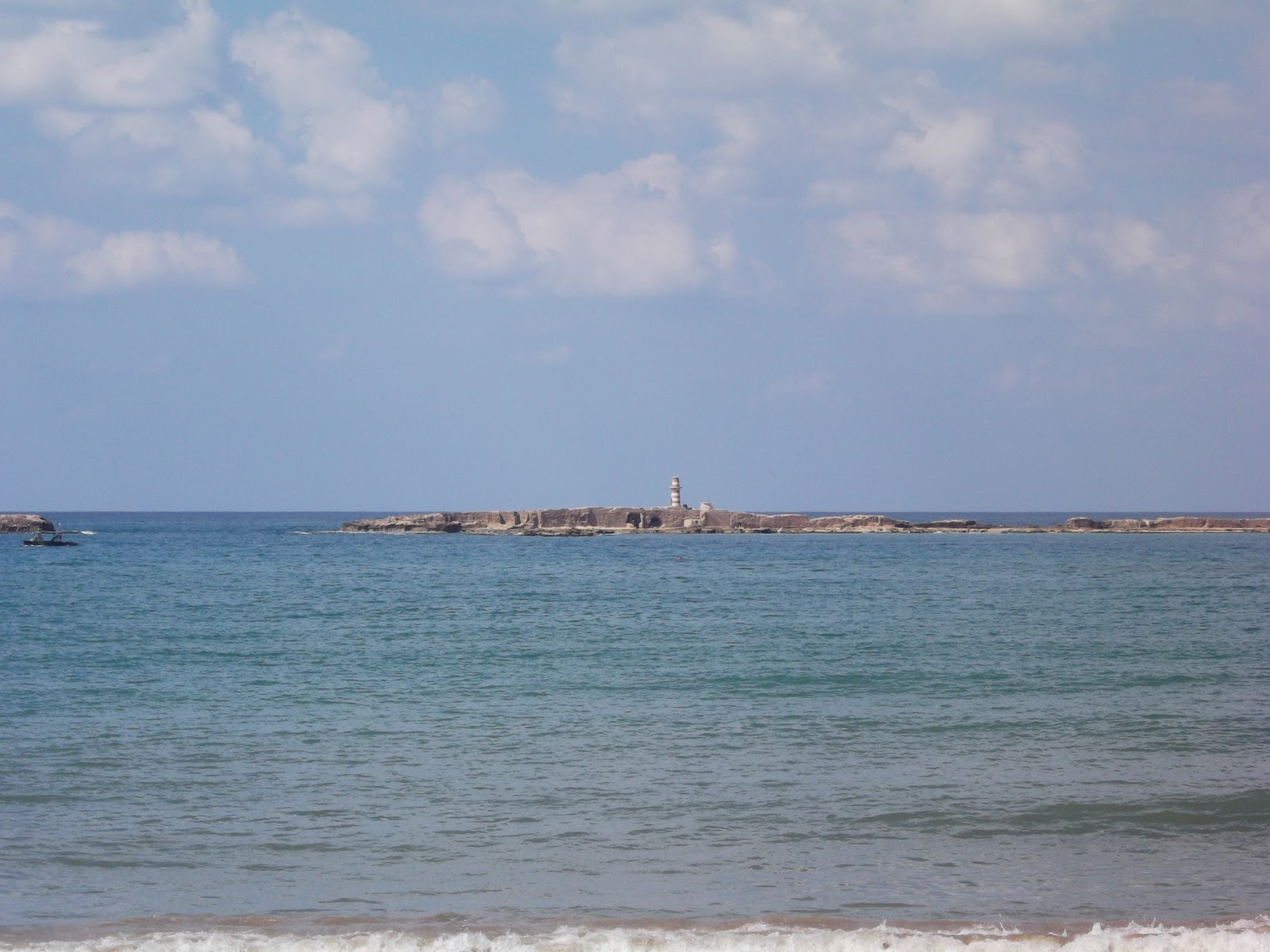
Zeereh Island, Sidon

Saddam Hussein poster, Tripoli


And so we pressed on south, tracing the gentle convexity of the brilliant Mediterranean through al-Ghaziyeh, site of the killing of eleven children and fifteen other civilians by two Israeli air strikes in ’06; and through Saksakieh, where yet another luckless shop owner fell victim to Hizbullah’s perennial war on alcohol when he arrived one morning in July to find his premises burnt to cinders – a casual trashing of a poor man’s livelihood that shows how much Nasrallah’s gangsters really care for the ‘downtrodden’. Just north of the Litani river, we passed Mazraat al-Yahoudieh – ‘the Jewish Farm’ – where the Jews of Deir al-Qamar had fled during the Christian-Druze war of 1848. God knows whether any Jews live there today - the website of the Lebanese Jewish Community Council puts the total size of today’s Jewish population at “less than 200”; a community that once numbered tens of thousands of Lebanese patriots, forced from their land by barbarous minds who could not distinguish between Jew and Zionist. 

The British Foreign & Commonwealth Office advises against “all but essential travel south of the Litani”. This seems to me an arbitrary point of reference, for there is nothing obviously different about the other side. True, the Party of God certainly makes its presence known, littering the streets with its green-and-yellow flags (bearing the AK-47 insignia it shares with the Iranian regime’s death squads); its morbid galleries of fallen ‘martyrs’; and of course its endless veneration of the Dear Leader himself. But the same could also be said of just about every village we passed since Sidon. It’s also true that crossing the Litani takes one closer to Israel; a state rather famed for its preference for bullets over questions in its dealings with unexpected company. But then the Israeli armed forces can, and do, hit any part of Lebanon they like - as the residents of al-Aabde, a small port town by the northern border with Syria, were reminded when fourteen were killed by Israeli air strikes in '06 (“Nothing is safe”, as the IDF Chief Dan Halutz bragged at the time). 

No, the only difference I could discern as we approached the bay of Tyre (Sour) was an amplification of the splendour of the general surroundings; the sea taking on a lighter, glossier sheen; the clouds breaking apart in tufts of cotton. The city itself is a living refutation of biblical ‘prophecy’; for despite the words of Ezekiel (and more than three decades at the frontline of the Arab-Israeli war), Tyre not only still exists but is once more a centre of regional commerce and culture. Seeing the city in 1697, ruined successively by Crusader and Mamluk conquests, the Oxford academic and Anglican priest Henry Maundrell crudely declared a vindication of scripture:

On the north side it has an old Turkish ungarrison’d castle; besides which, you see nothing here, but a mere Babel of broken walls, pillars, vaults, &c. there being not so much as one entire house left. Its present inhabitants are only a few poor wretches [...] subsisting chiefly upon fishing; who seem to be preserv’d ill this place by Divine Providence, as a visible argument, how God has fulfill’d his word concerning Tyre, viz. That it should be as the top of a rock, a place for fishers to dry their nets on, Ezek 26:14.1

How satisfying it is to see this infantilism made laughable, and to find in Tyre today a population of over 100,000 flourishing in very much “entire” dwellings that, moreover, strike an enviable balance between the polish of urban modernity and the ungroomed charm of the seaside. Stopping at a Byzantine villa-turned-resort – where I was able to get that drink after all – we encountered a group of Europeans who told us they’ve been holidaying in Tyre for years, and I can’t say I blame them. From its unique location, protruding so starkly from the mainland, one can see almost as far as Sidon to the north, and to the beginnings of Israel to the south. And should one tire of idling on the beach, the Roman ruins of the Al Mina excavation site, a mere five minute drive away, are the equal of anything to be seen in Byblos (Jbeil) – just as the shawarmas I had in the city centre were the equal of anything on Beirut’s Bliss Street. I left the city much as I had left Sidon; with regret that I couldn’t have stayed longer and with a wish to return for much more extensive investigation in future. 

View north from the Al Fanar resort, Tyre. Taken by MA

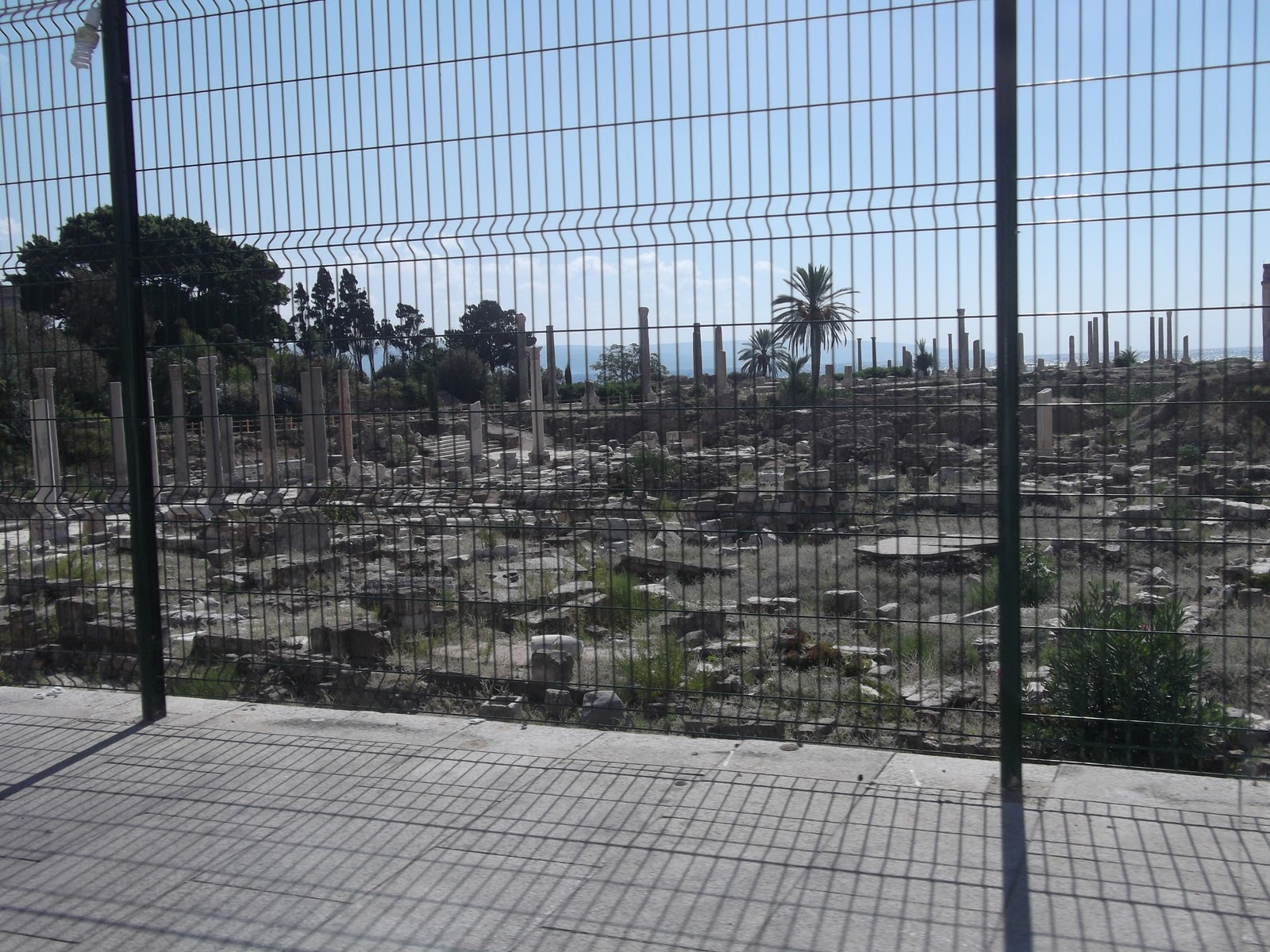
Al Mina Roman excavation site, Tyre


Heading south of Tyre, the road veers inland somewhat, the sea disappearing behind the vast banana plantations that will be disturbingly familiar to those who have seen Ari Folman’s 2008 film, Waltz With Bashir. An ostensible sign of increased danger arrives in the form of an army checkpoint, bearing a stern warning that no “foreigners” may pass without permission from the moukhabarrat, or intelligence agency, in Sidon. My heart plummeted, for I most certainly hadn’t obtained any such permission, and could scarcely imagine the headache that would be involved in doing so. However, by a blessing of fortune that mystifies me to this day, our car was waved through before we had even come to a halt. And so for the next twenty minutes it was us and the bananas, the sighting of other human beings becoming suddenly infrequent. Good pace was made possible by the remarkably fine condition of the roads – newly rebuilt, no doubt, after annihilation in ‘06 – and as the trees cleared and the Mediterranean came once more into view, we soon found ourselves being waved through the checkpoint at the entrance to Naqoura, the small town just two miles from the border that is also the headquarters of the United Nations Interim Force in Lebanon, or UNIFIL. These ‘peacekeeping’ units were initially deployed in response to Operation Litani, Israel’s first invasion of Lebanon in 1978, “for the purpose of confirming the withdrawal of Israeli forces, restoring international peace and security and assisting the Government of Lebanon in ensuring the return of its effective authority in the area”. Given that only the first of these three has been achieved – 22 years later than scheduled, at that, and little thanks to UNIFIL – the poor bastards, despised by Israel and Hizbullah alike, look doomed to be stuck in south Lebanon for quite some time yet. 

Checkpoint south of Tyre
UN base in Naqoura
“From here”, Ali announced as we left Naqoura, “UNIFIL bas”: UNIFIL, and nobody else. And so it proved, as we entered territory that, from 1978 to 2000, was for all practical purposes a part of the Israeli state. To come across a landmine or an unexploded cluster bomb would by no means be unheard of in these deserted plains, and so it was rigidly to the tarmac that we stuck as we began the final stretch, alone but for a UNIFIL jeep a few hundred metres ahead of us. What struck me most about the moment that the road ran out, and we were forced to turn east, was how utterly tranquil the whole scene was. No sniper-topped watchtowers; no rows of tanks; no convoys of helicopters swirling overhead. The border fence itself was the sort of thing a moderately foul-tempered farmer might erect to keep out teenage pranksters, not the frontline between two militarised nations officially at war. The dark green field through which we were driving simply dipped down a slight recess and there, not more than fifty metres away, was a parallel road in Israel. And behind it, not more than five hundred metres away, were the beige walls and red roofs - the same colour scheme I had seen at the Ma’ale Adumim settlement in the West Bank - of the Israeli village of Kfar Rosh HaNikra, a kibbutz and tourist attraction renowned for its grottoes.

UNIFIL jeep
A road in Israel


Israeli village


Amazingly, the more we drove east, the more our road and the parallel one in Israel began to converge. We passed Labbouneh, where the kibbutz of Hanita was practically touching the Blue Line; and Btaichiye, opposite the village of Arab al-Aramshe, where three Israeli Arab Bedouin civilians were killed by Hizbullah rocket fire in ‘06. At Boustane, just west of the Nabatieh governorate, we could practically read the number plates of cars in the Israeli village of Zar’it. And still, the calm in the air was preternatural; tantric; catatonic. Can it really have been from this very spot that Hizbullah crossed the border on July 12th, 2006, firing explosives and anti-tank missiles at an IDF jeep convoy, killing eight soldiers and dragging two back into Lebanon alive; in doing so provoking the most destructive Israeli assault on the country since ‘82? Apparently so, and yet aside from a fenced-off compound a couple of kilometres inside Israel, which Ali believably claimed was an IDF base, I could see no one around to stop me doing something similar myself – least of all the UNIFIL patrolmen, who regarded us on the whole with astounding incuriosity, as though to make inquiries about our intentions or indeed to acknowledge our presence at all would be an unpardonable violation of proprieties. 

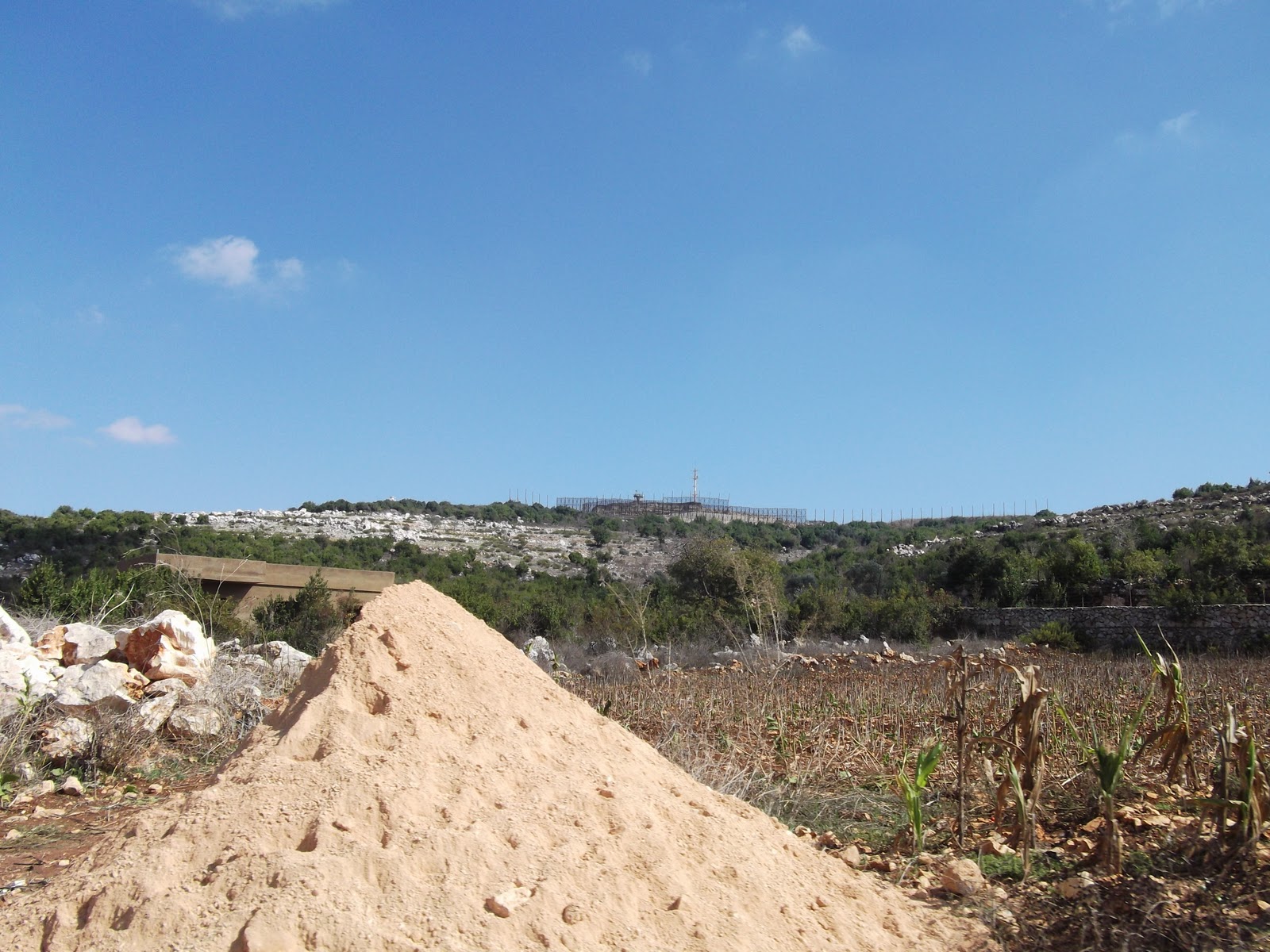
IDF base in the distance

UNIFIL jeep. Taken by MA


Even the Party of God was nowhere to be seen here. The American writer, Michael J. Totten – of whose book on Lebanon I am no great fan – saw the Blue Line further up to the north-east in ‘05 and posted pictures on his blog of various miscellanea assembled along the border in apparent attempts to intimidate Israelis: wrecked IDF trucks; ‘martyr’ shrines; photos of severed Israeli heads; etc. I have seen similar things myself in Baalbek. But nothing remotely of the kind could be found where we were; indeed, aside from one poster of the late Shiite cleric, Muhammad Fadlallah – bearing the not-too-terrifying inscription, “With my love and blessing” – the only graphic we came across was a white dove painted next to a green cedar on a concrete block. One wouldn’t wish to sentimentalise matters, or to pretend that the Lebanese are pacifists. But it’s useful all the same to have a qualification of the Totten narrative in which the Lebanese side of the border is little but a barbarous carnival of venom and violence.

Israel in the background. Taken by MA


Which brings me, somewhat elliptically, to Qana, roughly ten kilometres north of the Blue Line, which was to be our last stop before rejoining the coastal highway and returning to Beirut. A modest town in many ways, Qana is nevertheless believed by many to be the biblical Cana of Galilee, where Jesus performed his most useful miracle when he supplied the drink at an otherwise boozeless party, thereby delivering the presumably bored guests from further tedium (John 2:1-10). A spiriting distinction, to be sure, but I can’t say I felt much inclined to smile on my visit. For Qana today is a morbid town, known not for miracles but for massacres. The first one occurred during a sixteen-day battle between Hizbullah and Israel in ‘96, when on 18 April, the Israelis deliberately and repeatedly shelled a UN compound that was housing some 850 civilians, killing 106 (over half of them children) in a most unimaginably gruesome manner2. The second came just over a decade later, on 30 July, 2006, when Israeli jets bombed a three-story residential building housing 63 civilians, killing 27 (16 of them children). In both cases, the Israeli government involved itself in a disgraceful series of lies: in the first case claiming that a computer malfunction was to blame, and denying that a pilotless ‘drone’ reconnaissance aircraft had been flying over the compound before the shelling began; and in the second case insisting that Hizbullah combatants had fired rockets from the residential building, thus making it a legitimate military target. In both cases, the Israelis were forced to recant their original claims: in the first case after the discovery of a video clearly filming the ‘drone’ by the UN compound; and in the second after it became clear that eyewitnesses to the attack, including international rescue workers, journalists and human rights observers, were too numerous, and too consistent in their reports to the contrary of the Israeli claim, for the deception to work. In both cases, in other words, the flow of venom and violence was from Israel to Lebanon, not the reverse – a partial vindication, come to think of it, of Ezekiel after all. 

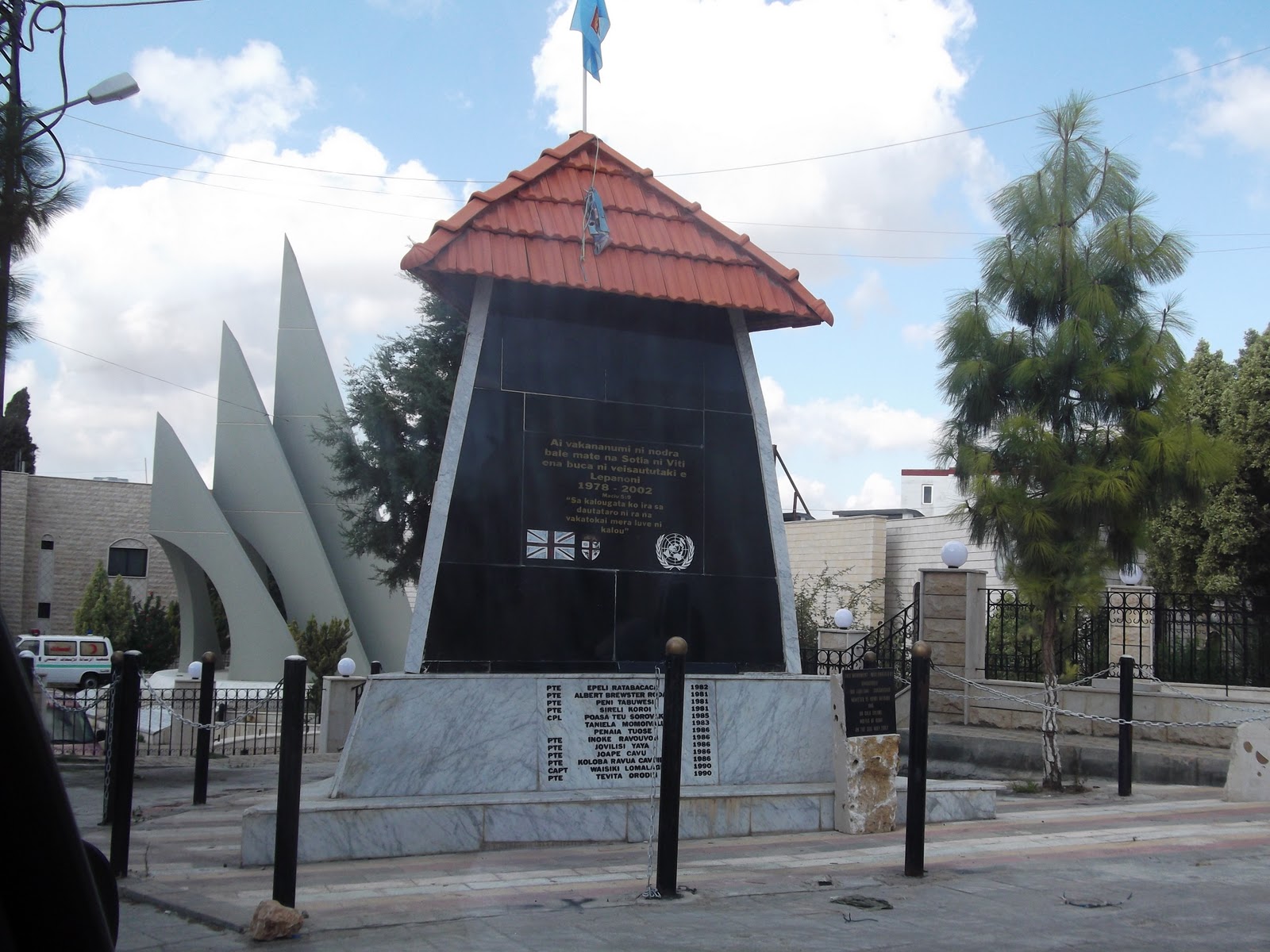
Memorial at the UN compound in Qana


Was it also a partial vindication of Hizbullah, and its claim to be a ‘liberator’ of the land? Certainly there are many who would answer in the positive. And in a way, the question isn’t for me to answer: I may not presume to speak on behalf of my Lebanese companions, for whom the trip we had taken that day would not have been possible just twelve years ago. What it means to stand on one’s national soil, previously stolen by a foreign power is unknown to me. Still, for however little it may be worth, my answer would always be an unhesitating ‘no’. The reason for this was neatly encapsulated in a poster I saw about five minutes south of Naqoura. Impaled on the shore of the resplendent Mediterranean, with the hills of Israel lining the horizon, stood a metal frame displaying the faces of two politicians, neither of them Lebanese: the inaugural Supreme Leader of the Islamic Republic of Iran, Ruhollah Khomeini; and his successor, Ali Khameini. Whether this was an expression of theological solidarity with these most eminent Ayatollahs – as is suggested by the total absence of tributes to the non-clerical President Ahmadinejad - or merely a thank-you for the vast sums of reconstruction funds donated, it points in either case to the long shadow cast by Tehran on Lebanese civil society. 

Khomeini and Khameini, just south of Naqoura


This shadow manifests itself in a number of ways: partly in the trampling of political dissent within the regions of the country which the Party controls, where members of rival factions such as Amal and the Communists are either subjugated or liquidated. It also manifests itself on a national scale, in the acquisition of a huge private arsenal, which the Party uses to suffocate the country’s democracy and hold the entire population hostage to its whims - a humiliation that further involves dragging the government into sordid alliances with grossly unsavoury regimes, most notably the Assad crime family in Damascus and the Putin dictatorship in Moscow (to say nothing of the Iranian theocracy itself). 

But more sinister than any of these is that part of the Iranian shadow that fell on the aforementioned shop owner in Saksakieh. How readily some people appear to forget that the original Hizbullah manifesto, published in the as-Safir newspaper in 1985, called openly and repeatedly for the Lebanese to submit to an “Islamic government” and a “culture [...] based on the Holy Koran, the Sunna and the legal rulings of the faqih [jurist] who is our source of imitation”, clarifying that the faqih in question was “Ruhollah Musawi Khomeini”. And despite much loose talk about the Party ‘softening’ its stance in its amended manifesto of 2009, Nasrallah plainly reaffirmed its “allegiance to the Fakih” and “commitment to the [Islamic] Jurisconsult” when challenged on the point by a journalist at the press conference launching the manifesto. Hizbullah has, in this sense, not removed the Israeli occupation but replaced it. Once again, the essential point is underscored: as long as it’s the mullahs and imams who have the power - or the patriarchs or popes or the rabbis for that matter – then real ‘liberation’ will never be attained. One hopes in Lebanon, as one hopes in every country, that it isn’t too late to realise this, and to act upon it.

1 Maundrell, H., Journey from Aleppo to Jerusalem at Easter A.D. 1697 (1703); as reprinted in Gorton, T.J. & Gorton, A.F., Lebanon: Through Writers’ Eyes (2009), p. 103
2 See esp. Fisk, R., Pity the Nation: Lebanon At War (3rd edition, 2001), pp.669-89