Whoever came up with the idea that the Arabs are a lazy people cannot have been to Beirut. What’s abundantly apparent to the first time visitor is instead their maniacal hyperactivity. Half past midnight on a Wednesday? A fine time to go for a jog along the corniche, in full athletic attire. Follow it up with a couple of whiskies at a bar twenty minutes across town? What could be more natural? There appears to be no time of day, on any day of the week, at which rest is permissible. The traffic is permanently terrifying: indeed, people do not seem to drive in Beirut; they simply point their vehicles at their destinations and rely on everything in their paths to get out of their way. More baffling than the question of when people sleep is whether anybody in fact can sleep amid the snarling cacophony of car horns; the hawk-like screeching of tyres; the pneumatic diesel exhaust fire and the staccato spitting of two-stroke mopeds; not to mention the orgiastic percussion of the uncountable construction sites. That is, when the perfunctory formality of construction is bothered with at all – many are the warfare-savaged buildings converted directly into hostels or shops or restaurants without so much as cosmetic renovation. The bullet holes will have to stay: there’s no time to fill them in. Time, indeed, is understood by the Lebanese in the Shakespearean sense. It’s as though, having been shown up front for fifteen years just how quickly the facts of existence can be snatched from them, they’ve resolved to snatch as much as they can from his ‘injurious hand’ in return.
At the same time, the hands of the Lebanese can be injurious enough themselves. Indeed, with her fertile slopes, her mounds, her peaks and her valleys, the land of Lebanon sometimes resembles the body of a beautiful but vulnerable woman, grappled on all sides by the groping fingers of greedy aggressors (as well as one time defenders who, upon feeling her flesh for themselves, grew perverted in turn). While some parts of her body are left comparatively unmolested, there are others where one can plainly see the thumbs and fingers wrestling and slipping; pressing and releasing; and sometimes coming to rest side by side with those of fellow assailants.
Thus one can drive through the pristine serenity of the Matn district of Mount Lebanon, a place of sweeping greenery galaxies apart from the noise and nuisance of Beirut, taking in the crystalline Mediterranean glistening beneath you, and barely even notice as you enter the town of Bekfaya, hometown and headquarters of the Phalange, whose name is not shared with the party of Francisco Franco by coincidence. Founded in the 1930s by the Hitler-smitten Pierre Gemayel, the Phalangist militiamen were the ironic Christian allies of the Israelis in the civil war, attaining infamy for their ruthless programme of ‘cleansing’ against the Palestinians that reached its nadir in the 1982
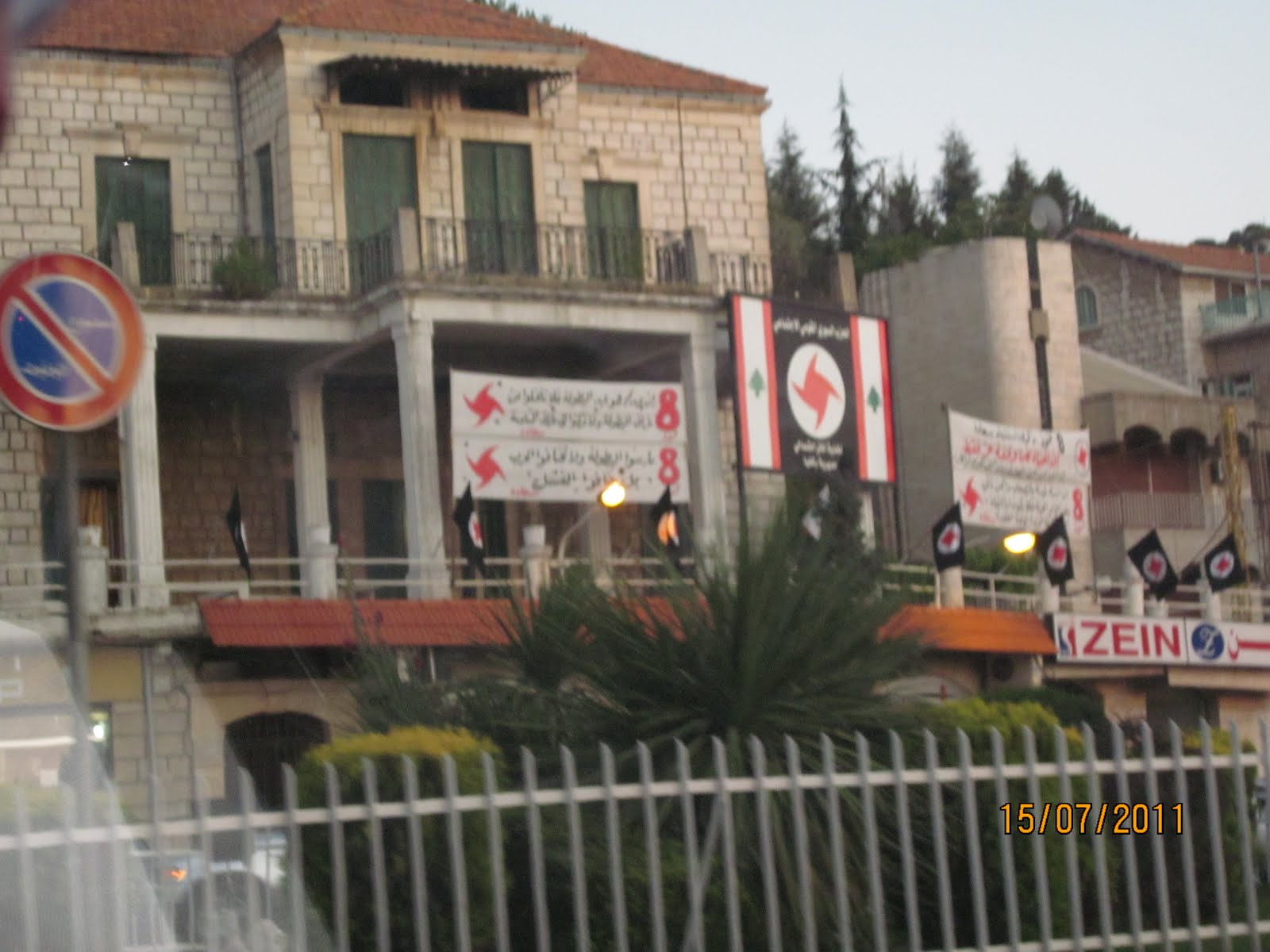
massacres at the Sabra and Chatila refugee camps. Whilst nowadays they are a demilitarised and somewhat legitimised political party, what’s disturbing about their offices is the large photo of Bechara Boutros al-Rahi, the new Maronite Patriarch approved by Rome in March, that can often be seen hanging directly above the main entrance. After all these years, and all these re-brandings and makeovers, it seems the Vatican still can’t help itself... And then what's simply astonishing about the headquarters in Bekfaya is that the building sits literally next door to a major office of the Syrian Social Nationalist Party, another spawn of 1930s European fascism, which calls not for the segregation of the Lebanese and the Palestinians but in fact for the amalgamation of the two, along with the rest of the Levant, into a ‘Greater Syrian’ superstate.
 |
| Phalange office in Beit Chebab with Patriarch's photo above logo |
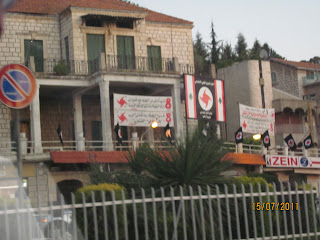 |
| SSNP office next door to Phalange HQ in Bekfaya |
Or take Beirut’s Hamra St, where supporters of the same SSNP
demonstrated just last Sunday in support not merely of the preservation of the Assad regime - which may have killed as many as 1,600 Syrian civilians since uprisings began earlier this year – but of the extension of the tyranny to Lebanese soil as well. Due to its proximity to the Syrian embassy, Hamra has witnessed a number of similar scenes in recent months: in June, thousands of SSNP sympathisers marched down the street carrying a jumbo jet-sized Syrian flag, and in May
the Lebanese army had to be called in to restrain the frenzied brutes from attacking a few hundred courageous men and women demonstrating against Assad’s mass murders. What makes Hamra so invigorating a street, however, is that in addition to being a hotbed for two-bit fascists and Syrian nationalist punks, it is at the same time one of the brightest flames of sophisticated civilisation in the whole country; with its fashion boutiques; its bookstores (of which
Antoine is the superlative); and its awning-capped streetside bars full of students, tourists and young professionals that have the feel and buzz of Amsterdam, or perhaps Edinburgh during the Fringe.
Speaking of students, and not leaving the SSNP just yet, I spent a very pleasant half hour in July strolling through the American University of Beirut off Bliss St, two blocks away from Hamra. Founded by the American Protestant missionary Daniel Bliss in 1866, the extraordinary beauty of the campus, with its forests of dark green and lavender perched over the corniche, prompted a friend to joke that surely now I couldn’t say the religious hadn’t got
something right. A point I could almost concede, even if Bliss himself was a bit of a fanatic on the Darwin question (see the ‘
Lewis Affair’ of 1882), and even if the whole point of what was originally called the Syrian Protestant College to begin with was
to convert the natives to evangelicalism – even if, in other words, AUB could only have become the ‘Harvard of the Middle East’ that it is today by rejecting utterly the theological character that Bliss spent his career trying to impose upon it and by secularising itself to the point where the once-central Department of Religion has disappeared altogether.
The elevation of spirit this reflection brought on me might well have lasted the rest of the day had I not realised, immediately upon exiting to Bliss St, that hanging directly above my head and in fact stretching the entire width of the street was a banner flying the spinning swastika of the SSNP. Voicing my displeasure to my companions, I was informed that the banner had been there for some time. The sight of students with Che Guevara caps and hammer-and-sickle t-shirts was by no means uncommon on the AUB campus, but one surely didn’t have to be a leftist to take insult at the idea of Damascus claiming such a jewel of Lebanese enlightenment – could it really be that
nobody had done anything about this? I hardly needed to ask the question. I already knew
what had happened to Christopher Hitchens when he tried to deface a SSNP sign on Hamra St, just as I knew
what had happened to the journalist Omar Harqous for the mere act of filming their filthy flags. Suffice to say I myself was not about to tear it down. They hadn’t draped their logo above the entrance to the university by accident: it was a calculated provocation; a boast that Bliss St, like Hamra and an ever-expanding portion of what used to be known as west Beirut, was
theirs. That the state can allow them to treat the heart of the capital like a private fiefdom at a time when Assad’s grip on power has never looked more tenuous is a mark of just how much remains to be done before the ‘
Cedar Revolution’ of 2005 is completed.
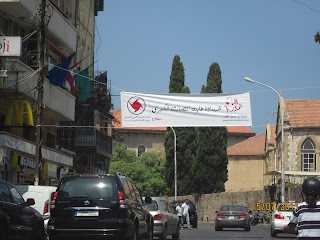 |
| SSNP banner by the entrance to AUB on Bliss St |
But more dispiriting still was my visit to the Roman temple ruins in Baalbek, in the Beqaa valley near the Syrian border. From the idyllic mountain village of Beit Chebab in the mostly Christian area north-east of Beirut, a friend took me on an exhilarating two-hour drive up the winding roads of Mount Lebanon and then down the other side into the Beqaa, where we eventually joined the Beirut-Damascus highway that was the scene of such memorable carnage in Robert Fisk’s
Pity the Nation*. After half an hour or so on what was quite literally the road to Damascus, we broke off north into Baalbek. And it was here that things started to change.
Because Baalbek, as it happens, is Hizbullah territory: one of several chunks of the country ruled by the totalitarian Shiite Islamist militia formed in the early 1980s to export the Iranian revolution to Lebanon and subordinate the population to the rule of Tehran. Hence we were scarcely thirty seconds inside the district before being confronted by billboards bearing the mirthless smirk of Hassan Nasrallah, Hizbullah Secretary General, along with the furious glare of Khomeini himself. Every single lamppost in the centre of the dual carriageway bore two identical yellow-and-green Hizbullah flags, along with two placards, one bearing generic Islamic imprecations (‘Allah is great’, ‘There is no god but Allah’, etc.) and the other listing in series the ninety-nine names of Allah (the internal inconsistencies of which gave us much presumably unintended amusement: for example, how can God be at once al-muqadim – the expediter – and al-mu’akhir – the delayer? Or the first – al-awwal – and the last – al-akhir? The evident – al-dhahir – and the hidden – al-batin? The avenger – al-muntaqim – and the forgiver – al-‘afou?). Unlike in Beirut, where the Muslim women wore colourful headscarves if they chose to wear them at all, here every female head was uniformly veiled in black, some even sporting the full burqa, which is an eyebrow-raiser even in the Gulf states. After a long silence, my friend said my own thoughts out loud: “This doesn’t feel like my country”.
 |
| Hassan Nasrallah poster, just inside Baalbek |
Stepping out of the car at the Roman temples site, I recall my first feeling being one of confusion. I knew where I was, and where I had to get to, but there was some sort of pseudo-musical din in the air, a creepy voice chanting something vaguely tribal through a cheap set of loudspeakers. My Arabic is far from great but even I know what “Ya Amrika” and “Ya Israyeel” mean, and the bad sign that they usually portend. And then we turned the corner to the ticket desk and we saw it: a huge, scowling Nasrallah plastered onto a tent next to larger-than-life images of bearded men firing Katyusha rockets and AK-47s. My Lebanese friends, some of whom looked more stunned than I was, informed me that according to the sign, this was some sort of Hizbullah war exhibition. We resolved to go inside, but only after seeing the temples, and only if we didn’t have to pay anything for it.
Mercifully, the Party of God left the temples themselves alone. Thus we ambled freely through the 2,000-year-old Great Court, under the remaining pillars of the Temple of Jupiter and into the magnificently-preserved Temple of Bacchus - the god of wine (the closest I’ll ever get to a religious pilgrimage) – where a local guide explained to us in painstaking detail the significance of every conceivable etch and scrape in the architecture (tour guides in Lebanon, by the way, are always fantastic value for money: at the cedar trees in the remote hamlet of Barrouk, nearly two thousand metres above sea level, we were introduced to the oldest cedar in the world by a naturalist of Attenboroughian omniscience). When we could bear it no longer – there is, after all, only so much the soul can take about the profound symbolism of locusts, or the terrific importance of the mosaic form – we left to face once more Nasrallah and his lugubrious groans of blood and conquest.
Stepping cautiously inside the tent, we met a grim-faced young man of about thirty sitting at a desk. My friend asked if we could walk around, and without smiling or indeed betraying any emotion he gestured toward the nearest section. Could we take pictures? He nodded in a way that couldn’t have given me less confidence in the idea. Thus we gingerly proceeded to the ‘Made in Israel’ section, which was a series of large and extremely graphic photos of corpses, presumably maimed in the 2006 war. Wondering what exactly these had to do with Islam, I noticed a picture of Khomeini with the following quote appended: “Had each Muslim poured a pail of water on Israel, it would have been shoved away by the floods”.
 |
| Inside the Hizbullah exhibition at Baalbek |
 |
| Ayatollah Khomeini poster inside the exhibition |
Moving on, we came to a kitchen-sized reconstruction of the Israel-Lebanon border, represented by a wire fence, with a felled Israeli ‘body’ (in what may well have been authentic IDF uniform) on the floor and a crude picture of a sunrise emanating from ‘Palestine’.
Finally, we entered a sort of mock-bunker with sandbags, machine guns and mortars arranged on the ground and dozens of photos of young men framed on the walls. Of course:
al-shuhada - ‘the martyrs’. No militants love their dead more than Lebanese militants. Every faction, both Muslim and Christian, has its shrines. Even the supposedly secular SSNP gets involved, smothering the walls and lampposts of Hamra St with morbid mugshots of Sana’a Mehaidli, the 18-year-old who blew herself up along with two Israeli soldiers in 1985 in what is thought to have been the first female suicide bomb attack. This fetishisation of the dead is less about paying respects and more about the cynical matters of branding and recruitment. As Zeina Maasri writes in her book
Off the Wall: Political Posters of the Lebanese Civil War:
It is hard for a youth impassioned by the same cause to pass by these posters without being affected and probably, if only for a brief moment, imagining him/herself in the photograph with his/her name praised as the martyr hero [...] On several occasions, the immediate family of a martyr has asked the party’s media office for posters to be made to honour their loved one as a hero, sometimes going so far as specifying the design of the poster to be ‘like the one designed for the martyr of such and such family’. Consequently, even at their basic informative level these posters acquire a different purpose: that of recruiting potential fighters, encouraged by the ‘noble’ example of their friend, neighbour, relative and comrade. (p.88)
Indeed, the whole exhibition was a naked public relations stunt. If only we’d all been Muslims, or better Muslims, we’d never have got into this mess in the first place. But since we have, just hand us over your sovereignty, your rights, your intellect and your culture, and tomorrow we’ll be dining in Jerusalem. And if you happen to get killed on the way, you’ll become a celebrity. ‘Honour’ shall bemedal your family name (when his eldest son was killed by the IDF,
Nasrallah himself thanked Allah for “generously [blessing] my family by choosing one of its members for martyrdom and [accepting] me and my family as members in the holy assembly of martyrs’ families”).
It also eloquently demonstrated the way in which Hizbullah manages to be both Israel’s greatest threat in the region as well as its greatest asset: a threat because, with its sophisticated arsenal and genuine grass-roots popularity (amongst the Shia, at least), it’s the only armed group in the region capable of visiting anything like a military defeat on the Israelis; and an asset because, so long as they make such pornography out of stupid barbarisms like ‘martyrdom’ and Jew-baiting and Islamism, Netanyahu has to waste very little time indeed convincing his friends and patrons in Washington that Israel is the lesser of the two evils.
As I wrote in a previous post, it isn’t just the Lebanese but the Palestinians too who deserve better ‘friends’ than these.
*
The conventional wisdom has it that Lebanon is a land of ‘contrasts’ and ‘contradictions’. It would be more accurate to call it a land of irreconcilable disagreements. The Lebanese cannot agree on anything of any cultural or political importance: on what ethnicity they are (Arabs? Phoenicians? Druze?); what language to speak (Arabic? French? English?); whether to fight their neighbours or befriend them; what their modern history is (nothing after 1975 is taught in schools); whether they are even a distinct people at all (the SSNP, along with the pan-Arabs and the pan-Islamists, think otherwise). Most obviously, and most importantly, the Lebanese cannot agree on which god to worship, and indeed many if not all of the above disagreements are derived or in some way determined by this one.
In
God Is Not Great, Hitchens wrote of Lebanon that when he first saw it in the ‘70s, “it suffered from a positive surplus of religions” (p. 19). I know of no country on earth that wouldn’t benefit from a reduction in the number of its religions, and none perhaps more so than Lebanon: the state officially acknowledges the existence of
eighteen different religious sects – that’s eighteen different
indigenous sects - of which the three most powerful are the Maronite Christians and the Sunni and Shia Muslims. The confessional constitution stipulates that each three must be represented in the executive leadership, by the President, the Prime Minister and the Speaker of Parliament, respectively. The country is, in other words, not merely a theocracy but what one might call a polytheocracy: try to imagine the Vatican, the Muslim Brotherhood and the Iranian Revolutionary Guards sharing power on a territory the size of Cyprus and you’d still only grasp half the complexity.
So it’s little wonder, perhaps, that it all exploded so spectacularly. The civil war wasn’t only about religion, but as in Northern Ireland, it was no coincidence that co-religionists stuck together - whether in ‘Christian’ east Beirut or ‘Muslim’ west Beirut. The following is just one example from Fisk’s Pity the Nation that illustrates how viciously combustible could be the sectarian dynamite:
In December 1975, on what was ever afterwards to be known as Black Saturday, four Christians were found shot dead in a car outside the electricity company headquarters in east Beirut. Bashir Gemayel [son of Pierre who became President in 1982, to be assassinated three weeks later] was in Damascus when the news was reported to him. Phalangist officers of the time insist that he told them to kill 40 Muslims in reprisal. Christian roadblocks were therefore set up at the eastern end of the Ring motorway and the first 40 Muslim men to arrive at the Christian checkpoint, some of them travelling with their wives and children in their family cars to homes in east Beirut, were taken beneath the overpass and had their throats cut. When this news became known in west Beirut, Muslim militias followed the Christian example. For hours, civilians of both faiths dutifully queued at these terrible checkpoints at each end of the Ring on the innocent assumption that the gunmen there merely wished to look at their identity papers. Only when they saw the hooded men with blood-covered knives approaching their cars did they realise what lay in store for them. At least 300 Muslims were butchered in this way; an equal number of Christians probably met the same fate. (p. 79)
Things have moved on a bit since these dark days - the PLO has left; the Israelis have left; the Syrians have (theoretically) left - but the parties of god are now more of a menace than ever. After the Taif Agreement that brought about the end of the war in 1990, all of the major militias agreed to disband and disarm except for one: Hizbullah. To this day the Iranian-backed Shiite group stands in defiant contravention of UN Security Council Resolutions
1559 (adopted in 2004),
1680 (2006) and
1701 (2006), all of which order it to surrender its arsenal to the state. As a result of its unrivalled military might, Hizbullah is able to operate a state-within-a-state in the south of the country where even the Lebanese Army hesitates to venture, and where anyone who has other ideas about
vilayat-e faqih is dealt with the hard way. Elsewhere, Hizbullah tramples on Lebanese civil society; storming Beirut with guns blazing and
bringing the country to the brink of civil war in 2008;
toppling the democratically-elected March 14 government in January of this year and, according to the UN-backed Special Tribunal for Lebanon,
car-bombing the ex-Prime Minister Rafiq Hariri in 2005.
Religion is their cause, and it is also the source of their strength. Lebanon desperately needs a powerful and sovereign army that can overpower and suppress Hizbullah’s criminals (and carry out its own ‘resistance’ against Israeli aggression). But such a scenario is made impossible, in large part, by the religious divisions within the Lebanese Army itself. As Michael J. Totten writes in his new book
The Road to Fatima Gate:
[There are] fears that the army would break apart along sectarian lines if orders to disarm Hezbollah were given. Parts of the army split off into sectarian militias during the civil war, after all, and could easily do so again. Roughly a third of the soldiers were Shia conscripts. Many were more loyal to Hezbollah than to the legal authorities. (p. 178)
Just like that other, related fight to the death between Hamas and Netanyahu’s Shas-infested coalition, this is something that can never be resolved so long as people are prepared to die and kill for their supernatural beliefs. In no other part of the world is it more obvious that, contrary to the endless fatuous babble of the ‘faith community outreachers’ and the ‘interfaith dialoguers’, what the world needs is not more religion but much, much less of it. Of the sights I saw in Lebanon, there was one above all that stays with me to this day. Overlooking the Temple of Bacchus from the Temple of Jupiter in Baalbek, from the right angle one can see the turquoise minaret of a grand Persian-style Shia mosque poking above the wall about half a kilometre beyond the ruins. I had to stare for some time before I could pinpoint what it was that so arrested me about it, and then I realised: it was the stark juxtaposition of the convivial and the austere; the joyous and the anti-joyous. In the foreground, the temple of wine and sex; and in the background, the temple of no wine and no sex. In front, the lovers of life; behind, the lovers of death. Between these two lay all the permutations of the Lebanese character, and everything wrong with it is encapsulated in the repudiation of the former in favour of the latter. Nothing less than the survival of the state depends on the reversal of this decision.
 |
| Shia mosque behind the Temple of Bacchus at Baalbek |
|
|
* “A huge explosion blasted round the corner of the mountainside, from the crossroads at Mdeirej ridge, the intersection marked on the maps that the Israelis had dropped over Beirut. In a dark brown cloud of smoke, we could see pieces of debris hurled hundreds of feet into the air, but [Bill Foley, Associated Press photographer] jammed his foot on the brake when we saw two Syrian army trucks that had been thrown into a sloping field beside the road. Cars lay smashed beside them, either in a series of large bomb craters or smouldering beside the gorge to our left. ‘Bill, they’re being bombed. For Christ’s sake get out of here!’ There was another devastating explosion. Afterwards, we were to recall our exact words. The most mundane expressions become memorable when they are uttered in panic. I kept on shouting to Foley: ‘Turn the car around for Christ’s sake’ and Foley screamed back: ‘What the fuck do you think I’m doing, you asshole?’" (p. 225)