Showing posts with label Benjamin Netanyahu. Show all posts

Sunday, March 1, 2015

Israel makes largest West Bank land grab in 30 years

[Originally posted at NOW]

Sometimes it takes the placid, sterile dispassion of the BBC to fully ram home the amazing arrogance and malevolence of the Israeli government.

Describing Tel Aviv’s declared seizure of – sorry, “decision to appropriate” – more West Bank territory than it’s snatched in one go for three decades, the BBC staff writer says with serene insouciance that, “The military-run local administration said it was a response to the kidnapping and killing of three Jewish teenagers in the area in June.”

More or less everything one needs to know about Israel today is contained in that sentence. In case the full implications aren’t immediately clear: by way of response to the murder of three teens from families already settled on the West Bank (“in the area”), Israel will add five entire Palestinian villages, along with their farmland, to its already vast takings from what remains of non-Israeli land between the Mediterranean and the Jordan. (Having taken them, of course, it will then raze them to make way for more theocratic settler-colonies; in this case an extension to the Gevaot settlement.) It’s as if Mexico, in response to the killing of Mexicans living illegally in the USA, were to permanently award itself a portion of Texas.

What, for that matter, did the United States, the honest broker of the peace process, have to say about it? Surely, after all, there would be outrage were the Palestinian Authority, following the murder of 16-year-old Muhammad Abu Khdeir in occupied East Jerusalem, to react by annexing five West Jerusalem neighborhoods. Condemnation, if that’s the word, came from the State Department in the form of a description of the move as “counterproductive” to the two-state solution – a statement of the obvious on par with saying fire is counterproductive to the treatment of burns. Evidently missed by the State Department was Netanyahu’s statement in July that he had “always” opposed the two-state solution; that “to pull out of Judea and Samaria [Bible-speak for the West Bank]” was something that “cannot” be contemplated “under any agreement.” Far from giving the Israeli government pause, in other words, the idea that the two-state solution has been further derailed will have been received in Tel Aviv with warm gratification.

Monday, September 16, 2013

After twenty years, Oslo defender changes his mind

[Originally posted at NOW]

It was twenty years to the day Friday since Yasser Arafat and Yitzhak Rabin shook hands on the White House lawn to mark the signing of the first Oslo Accord, and while the politically correct opinion may continue to be that this was a genuine, if short-lived, high point for humanity, many who were enthusiastic at the time have come to take a considerably dimmer view in retrospect.

Take Avi Shlaim, the eminent Iraqi-born Israeli historian who wrote in The Guardian last Thursday of his disillusionment with the initiative he had defended in an October 1993 issue of the London Review of Books against the scathing criticisms of Edward Said. “20 years on, it is clear that Said was right in his analysis and I was wrong,” he now concedes.

Shlaim pins the bulk of the blame on Netanyahu, who “spent his first three years as PM in a largely successful attempt to arrest, undermine, and subvert the accords concluded by his Labor predecessors,” particularly with regard to the settlements. We know this is certainly the case – indeed, Netanyahu later boasted that “I stopped the Oslo Accords” by signing the lesser-known 1997 Hebron Agreement with the PLO, indefinitely legitimizing continued Israeli occupation of vaguely-defined “military locations” inside the West Bank. “Nobody said what defined military zones were […] as far as I’m concerned, the entire Jordan Valley is a defined military zone. Go argue,” as he tactfully spelled out.

Yet, as Said saw clearly in his ‘93 essay, the accords were always going to fail, with or without Netanyahu’s sabotage. Inequity and injustice were their very foundations. Re-reading the piece today, it’s impossible not to be struck by how handsomely it’s aged.

He saw – as surely anyone could have seen – that the humanitarian nightmare facing the scattered hundreds of thousands of refugees would only compound in agony. He accurately predicted the ruinous corruption and authoritarianism that would come to characterize the PLO, and the encouragement Israel would give in both respects. In a particularly prescient passage, he foresaw the manner in which the basis for territorial negotiations would shift from the pre-1967 border, as envisaged in UNSC Resolution 242, to a vague approximation of the Green Line adjusted by what are presently euphemized as ‘mutually agreed-upon land swaps’ – that is, pre-1967 Israel plus a significant proportion of the existing West Bank settlements:

“[B]y accepting that questions of land and sovereignty are being postponed till ‘final Status negotiations’, the Palestinians have in effect discounted their unilateral and internationally acknowledged claim to the West Bank and Gaza: these have now become ‘disputed territories’. Thus with Palestinian assistance Israel has been awarded at least an equal claim to them.”

Perhaps most arrestingly, he guessed then what far too few of us are able to face even now – that the entire ‘peace process’ has much more to do with the theatre of the ‘process’ than the actual attainment of any ‘peace’:

“[O]n the matter of how, by what specific mechanism, to get from an interim status to a later one, the document is purposefully silent. Does this mean, ominously, that the interim stage may be the final one?”

Sunday, June 16, 2013

Israel's shameless trashing of the futile 'peace process'

[Originally posted at NOW]

One of the surest ways, it seems, to increase the rate of Israeli colonization of Palestinian land is for a senior White House official to declare a new round of attempts to resolve – or, at least, attempts to agree to attempt to resolve – the modern Middle East’s oldest and most exasperating quarrel.

It happened in 2010 when the comparatively high hopes of Vice President Joe Biden’s visit to the Holy Land were summarily quashed by news from Tel Aviv that 1,600 new Jewish-only homes were to be constructed in the Arab half of Jerusalem.

And it’s happened again this week when, less than a month after Secretary of State John Kerry put American credibility (and four billion dollars) on the line in his own trip to the region – in which he warned explicitly against “changes on the ground,” i.e., another Israeli construction spree – the Israelis apparently just couldn’t help themselves, and filed plans for more than 500 new homes in the ultra-religious settlement of Itamar, 28 kilometers east of the Green Line by the city of Nablus, right in the heart of the West Bank.

Intriguingly, unlike the 2010 humiliation, there wasn’t even a show of contrition from Tel Aviv this time. Nor should anyone have expected one, when just Tuesday Prime Minister Netanyahu assured his nation that, “Construction in communities in Judea and Samaria [Bible-speak for Palestine] will continue, and is continuing still today.”

Dismissing the idea that this broad-daylight land theft could conceivably complicate Kerry’s task, Netanyahu asserted that, “The real question is whether there is or isn’t a willingness [among the Palestinians] to accept a Jewish state” – which is an odd thing to say, considering the PLO has publicly advocated a two-state solution since 1988.

As though to remove any lingering doubt about the mendacity of his argument, Netanyahu went on to complain about the intolerability of Palestinian pre-conditions for negotiations (chief of which is a mere halt, not even a reversal, of the settlement frenzy), before demanding that any hypothetical future Palestinian state would be fully demilitarized, entrusting the security of its population to the very army that is currently confiscating its land. You can’t make this stuff up.

This round of the ‘peace process’ will fail, and when it does, Kerry and Obama will shrug, and tell the world they tried. Meanwhile, American taxpayers will continue to subsidize the creation and expansion of theocratic colonies built to hasten the advent of the Messiah, as well as the paramilitary equipment that settles any disputes that may arise with the natives. It will be a wholly fitting legacy for an administration whose only discernable policy for the Arab world has been one of uniform, perfect indifference to its suffering.

Wednesday, May 22, 2013

Israel: Against Hezbollah in Lebanon, with them in Syria

[Originally posted at NOW]

Terrorism can be so complicated sometimes.

When it comes to Syria, the number one question on the Israeli hawk’s mind today, anxiously debated on the opinion pages of establishment papers, goes something like this: Everybody knows that both the Free Syrian Army rebels and their Hezbollah antagonists are abominable terrorists, the very antithesis of civilization as we understand it. But what is a respectable non-terrorist actor like Israel to do when these two groups of terrorists are battling one another on their doorstep? Are all Muslims carrying guns equally considered terrorists, or are there varying degrees of terrorism to be assessed?

The conclusion, judging by an already substantial and daily-growing body of evidence, appears to be the latter, with the Syrian opposition just pipping the Party of God to the pinnacle of the terrorist pyramid. Take, for instance, Friday’s article in the London Times, "Islamist fears drive Israel to support Assad survival," wherein “senior Israeli intelligence officials” presented the following argument for the Baath regime’s survival: “Better the devil we know than the demons we can only imagine if Syria falls into chaos, and the extremists from across the Arab world gain a foothold there.” The best-case scenario, the officials further opined, was (in Haaretzsummary) “a weakened but stable Syria under Assad.”

That report prompted a carefully-worded half-denial from Netanyahu, who asserted it did “not represent the Israeli government’s position,” but only on the technical grounds that Israel did not in fact have a position on who should govern Syria – hardly an endorsement of the opposition, and indeed an implied suggestion that Assad – along with his Lebanese Islamist allies - were no less preferable candidates than any of the alternatives.

Not that this was the only conciliatory signal Tel Aviv has sent in Assad’s direction of late. Following the most recent air strike on an alleged Hezbollah weapons convoy near Damascus at the start of this month, Israeli officials rushed to assure Assad they meant no harm to his regime per se. They were just there to prevent terror – if Assad chose to SCUD-missile, cluster-bomb, and air-strike Syrian civilians, well, that was another matter entirely.

Nor does the de facto support for Assad end with merely enabling his war crimes to continue. Last month, Netanyahu announced Israel reserved the right to physically obstruct the opposition’s armed struggle against the dictatorship by blocking weapons transfers to rebel brigades.

Incompatible as all this may seem with Assad and Hezbollah’s bellowings about confronting the grand Zionist conspiracy, Tel Aviv’s under-the-table camaraderie with Damascus has long been the Middle East’s worst-kept secret. An excellent explanation of this decades-long relationship appeared recently in Foreign Affairs under the candid title, ‘Israel’s Man in Damascus: Why Jerusalem [sic] Doesn’t Want the Assad Regime to Fall.’ The author, former Mossad chief Efraim Halevy, runs down the key bullet points: 40 years of calm on the border, fears of Islamism among the opposition, and enduring hopes for a peace treaty that has been on the table since the 1990s. The article concluded that “[Israel] ultimately has little interest in actively hastening the fall of Bashar al-Assad.”

In other words, Israel watches – presumably with some satisfaction – as a kind of umpire in the sky, as Assad and his proxy militias (foremost among them Hezbollah) rain rockets upon rebel “terrorists” just kilometers from Lebanese territory, only stepping in to interrupt the fun when those rockets venture west of the border. So long as Hezbollah plays by the rules – keeping the guns pointed east rather than south – they’re doing more good than harm in Israel’s eyes, and so they can even be given indirect nudges of assistance. It’s tough to say which is the greater of the ironies – that Israel is making common cause of a kind with the chief proxies of its supposed arch-enemy Iran, or that so many ground troops of the ‘Islamic Resistance’ are giving their lives to facilitate precisely the Zionist “project” they set out to thwart.

Tuesday, June 19, 2012

Putin, 'resistance' kingpin, snubs Assad to visit Israel

[Originally posted at NOW Lebanon]

In a story that I wager will not make the Syrian state press, Russian President Vladimir Putin – whose watertight loyalty to his ally Bashar al-Assad has been hailed by ‘resistance’ types as a mark of his unshakeable anti-imperialist grit and courage – is set to travel to Israel next week, where among other things he will be opening a World War II memorial in the city of Netanya. He will also be travelling to the West Bank (to meet Palestinian Authority head Mahmoud Abbas, arch-foe of ‘resistance axis’ heavyweight Hamas), and to Jordan (one of only two Arab countries to have made peace with Israel).

Sadly for his protégé Bashar, Putin doesn’t seem to have made time for a stopover in Damascus.

What I look forward to is seeing how this gets contorted to fit the ‘resistance’ party line. As it stands, you will recall, the noble Syrian Baathists are being attacked by ‘terrorists’ who take their orders from Tel Aviv (perhaps occasionally via Riyadh and/or Washington: a distinction without a difference). As against these beasts, Assad stands alone but for benevolent Putin, who happens to have increasingly warm relations with… Tel Aviv.

So wait, who are we resisting again?


Saturday, June 16, 2012

The pulse of Palestine: Dispatch from Ramallah and elsewhere

Last weekend, I spent a day and a half in various parts of the West Bank. Rather than write it up as a conventional travel piece, I thought I’d profile three people I met during my stay, with extracts from conversations we had, and then end with a description of Ramallah and some general concluding remarks. [Note: For my account of a previous trip to Jerusalem, see here.]

Muhammad

Muhammad was the first person I spoke with at any length. We happened to be sitting next to each other on the public taxi (‘service’) from Jericho to Ramallah – a ride of about half an hour that passes countless settlements and some of the most famous sections of the West Bank wall. It also transports one from the arid landscape of the eastern border strip to the relative greenery of the rest of the country.

Inta min hon?” is how he begins our conversation. Are you from here? The question is so ridiculous, given how I look, that in retrospect I realize he was finding a diplomatic way of asking if I was Israeli. I tell him in Arabic that No, I am in fact a British tourist. He smiles and seems to relax. “Ah, British – welcome!” he replies in English. I ask where he’s from (Jenin) and from there we proceed to chat about Jerusalem, the Wall, and the occupation in general.

“There are three kinds of Palestinians: those who can go to Jerusalem any time; those who can go only with special permission; and those who can never go. In fact, there’s a fourth kind – those from Gaza, who can’t even leave there. I’m the second kind. Usually we only get the permission on religious holidays, if there’s been no violence lately. But even then, they don’t allow men between the ages of 18 and 35. They’re the youth, they’re most likely to, uh, do something.”

He pauses and smiles after those two words. “You can sneak in, you know. There are guys who do it, with ladders or whatever. And usually, you don’t sneak in unless you’re going to do something! But even if they catch you, they just kick your ass and send you back. It’s no big deal.
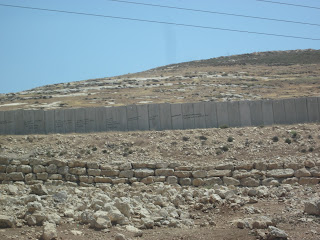
West Bank wall, somewhere between Jericho and Ramallah

“The wall is like a snake,” he says when it first comes into view – ugly, and rather smaller and feebler than I’d expected. “It snakes from village to village, because they want to take a bit from every one along the way.” After a pause, he adds with a laugh, “They’re stupid; they’re caging themselves in. We don’t care!” 

Arafat's and Marwan Barghouti's faces on the Wall

Rawda

Rawda Khouriya is the co-owner and manager of my hotel for the night: the Khouriya Family Guesthouse, a stunning stone villa converted into a bed & breakfast in the village of Jifna, about fifteen minutes north of Ramallah. The Khouriyas are a Christian Palestinian family originally from Taybeh, which readers may know as the hometown of Palestine’s very own Taybeh Beer. Everything about the house reminds me of a Lebanese Christian home, from the ubiquitous pictures of Mary to the bottles of Johnnie Walker Black to the view from the balcony, which could easily be Marjayoun (and, indeed, is only 200km south of it). 

View from the Khouriyas' home
The Khouriyas' villa


We talked a great deal over the course of my stay, about Lebanon as well as Palestine (“The Lebanese,” she said with a gush of admiration. “They really know how to live!” Yes, and how to kill, too, I replied, perhaps unfairly). At a glance, life in Jifna looks wonderful. Even the nearby Jalazun camp for refugees of the 1948 war is heaven on earth compared to the dumps that Palestinians have to live in here in Lebanon. But on closer inspection, the comforts are illusory, even for a well-off family like the Khouriyas.

“Please, when you shower, be quick,” urges Rawda. “Water is very limited here, and we haven’t been able to buy any for two weeks. It’s going to cut off any day now.” She points out the black cartons of water, bought from Israel, that are placed on the roofs of every house in the village. “You won’t see these in the settlements,” she adds with a snort. 

Water cartons on the roofs of Jifna homes
As indeed I did not. And speaking of which, Jifna lies on the outskirts of a certain Beit El, a religious Zionist settlement which was in the news at the time for having been declared partially illegal by the Israeli High Court (a decision that Prime Minister Netanyahu was “not happy” about, but which would ultimately “strengthen the settlement movement” when the homes were moved to another, “legal” part of the same complex). Proximity to a settlement adds numerous difficulties to everyday life, including sudden road closures, harassment, and violence. “Last week [the settlers] stoned four passing cars,” says Rawda. “We don’t dare drive past at night anymore. And if anyone approaches on foot, they shoot.” 

Beit El settlement, near Jifna

I ask her about Hamas; specifically whether as a Christian Palestinian she has conflicting feelings about a strong party that is nevertheless Islamist. “We don’t really think as Christians or as Muslims. Everybody is so sick of the Palestinian Authority; their corruption, their weakness. So people voted for Hamas – yes, even Christians – because we thought they were different, that they had integrity. But now, it looks like they’re all the same.”

And I ask her that clichéd, but necessary question: what’s the solution?

“64 years is enough. We can’t take anymore. Khalas [enough], you take Haifa, take the beach, take everything that’s nice, but leave us this. We don’t need a new settlement appearing every month. Let us live in our part, let us move around, don’t make us drive for hours when it should take twenty minutes. You can have your land, we can have ours, and we can visit each other. But let us share it as equals, not with one above the other.”

Jan

Jan is not someone I expected to meet in the West Bank. A Dutchman in his fifties or perhaps early sixties, he is not a journalist, nor an activist, nor really a political person of any kind. He is, in fact, a stamp collector. His dream is to own all of the 82 varieties of Palestinian stamps that have been issued since 1994. Within minutes of us meeting he is pulling out entire sheets of them, each bearing a slight variation on the classic Arafat portrait. This is apparently a business. “You know how much these are worth? $600,” he smiles. “I’m holding $600 in my hands. And this is nothing!”

Over arguileh at the Jifna village club that night (Jan is also staying at the Khouriyas’), I learn a bit more about why Jan is really in Palestine. It transpires that he once lived for three years in Israel, during the 1970s. “I’m not a Jew,” he says (not that I asked or would have minded), “but I was married to an Israeli girl at the time.

“I was always being told by Israelis of the urgent need to kick all the Arabs out, how the only good Arab was a dead Arab, and so on. This was the norm. It converted me, to put it bluntly, from being pro- to anti-Israel.”

He complains of the overwhelmingly prevalent pro-Israel bias back in Holland (which he credits to the still-seeping scars of the Nazi occupation). “When I tell friends I’m going to Palestine, they become hysterical. ‘Don’t you know how dangerous it is? They’ll stab you, they’ll rob you, they’re terrorists for God’s sake!’ All I can do is laugh. I’ve never felt safer or more welcome than I do here in Jifna.” Indeed, as we sit outdoors among twenty or so locals watching the Euro championship, the only conceivable source of anxiety is the verbosity of the commentator. (Rawda, too, had complained with great bitterness of the tired and stupid “terrorist” line, which belongs in the same intellectual dustbin as the The Protocols of the Elders of Zion.)

There is a charming sort of innocence to Jan, which emboldens him to do things few others would. In Hebron, he says, he approached the sealed Jewish quarter (or “clean zone”, in the settlers’ parlance) with an Arab friend. “Can we go in?” he asked the soldier in Hebrew. “You can, but he can’t.”

“Doesn’t it make you feel strange,” Jan then asked, “that in front of you are two human beings, and you’re telling one that he can come in and the other that he can’t?” 

“Such is life,” was the soldier’s reply, though Jan insists he detected a glimmer of unease. “At the end of the day, it’s his job, what else could he do? But I’m convinced I made him think a little.”

Before calling it a night, I ask Jan too what the solution is. “Nothing that can be done overnight. But in the long run, I’d say what’s needed above all is the education of women. Educated women will raise their sons not to be extremists, not to continue the endless cycle of revenge. It’s actually an idea I read about in ‘I Shall Not Hate’, the memoir of a Palestinian doctor whose three daughters were killed by Israeli tank shells. It was the cleverest idea that I’d heard, personally. But it will take generations.”

Ramallah

There’s an energy in Ramallah quite unlike that of any city I’ve seen. With its winsome stone buildings, built around cobbled churches and mosques in the hills on the outskirts of Jerusalem, in other circumstances it might have just been a picturesque escape from the crowds of the Old City. Things, however, worked out rather differently, with the result that Ramallah today is a city galvanized by politics. There isn’t a square inch of al-Manara, the city centre, that doesn’t host a poster, a flag, a sticker or graffiti. Parts of Beirut are like this, but Beirut is a city of internal disagreement; of fragmentation and factionalisation. In Ramallah, there is that rare, spiriting feeling of single-minded purpose. 


al-Manara, Ramallah city centre

Tribute to Vittorio Arrigoni, Italian activist killed by Islamists in Gaza

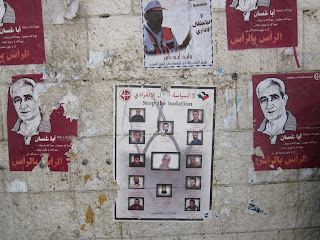
Posters protesting administrative detentions of Palestinians in Israeli jails

And that purpose – much as I detest the word and all its abuse and misuse around the Arab world – can only be described as resistance. Not the lugubrious, murderous, religion-soaked pseudo-resistance of a Bin Laden or a Khomeini. On the walls of Ramallah there is colour, there is humour, there is a celebration rather than a negation of humanity. Like Beirut, Ramallah is a city of both Christians and Muslims, but unlike Beirut, the posters in Ramallah don’t distinguish between Christian and Muslim slogans and heroes. “Ramallah does not know creeds and factions,” wrote the poet Mourid Barghouti in ‘I Saw Ramallah’. I snorted when I read it – living in Lebanon will do that to you – but now I believe I was wrong to do so. 

Barghouti’s equivalence

I could write more: about the Wall, about Bir Zeit, about driving to the Green Line and the settlements every fifteen minutes along the way. But as I said, this is not a travel piece, so I’ll close instead with the following.

In I Saw Ramallah, Barghouti makes a seemingly straightforward observation as he prepares to enter his country of birth for the first time in thirty years. “There is no topological difference between this Jordanian land that I stand on and that Palestinian land on the other side of the bridge.”

Those of us fortunate enough to have been able to verify this, and to have descended into the Jordan Valley from both the eastern and western directions, will agree that the two sides are indeed nearly mirror images of one another. Anyone who has stared from Jordan across those agricultural plains, or the Dead Sea, at the peaks of Palestine on the horizon knows well enough what the peaks of Jordan look like when viewed from the other side.

It was this juxtaposition, or equivalence, of Barghouti’s that flashed to my mind as I crossed the King Hussein Bridge from Jordan myself, and saw all over again the unfolding of the apparatus of occupation. In particular, it was the sight of a young, pale blonde girl ordering a veiled Palestinian woman to queue that brought it on. Never before was the utter, radical abnormality of the Zionist project so plain to me. Consider, I thought, how Lebanese women look, how Syrian women look, how Jordanian women look. Consider how Palestinian women look. Now look again at that blonde hair, that white skin. Can there really be a dispute as to which one is the native around here?

Tuesday, September 20, 2011

Only Gulf Arabs can deliver a Palestinian state


President Obama’s promise to veto the Palestinian bid for United Nations membership this week was as predictable as it was despicable. Nobody pretends that Security Council recognition can bring tangible relief from the humiliation of life under occupation – still less anything like ‘a lasting peace’ – but even if its significance were to be chiefly ‘symbolic’ (the journalistic mot du jour), that doesn’t seem good reason in itself to oppose it. To recognise the right of Palestinians to a sovereign state on the territories captured from them in 1967 would be a first step in redressing the defining injustice of the post-WWII era, as well as restoring a modicum of dignity to a people who for three generations have known only betrayal and abuse. It would, in other words, have been a matter of elementary moral principle. But if Obama has shown one trait since assuming the Presidency it is an appalling lack of principle. He’s already used his veto, after all, to kill a Security Council resolution merely condemning settlement construction – this despite his saying in Cairo in 2009 that, “The United States does not accept the legitimacy of continued Israeli settlements”. When Netanyahu refused to extend a 90-day pause in the expropriation of Palestinian land - a pause that was anyway never honoured to begin with – Obama didn’t just fail to punish him. He spinelessly arranged, along with his promiscuously unprincipled Secretary of State, for a sordid bribe of $3 billion to be slipped inside Netanyahu’s palm, only to have the spoilt brat slam the door in his face. Apparently not yet insulted enough, in his most recent speech on the Middle East in May of this year, Obama became the first American president to publicly refer to Israel as a “Jewish state”, thus simultaneously erasing what the Israeli historian Ilan Pappé called the ‘forgotten Palestinians’ - the 1.2 million Arab citizens of Israel itself - as well as undermining the Israeli moderate majority who understand that a “Jewish state” cannot also be a democratic one, and who have every intention of living in the latter as opposed to the former. He has, in short, presided over the most ardently Zionist American administration on either side of the aisle in recent history (who now remembers a furious George H. W. Bush withholding $10 billion in loan guarantees from the Irgun thug Yitzhak Shamir in response to renewed settlement expansion?). 

As a Westerner living in the Arab world, the question I get asked perhaps more than any other when the subject of Israel comes up is why – why does the American government continue to so unshakeably and unashamedly stand by a regime that colonises its neighbours’ lands and persecutes its ethnic minorities and has a consistent and meticulously-documented record of launching merciless assaults on civilian infrastructure both inside and outside its borders that often, if not always, implicate it in war crimes and crimes against humanity? As resolutely as one must combat all stupid and loathsome innuendo about clandestine ‘Jewish cabals’ usurping world government, for every answer I suggest to them (historic Cold War alliance; supposed shared ‘Judeo-Christian values’; common Islamist enemy; mistaken view of Israel as democracy; misplaced belief in Israeli ‘purity of arms’; etc.) it remains a simple fact that a well-financed and well-organised group of Israel’s supporters continues to command substantial influence over American policy. The Israel Lobby (it’s emphatically not the ‘Jewish lobby’, since a sizeable chunk of its constituents are in fact messianic Christians, who see in the ethnic cleansing of Palestine a portent of the Second Coming of Christ) doesn’t have quite the stranglehold on the Pentagon imagined by some of its critics – for instance, in their 2007 book The Israel Lobby and US Foreign Policy, Professors John Mearsheimer and Stephen Walt write that for “fifteen years, Israel and the lobby have pushed the United States to [use] military force to destroy Iran’s nuclear facilities” (p. 282), and yet it was not to Iran but Iraq that the Bush administration turned its guns when the ‘war on terror’ was declared – but at least so far as the Holy Land is concerned, the American Israel Public Affairs Committee (AIPAC) and its affiliates are capable of making life very difficult for anyone in Washington who takes a line other than their own (see, for example, this piece by MJ Rosenberg, the foreign policy writer who has worked for both AIPAC and the US Senate). Put simply, the strategic benefits of siding with ‘the lobby’ are many, while the costs are as good as nil.

Which raises the question of why there is no equal and opposite ‘Arab lobby’ feared and revered in the same way. After all, the application of Arab ‘leverage’ on Washington is not without historical precedent. In 1973, after the Nixon administration bolstered the Israeli military during the October War, the Organisation of Arab Petroleum Exporting Countries placed an oil embargo on the USA and implemented production cuts that swiftly quadrupled the global crude price and ended up costing America “some $48.5 billion in 1974 alone (equal to roughly $140 billion in 2000 prices), due to higher petroleum costs and an estimated 2 percent reduction in GDP” (Mearsheimer and Walt, p. 54). 

The embargo was eventually called off (at the request of Anwar Sadat), but its effects were sufficiently punitive that, nine years later, the mere threat of its resumption was enough to prompt action. In Robert Fisk’s Pity the Nation, he describes how, when it became apparent that Israel’s steamrolling of Lebanon in 1982 was to be taken as far as Beirut,

King Fahd of Saudi Arabia warned that his country would withdraw all its investments from the United States at once and impose oil sanctions against the West within hours if the Israeli army was not brought under control. Reagan was at last made aware of the gravity of the crisis and Haig – who has always denied that he gave Israel a ‘green light’ – resigned. (pp. 268-29)

Sure enough, a ceasefire was obtained - even if, in the end, Reagan was unable to prevent Menachim Begin from his carpet bombing of Beirut. 

Next year, Obama will seek re-election in a contest that everybody agrees will be decided by economic credentials. If Saudi – or any of the oleaginous Gulf states, for that matter – had any interest in securing a Palestinian state at the UN, mightn’t they seek to exploit this nontrivial fact? Brent Crude prices have already breached the $100 mark again for the first time since the vertiginous days of 2008. Isn’t it possible that the prospect of a nudge in the upward direction might give Obama some pause for thought? Even if it’s true that the ‘oil weapon’ would no longer be as destructive today as it was in ’73, there are other potential arrows in the Arab quiver. How keen would Obama be, for example, on Saudi dumping its nearly $500 billion holdings of US debt two months after the country lost its AAA credit rating? To what extent would he be pleased to hear that, say, the Abu Dhabi Investment Authority, whose assets have been conservatively estimated at $340 billion, was exiting its American real estate and equity positions (including the 5% of Citigroup it generously bought at the height of the credit crisis) to pursue new opportunities in, I don’t know, China? 

As it happens, some influential Gulf Arabs have caught on to the simple force of such considerations, and have hinted at a resurgence of the Arab lobby of bygone days. Turki al-Faisal, a Saudi prince and former ambassador to the US, wrote in June in an op-ed in the Washington Post that 

In September, the kingdom will use its considerable diplomatic might to support the Palestinians in their quest for international recognition. American leaders have long called Israel an “indispensable” ally. They will soon learn that there are other players in the region — not least the Arab street — who are as, if not more, “indispensable.”

As he elaborated:

There will be disastrous consequences for U.S.-Saudi relations if the United States vetoes U.N. recognition of a Palestinian state. It would mark a nadir in the decades-long relationship as well as irrevocably damage the Israeli-Palestinian peace process and America’s reputation among Arab nations. The ideological distance between the Muslim world and the West in general would widen — and opportunities for friendship and cooperation between the two could vanish.

This was a theme repeated in a New York Times op-ed earlier this month, in which al-Faisal warned that a veto at the UN would mean that 

Saudi Arabia would no longer be able to cooperate with America in the same way it historically has. With most of the Arab world in upheaval, the “special relationship” between Saudi Arabia and the United States would increasingly be seen as toxic by the vast majority of Arabs and Muslims, who demand justice for the Palestinian people.

How did we get to here? If it’s nauseating to be lectured on “justice” by a senior emissary of a monarchical Wahhabi police state that is itself crushing the democratic aspirations of Bahrainis this very minute (we can be sure that if the Palestinians were Shia, there would be no lofty talk from Riyadh about their “quest” for freedom), then it’s a mark of how contemptible the 2009 Nobel Peace Laureate’s handling of ‘the Conflict’ has been that such an unsavoury character can appear genuinely courageous and principled next to him. For Christ’s sake, you know you’ve lost your way when you make the Saudis look good. Yet as long as Obama continues to consign the ‘peace process’ to the cemetery, it will remain the case that only Gulf Arabs have the power to deliver a Palestinian state. May they do so with all speed.

Thursday, July 14, 2011

The joke of Israeli democracy

There isn’t an educated person today who hasn’t heard it before: Israel is ‘the only democracy in the Middle East’; the ‘vanguard’ of freedom against tyranny; an ‘island of enlightenment’ imperilled on all fronts by a malevolent ‘sea of backwardness’. It’s a line that goes right back to Theodor Herzl’s 1896 pamphlet, Der Judenstaat, in which he envisaged a future Jewish State as “a rampart of Europe against Asia, an outpost of civilization as opposed to barbarism”*. And it’s invariably the trope of choice whenever the Israeli government embarks on a PR exercise: here is Prime Minister Netanyahu addressing his sponsors in the US Congress in May of this year:

In an unstable Middle East, Israel is the one anchor of stability.

[America and Israel] stand together to defend democracy. We stand together to advance peace.

[I]n our free societies you can have protests. You can’t have these protests in the farcical parliaments in Tehran or in Tripoli. This is real democracy.

Israel has always embraced [liberty] in a Middle East that has long rejected it.

George Eliot predicted over a century ago that once established the Jewish state – here’s what she said, “The Jewish state will shine like a bright star of freedom amid the despotisms of the East.”

You don’t need to export democracy to Israel. We’ve already got it.

The passing by the Knesset this Monday of the Boycott Prohibition Law was merely the latest iteration of the Israeli government’s long-established tradition of unwittingly discrediting its own propaganda. For those who missed it, the law makes it a criminal offence for organisations and even individuals to boycott Israeli settlements in the West Bank. These settlements, of course, are illegal under international law, and thus it is incumbent on all Israeli citizens to oppose them by all peaceful and democratic means. Under a government that has shown itself vehemently opposed even to freezing the settlements, let alone dismantling them, boycotting is one of the few available non-violent options. This law, therefore, does not merely “subvert Israeli democracy”, as an editorial in Monday’s Haaretz proclaimed (as usual, one finds far more courage and principle from Israeli journalists than from their craven American counterparts: even the right-wing, pro-occupation Jerusalem Post published a critical editorial) - it actually makes it a crime for the Israeli citizen to abide by international law. 

Yet, as I say, this is by no means the only frontal assault on democracy in Israel in recent memory. In June, Haaretz reported the story of Lucas Koerner, a 19-year-old American college student who was violently arrested in Jerusalem and jailed for two days for protesting outside the Old City. A video featured in the online version of the article (and now viewed by over 345,000 people on YouTube) showed the plainly non-violent teenager, wearing both a kippa and a keffiyeh, speaking eloquently of the “completely unjustified and ethically reprehensible” occupation before being confronted by Israeli police (who, one mustn’t forget, have no right under the 1967 borders to be in East Jerusalem in the first place). After he refuses to hand over his passport, we see him being shoved to the ground and roughly manhandled into a nearby police car. Legal considerations aside, this seems a remarkably ungrateful way for the Israelis to repay their American patrons for the $3bn in aid they annually receive. Imagine the same had happened to a blue-eyed boy in Pakistan! Would the State Department have thought that unworthy of comment too? What does Alan Dershowitz, the Felix Frankfurter Professor of Law at Harvard, author of The Case for Israel and self-styled ‘civil libertarian’, have to say about his tax dollars being spent beating up Jewish American kids?

Sticking for the moment just to free speech in Israel (which Dershowitz describes in his book as “complete”**), it might be worth mentioning the case of Uri Blau, the Haaretz journalist who fled to London in 2010 for fear of arrest after exposing the assassination by the IDF of two suspected Palestinian militants in contravention of a ruling of Israel’s own Supreme Court. So apparently embarrassing was the report that the government placed a gagging order silencing all mention of it in the Israeli media. It’s one thing for media organisations to censor themselves – as almost every Western newspaper and television network did, to their everlasting shame, at the time of the Jyllands-Posten Muhammad cartoons. But for the government itself to intervene is sheer totalitarianism – exactly of the sort, as it happens, that one might encounter in Tehran and Tripoli.

And then there was the Nakba Bill, passed in March, which forbids state funds from being used to commemorate the nakba, or ‘catastrophe’, as Arabs describe their defeat and ejection from Palestine in 1948. I happen to think there’s a good case for the prohibition of spending public money on any such event – the day cannot come soon enough that, say, British monarchs start paying for their own damned weddings, or Popes for their own insulting public parades – but so long as state funds continue to be deployed in celebration of the Israeli Independence Day (which is, after all, the same nakba seen through the victors’ eyes) there is a plainly undemocratic double standard which serves only to Judaise the national historical narrative.

Which brings me to the plethora of similar Judaisation programmes, many of which would be roundly denounced as broad-daylight bigotry if enacted elsewhere. Last October, Netanyahu’s Cabinet approved an amendment requiring those seeking naturalisation as Israeli citizens to pledge loyalty to a “Jewish and democratic state”, a deeply sinister initiative, not inaccurately compared by the Israeli academic Prof. Gavriel Solomon to the Nuremberg Laws in Nazi Germany. Leaving aside the question of whether a state defined by an ethnicity or religion can ever be “democratic” (and here one thinks wearily of the ‘Islamic Republics’ of Iran and Pakistan), a fundamental principle of freedom is violated when citizens are required to pledge servility to their governments, rather than the other way around (the term ‘public servant’ did not enter our language by accident).

Or how about the Law of Return, which grants any Jew - defined as “a person who was born of a Jewish mother or has become converted to Judaism and who is not a member of another religion” - the automatic right to Israeli citizenship? This official, undisguised discrimination on the basis of religion is quite clearly anti-democratic by definition: just try to picture the reaction if the United States were to offer instant green cards for all Jewish converts to Christianity. Moreover, as the Palestinians are famously denied their own right of return, the result is the absurd situation that an Arab refugee born in Jaffa or Jerusalem cannot return to his house – even if he still holds the British or Ottoman era title deeds to it, as many do*** – while an American born in New Jersey can immigrate tomorrow as long as his mother never gathered figs on the Sabbath. 

A related injustice concerns the ownership of land. As Haaretz explained in an article bluntly titled, ‘Most Arabs can’t buy most homes in West Jerusalem’, in practice, 93% of Israeli land is not privately owned, but rather leased on a long-term basis from the Israel Lands Administration. This would be uncontroversial – the London real estate market works in much the same way – if it weren’t for Article 19 of the ILA lease, which stipulates that land may not be leased to foreign nationals, except those “[eligible] to immigrate to Israel in accordance with the Law of Return”; i.e. Jews. Since many Palestinians living in Israel do not have full citizenship, they are legally confined to living in just 7% of the country – unless, that is, they convert to Judaism or pledge allegiance to a “Jewish and democratic state”! Once again I invite you to imagine an America in which Jews were forbidden by law from living in Christian neighbourhoods. Why, I dare say Abraham Foxman might go as far as to call it anti-Semitic...

I could go on, but I imagine by now the reader has got the drift. And I’m wary of losing an important sense of perspective. Israel is still undoubtedly the best place in the Middle East to be a woman or a homosexual (even if women cannot divorce without their husband’s consent, and same-sex marriage is illegal), and the fact that most of the incriminating evidence in the foregoing is freely available in the Israeli public domain is indeed to the country’s great credit. But such achievements are merely minimum requirements for a democracy: the necessary but far from sufficient conditions. As long as the Israeli government continues to illegally occupy the territories of Arab peoples outside its borders; to ghettoise and persecute the Arab minority within its borders; and to clasp ever tighter at the bruised throat of free expression, then it forfeits its right to sit at the table of free nations, and its claim to be democratic is little more than a bad joke.

* Herzl, T., The Jewish State (1896), p. 96, as published by Dover Publications, Inc. (1988), based on the American Zionist Emergency Council text (1946)
** Dershowitz, A., The Case for Israel (2003), p. 218
*** See esp. Fisk, R., Pity the Nation: Lebanon at War, Chapter 2: ‘The Keys of Palestine’