Saturday, November 26, 2011

Hizbullah brings Lebanon once more to the brink of collapse


The Lebanese Prime Minister Najib Mikati announced on Thursday that he will resign next week if a Cabinet meeting scheduled for November 30th fails to agree to fund the Special Tribunal for Lebanon, the UN-backed court investigating the 2005 assassination of the Lebanese Prime Minister Rafiq Hariri. Other ministers, such as those of the National Struggle Front, loyal to Walid Jumblatt, now say that they will follow Mikati in that event. These are honourable decisions, not only in their commitment to international law (Article 5.1 of Security Council Resolution 1757, signed and agreed by the Lebanese government in 2007, makes it unequivocal that Lebanon will provide 49 percent of the funding of the STL), but in their obvious justice – how, after all, can one Prime Minister of Lebanon be expected not to endorse the punishment of the murderers of a previous Prime Minister?  

As things stand, twelve of the thirty Cabinet ministers have confirmed they will vote for the funding – six on Mikati’s behalf; three on President Michel Suleiman’s behalf and three on behalf of PSP leader, Walid Jumblatt. Mikati’s task, therefore, is to persuade four more to join his side. This may not be impossible – indeed, An-Nahar has cited “informed sources” as saying that as many as five more will “most likely” vote with him (from the Tashnag, Marada and Lebanese Democratic Party seats) – but there are reasons to be pessimistic. Hizbullah, the most powerful faction in Lebanese politics despite having only two official seats in the Cabinet, has repeatedly denounced the entire tribunal as an American-Zionist conspiracy, a position that its Minister of State, Mohammad Fneish, described on Thursday as unchanged. And Michael Aoun, whose Free Patriotic Movement commands seven seats, has promulgated the absurd falsehood that Lebanon isn’t even legally bound to pay its share of the funding in the first place. These are forces against which the undecided members of Cabinet will not act without reluctance. 

If, then, the majority votes against funding, and Mikati keeps his word and resigns, the Lebanese government will once again cease to exist, and once again it will be the people who pay the price. According to “ministerial sources” quoted in the Daily Star, “it will be difficult if not impossible to form a new government” after this one, meaning that that price could be very extortionate indeed. The irony that this ‘March 8’ coalition was brought down for the same reason, by the same party, that felled its ‘March 14’ predecessor is one that should not be missed by the Lebanese people, who will have to suffer all over again for that party’s arrogant intransigence. For if the Cabinet puts its interests before the country’s and votes ‘no’, will it ever have been plainer that there cannot be a Lebanese government so long as there is a boneheaded gang called Hizbullah pulling the strings? A militia that exploits its illegal arsenal to negate the country’s obligations under international law; to insult the sovereignty of the national army; to recklessly endanger the lives of Lebanese civilians with its unilateral attacks on Israel; to force Islamic law on drink merchants in the south; and to show nothing but loathing and contempt for the democratic process in general? In a week that has seen their brothers and sisters in Egypt, Syria and Bahrain escalate their courageous struggle for liberation, it’s high time the Lebanese reassessed their devotion to the Mubaraks, Assads and Khalifas amongst their own purported ‘leadership’.

Thursday, November 24, 2011

Jeffrey Goldberg enables extremists by denial of Israel's theocracy

Reviewing the Israeli historian Gershom Gorenberg’s new book, The Unmaking of Israel, in last week’s New York Times, the Atlantic columnist and author Jeffrey Goldberg took care to get his apology in early for the mild criticism he was about to make of the Israeli settler movement, beginning by saying:

Let me list, at the outset, the many things that the diminutive but disproportionately interesting state of Israel is not [...] Israel is not a fascist state, nor is it a theocracy nor, for that matter, is it a fascist theocracy.

Leave to one side the redundancy of those last nine words, and put off for another day the question of Israeli fascism, which is in any case not an easy term to define. What is most inadmissible about this sentence is the way it denies the perennial and impermeable divide within Israeli society about the religious character of the state, and by extension undermines the millions of secular Israelis who have to fight every day – not always with much success – to repel the swelling tides of the ultra-Orthodox right wing. As Goldberg knows well, having lived in Israel himself, the suggestion that the Israeli legem terrae is free from religious interference might assuage the anxieties of Zionists in America, but it would meet with ridicule from Israeli Jews – to say nothing, of course, about Israeli Arabs.

The briefest glance at the headlines of Haaretz, Israel’s best-known Anglophone newspaper, suffices to make the point. ‘New rabbinical courts will lead to oppression of women’, read an editorial this week, condemning a move to reduce women’s rights in the country’s powerful religious courts (the mere existence of which provokes some curiosity, does it not?). ‘Fighting to make Israel into a military theocracy’ went another one earlier in the month, explaining how “the hesder yeshivas, which combine army service with Torah study, were making a concerted effort – in conjunction with the IDF rabbinate – to create a theocratic military culture”. Just substitute the words ‘Torah’ and ‘IDF rabbinate’ with ‘Qur’an’ and ‘Ayatollahs’, and try to imagine Goldberg coolly assuring New York liberals that this was a secular state of affairs. A similar editorial in June, ‘Israel needs to keep religion out of the army’, lamented that Israel was “turning from a secular country into a theocracy in which the rabbis set the rules”. 

Lengthy indeed would be the task of listing all the ways in which this phenomenon is occurring. I shall restrict myself, therefore, to just three examples of what are unequivocally theocratic characteristics of the Israeli state. 

Firstly, there are separate courts for religious and secular matters. Arbiters in the battei din, or religious courts, are rabbis, and the law applied is the halakha, or Jewish law, derived from the Torah and the Talmud. This is no different in principle from the situation in Saudi Arabia, which also divides jurisdiction between civil and religious courts, the latter of which uphold the shari’a, or Islamic law, derived from the Qur’an and the Hadith. (If Goldberg believes the Kingdom to be a secular country, I’m not aware of his having said so.) In Israel, the battei din are invested with substantial power, including total control over marriage – as in Saudi, there is no civil marriage in Israel, meaning that non-believing citizens must travel abroad to tie the knot – and divorce. In addition, there exist in Israel de facto supplementary religious courts, such as the Takana, which handles crimes committed by the clergy and, not unlike the Vatican, tends to prefer to keep things ‘within the family’ where possible. As the Haaretz columnist Gideon Levy put it:

A high school teacher at a secular school who sexually assaults his students would be turned over to the police. A rabbi at a yeshiva [religious school] suspected of the same thing would be turned over to Takana. Perish any connection between them, but the criminal underworld also has its own judicial system with the means to investigate and punish. In that respect, there is no difference between the underworld and Takana.

Secondly, the laws concerning immigration are explicitly religious in both letter and spirit. The text of the amended ‘Law of Return 5730-1970’ defines a “Jew” as “a person who was born of a Jewish mother or has become converted to Judaism and who is not a member of another religion”, and grants any such person the automatic right to citizenship. This definition, as the great Israeli polymath Israel Shahak noted in his seminal Jewish History, Jewish Religion, comes directly from the halakha, being:

[T]he Talmudic definition of ‘who is a Jew’, a definition followed by Jewish Orthodoxy. The Talmud and post-Talmudic rabbinic law also recognise the conversion of a non-Jew to Judaism (as well as the purchase of a non-Jewish slave by a Jew followed by a different kind of conversion) as a method of becoming Jewish, provided that the conversion is performed by authorised rabbis in a proper manner. This ‘proper manner’ entails, for females, their inspection by three rabbis while naked in a ‘bath of purification’, a ritual which, although notorious to all readers of the Hebrew press, is not often mentioned by the English media in spite of its undoubted interest for certain readers.1

One assumes that Goldberg would be less than thrilled if Congress passed a law granting instant green cards for all Jewish converts to Christianity, and indeed Levy has argued that the Israeli legislation amounts not only to theocracy but to racism as well:

It's time to admit that this approach can only be called racist. Yes, that hackneyed term. That's what it is when it is the blood flowing through the veins that determines your status. If the grandson of a woman whose Judaism is doubtful has the right to automatic citizenship when he arrives here from the ends of the earth, and a non-Jewish soldier who chose to fight and live here runs into rabbinic obstacles, then this is not just judgment by religious law, but judgment by racist law. If the Arab native is an outcast, but a member of the "Tribe of Menasseh" from Burma is welcomed with full rights simply because a rabbi said he was Jewish, then this is a benighted theocracy.

Thirdly, and most gravely, as Goldberg no doubt recalls from his own stint in the IDF, the laws concerning military service are different for secular and religious Israelis. In their indispensable book, Jewish Fundamentalism in Israel, Shahak and Norton Mezvinsky draw attention to the frightening world of the hesder yeshivot, the religious corps, who serve not for three years, as do other soldiers, but for eighteen months, divided into three six-month periods, in between which they “leave the army for a six-month period of talmudic study in a yeshiva wherein the presumably negative influences of having met secular Jewish soldiers are supposedly countered”2. As might be expected, the scheme of training religious fanatics in the use of state-of-the-art military equipment is not without its demerits. They elucidate:

Soldiers in Hesder Yeshivot units [...] distinguished themselves during the suppression of the Intifada; they were noted for their cruelty to Palestinians, which was from many perspectives much more severe than the Israeli army average [...] When the army commanding officers have wanted to inflict especially cruel punishment upon Palestinians or others, they have most often relied upon and used religious soldiers. In more ordinary companies, consisting of soldiers holding varying political views, some members might object to illegal cruelty and even inform media people of its use. In Hesder Yeshivot units the religious soldiers, who are anyway more cruel than most secular Jews, will not object to the orders.3

A perpetually baffling fact of American writing on Israel is how markedly it differs from its Israeli counterpart. The works of Israelis like Shahak and Levy are infused with everything the intellectual descendents of Thomas Jefferson should celebrate: unswerving commitment to reason, democracy and secularism, undergirded by a visceral contempt for injustice. Why then is their voice so persistently ignored? One of the things that has to happen in order for there to be peace in Israel is that, in the battle for the national identity, the secularists must win and the theocrats must lose (the same must happen, incidentally, on the eastern side of Jerusalem). By denying that such a battle is being waged in the first place, Goldberg only further isolates the secular camp and clears the path for the Liebermans and Lubavitchers. Let us hope that Israelis – and their sponsors in America – have more sense than to listen to him.

1 Shahak, I., Jewish History, Jewish Religion (4th edition, 2008), p. 5
2 Shahak, I., and Mezvinsky, N., Jewish Fundamentalism in Israel (2nd edition, 2004), p. 91
3 Ibid.

Sunday, November 20, 2011

Istanbul, graveyard of empires


That the description of being ‘where east meets west’ is applied to so many cities – ranging as vastly in look and location as from Sarajevo to Singapore – is of course an indictment of its essential vapidity. But to the extent that it's true of any city, it is surely truest of Istanbul, that ancient imperial capital with its spinal Bosphorus river across which the lands of Europe and Asia are quite literally ‘bridged’. In this distinction – of being a single city adjoining two continents – Istanbul is unique. Less trivially, and not coincidentally, it has the further unique distinction of being the former seat of four epochal empires – Roman; Byzantine; Latin; and Ottoman – making it in effect the global centre of power for more than 1,500 consecutive years. That these empires (as we sometimes forget) were officially faith-based gives the city the additional distinction of being the only former capital of both Christendom and the Islamic caliphate. And finally, in its latest form within the borders of modern Turkey, its people were the first in history to have thrown out the Islamic shari’a in favour of a secular constitution. 

The city today bears the stamp of each of these origins, if in different ways and to uncertain extents. To take them broadly in order, the ‘European’ cloth of the tapestry is evident from the moment one steps into Atatürk International, which flexes the bulk and polish of a Schiphol or a Gatwick without the gilded glitz of, say, a Dubai. On the roads, the restraint and consideration shown to fellow drivers are truly foreign to anyone accustomed to the Middle East, as is the thoughtfully built and efficiently run public transportation system. The food, on the other hand, is unmistakeably ‘Asian’, as the faintest whiff of the Eminönü Spice Bazaar will confirm. Indeed, much of what is now eaten in the Arab world descends from traditional Ottoman cuisine: from the döner (shawarma in Arabic) and the şiş kebap (shish kabab) to the baklava sweets (baqlawa) and more (the Arabs were able to return the favour with their lahm b’ajin, the meat pastry now rendered in Turkish as lahmacun). In terms of dress, there’s been a good deal of cross-pollination, with about as many heels and skirts as headscarves and skull caps (on which more later). Perhaps above all else, it’s in the language that the cultural DNA is most nakedly revealed: distinctly Balkan to the ear, the vocabulary is nevertheless replete with loanwords not only from Arabic and Persian (including the most basic of all, merhaba, from the Arabic marhaba) but also from the West (one purchases a jeton to ride the tram, for instance). These adopted words persist despite attempts since the formation of the Republic in the 1920s to replace them with ‘purer’ Turkish equivalents – an initiative that also brought about the enforced Latinisation of the old Ottoman script. As we shall see, this is not the only way in which the Turks have not entirely taken to the ‘Reforms’ imposed by Atatürk. 

In the 4th century AD, around the same time that Constantine ‘The Great’ was making Christianity the state religion of the Roman empire, the need was felt for a new capital east of Rome to address the vast territorial gains made in that direction. It was decided that the strategically-located city then known as Byzantion best met the requirements, and what was to become Constantinople was in fact briefly named Nea Roma, or ‘New Rome’. Much of the city as it was then remains visible in the Sultanahmet district of Istanbul today, from the Hippodrome with the surviving section of the Serpent Column to the Basilica Cistern now lying beneath Yerebatan Street. But the most striking creation of what became the Eastern Roman, or Byzantine, empire was the Hagia Sophia cathedral completed in the 6th century during the reign of the emperor Justinian. 
Egyptian obelisk in the Hippodrome

Basilica Cistern

Hagia Sophia/Ayasofya 'Museum'


This magnificent building - whose signature dome would inspire the Sultanahmet and Süleymaniye mosques a thousand years later, and which was in fact itself later converted into a mosque by Sultan Mehmet II - was by far the largest of its kind worldwide; a record it held for nine centuries until the building of the Saint Mary cathedral in Seville. After five hundred years as the ‘Ayasofya’ mosque, it was eventually stripped of its religious status by Atatürk and is today strictly referred to as a ‘museum’, much to the fury of fundamentalist Christians and Muslims alike.

Indeed, the ‘museum’ is nothing if not a damning testament to religious hatred and tyranny. Repeatedly sacked and pillaged throughout its existence – by the Islamic invaders but more devastatingly by the Catholic Crusaders (whose loathing of the Orthodox Church is still very much alive in eastern Europe today) – it’s a wonder the thing still stands at all. In addition to the four minarets added to the exterior by the Ottomans, inside one finds Islamic calligraphy on great black discs crudely affixed like cheap stickers to the walls, in places just metres from the original Christian mosaics. And the mosaics themselves tell a sordid story of their own; many of them depicting Christ and Mary shoulder to shoulder with Constantine and Justinian – brazen attempts to deify the emperors and thus render themselves, and their authority, infallible. That the Byzantine empire turned out to be very much fallible, and that it was an orgy of violence and despotism while it lasted, is a lesson in humility that far too few religions appear to have learned (not least of them Catholicism, which actually does still use the word ‘infallible’ in official descriptions of the pope).

Inside the Hagia Sophia/Ayasofya

Christian mosaics behind Islamic calligraphy
From left to right: Constantine, Mary, Jesus, Justinian


Of course, Atatürk couldn’t convert every house of worship into a museum, and the two most marvellous mosques still in use – the Sultanahmet, or ‘Blue’ one to the east of the Hippodrome; and the Süleymaniye one further to the west – have generously been made open to the public free of charge (entrance to the Hagia Sophia/Ayasofya costs 20 TL, or $11). These skyline-defining structures, exquisitely sculpted of marble and granite, are examples not only of the egos of the Sultans Ahmet and Süleyman (‘The Magnificent’) but also of the genius of the architect Mimar Sinan, the ‘Michelangelo of the East’, whose legacy extends from the Tekkiye Mosque in Damascus to the Sokolović Bridge in Bosnia and Herzegovina. Yet perhaps the most interesting relic of the Islamic period is the colossal Topkapi Palace, personal residence of the Sultan and seat of the Ottoman government from the 15th to the 19th centuries. 
Sultanahmet Mosque

Süleymaniye Mosque
Entrance to Topkapi Palace


Built on the ruins of the ancient Great Palace of Constantinople, the grounds of what we now call the Topkapi Palace Museum - which effectively comprise an entire borough of the city – are the very height of Ottoman glory and greed; containing not just the old living quarters of the Sultan and his 4,000-strong support staff, but a mosque, a Byzantine church, a library, a treasury, a hospital, a mint, and over a hundred acres of gardens and courtyards. Within these walls can be found an 86-carat diamond; thrones made of solid gold and ebony; emeralds and rubies the size of golf balls; and the most exquisite porcelain of China. One can also find several purported belongings of the Prophet Muhammad, including his swords; his cloak; a tooth and even the individual hairs of his beard (why anyone should want to see these, I couldn’t say). Most famously, one can also find the Harem; the private quarters where the Sultan lived in the company of his hundreds of concubines. These often very young women were bought, donated or simply stolen into slavery and put to whatever use the Sultan desired. A New York Times article elucidates the grotesque way in which the girls were forced to feign interest in their owner and master:

At times up to 300 young women lived here, most of them in tiny cubicles, including four wives, the favorite concubines, the young up-and-coming odalisques. Harem girls were captured in wars or bought as slaves; some were offered by their parents. Russian and Georgian girls were considered great beauties and much in demand. [The Sultan’s] Mother apparently had the first choice and alloted the girls different tasks so that they might or might not be noticed. If you were an odalisque you could try to catch the sultan's eye when you served his coffee or when he called for the girls to parade and perform dances for him. If he offered you his handkerchief, you knew.

One must never forget that this monstrous combination of slavery and rape is wholly licensed by the tenets of Islam. The Qur’an makes repeated reference to slaves as ma malakat aymankum, or ‘what your right hands possess’, e.g., Suras 4:24; 23:5-6; 70:29-35:

And all married women (are forbidden unto you) save those (captives) whom your right hands possess.

[The believers are those] who guard their modesty, save from their wives or the (slaves) that their right hands possess, for then they are not blameworthy.

And those who preserve their chastity, save with their wives and those whom their right hands possess [...] These will dwell in Gardens, honoured.

Muhammad himself had a number of concubines – indeed, the canonical tafsir, or exegesis, of Ibn Kathir tells the illuminating tale of Maria the Copt, the concubine whom Muhammad swore never again to see after his wife Hafsa found the pair of them in bed. “Why bannest thou that which Allah hath made lawful for thee, seeking to please thy wives”? was the Almighty’s contemptuous response (Sura 66:1). Thus the Ottoman Sultans, in consigning thousands of girls to lives of abuse and abjection, were in fact only following the example of their moral and spiritual tutor. 

Which seems as good a reason as any to celebrate the day in 1924 when the inaugural President of the Republic of Turkey put a stop to all that forever, abolishing the caliphate and establishing the first secular country of the former Muslim world. That state would quickly go on to grant equal rights to women in things like education and marriage; outlaw the degrading practice of polygamy; and give its female population the vote long before supposedly enlightened nations such as France and Canada would do the same. The social and economic dividends of these revolutionary steps were suggested by Turkey’s joining of NATO in 1952 (it remains the only Muslim-majority country in the organisation) and its candidacy – recognised in 1999 - for membership of the European Union. 

Today, however, these hard-won gains face a threat that cannot easily be exaggerated. Never entirely accepted by the Turks from the start, over the years Atatürk’s constitution has had to be upheld by a powerful military establishment that can be as ruthless as it needs to be against its enemies, perceived or actual. Or at least that was the case until July of this year, when in an event that went largely unnoticed outside the country – and is still not nearly well enough appreciated - the entire leadership of the armed forces simultaneously resigned. This major and unprecedented move, described by the Milliyet columnist Asli Aydintasbas as “the symbolic moment when the first Turkish republic ends and the second republic begins”, was in response to the arrests of dozens of generals on what may or may not be fabricated charges of plotting to overthrow the government. The man behind all this, of course, is the Prime Minister and top Atatürk-despiser, Recep Tayyip Erdoğan. 

An incredible amount of loose talk has it that Turkey strikes the ideal balance between the secular and the Islamic (when Rachid Ghannouchi’s Ennahda party won last month’s elections in Tunisia, for example, he cited the Turkish “reconciliation between Islam and modernity” as though to negate fears about his own non-secular proclivities). Yet Erdoğan’s entire political career, from the day he joined the now-banned Islamist ‘National Salvation Party’ as a teenager, has been focused on advancing the former at the expense of the latter. 

As the Mayor of Istanbul in the 1990s, elected on the Islamist ‘Welfare Party’ ticket (also now banned), Erdoğan illegalised the sale of alcohol in city-owned establishments. Having presumably been on the military’s hit list for some time, the man describing himself as a “servant of the shari’a was eventually arrested and imprisoned in 1998 for the somewhat ridiculous crime of ‘inciting religious hatred’ for reading a poem at a rally that contained the lines:

The mosques are our barracks, the domes our helmets, the minarets our bayonets and the believers our soldiers.

Since coming to high office in 2003, Erdoğan has, to borrow a phrase used by Patrick Cockburn in another context, done as much harm as he can and as much good as he must. His ‘Justice and Development’ party attempted to criminalise adultery in 2004, a blatantly Islamist move defended by Erdoğan as a question of “human honour”. At a NATO summit in 2009, the Turkish delegation made enemies of everyone in the room when it threatened to veto the appointment of the Danish Prime Minister, Anders Rasmussen, to the post of Secretary-General, on the preposterous and fascistic grounds that he had not censored the publication of the Muhammad cartoons in the Danish media – something the Danish constitution would not have allowed him to do even if he had wanted to. This sinister piece of galling impertinence led the French Foreign Minister to publicly withdraw his support for Turkey’s EU bid. And while Erdoğan has become something of a hero in the Arab world for (rightly) standing up to the Israelis, his defence of Palestine rests on the insulting notion of it as an ‘Islamic’ territory. Certainly, he seems to mind much less about slaughter and military occupation when the subjects of Armenia, Cyprus or Kurdistan are brought up – not to mention that he’s happy enough in the company of mass-murderers such as Mahmoud Ahmadinejad (“my good friend”) and Omar al-Bashir, whom he defended from the charges brought against him by the International Criminal Court by saying it was “not possible for a Muslim to commit genocide”. 

And then of course there is the drink question. Happily, the ban from the ‘90s has been repealed, but Erdoğan has never been one to give up easily on the imperatives of moral policing. Indeed, for the fruits of the grape and grain he appears to reserve especial distaste. After yet again raising taxes on alcohol in October, his advice for disgruntled drinkers was to “consume less alcohol”, echoing the call he made last year for Turks to eat grapes rather than drink wine. The courts had to get involved in 2007 to block a proposal to create designated “red zones” outside the cities in which alcoholic venues could be quarantined. While I was able to get a glass of raki easily enough in the famously convivial Beyoğlu district, the atmosphere was slightly but perceptibly diminished by the brand new law banning outdoor seating. This of course came after a series of restrictions introduced in January on things like advertising alcohol and the way in which it may be served at events (not for free, and not to anyone younger than 24). That package was to spark one of the most heartening sights of the year: crowds of protesters gathered in city centres across the country, each man and woman equipped with a brimming tumbler of tipple, in what they called a “drinking action” demonstration. To irk the forces of clerical fascism and get jolly drunk in the process is as fine a day’s work as any. 

There are still a lot of Turks, in other words, for whom secularism and individual liberties mean a great deal (there had, after all, been a number of rather larger rallies in 2007, when over a million people took to the streets to protest the presidential nomination of Erdoğan’s ally, Abdullah Gül). Whether they outnumber their more pious compatriots, however, is unclear. Peter Hitchens – a man with whom I very often disagree – made the interesting observation that while in the seriously Islamist country of Iran, the young women have a healthy contempt for the veil, in Turkey a very ugly kind of zealous conservatism appears to have become the fashion:

The Iranian women mock the headscarf as they wear it, pushed as far back as possible on the head, revealing as much bleached-blonde, teased hair as the piety police will allow. 


Their message is: 'The law can make me wear this, but it cannot make me look as if I want to.' The young Turks, by contrast, are saying: 'This is how I want to look, even if the law says I cannot.' For the scarf is banned by law in many universities and in government offices, and they view this ban as a challenge they must defy. 


There is no simpler way of making the point that, while Iran is a secular country with a Muslim government, Turkey is a Muslim country with a secular government. 

If Turkey truly hopes to be a First World nation, it would do well to start taking large strides away from, rather than toward the ideals that have turned life in the great Persian nation into a waking nightmare. And unless it wishes to lose its few remaining secular friends, it will have to come to terms with being the graveyard of the Islamic empire, and not the soil of its rebirth.

Tuesday, November 8, 2011

Why are we ignoring Syrian calls for intervention?


How Bashar must have smiled. In almost the same breath as Anders Rasmussen, the NATO Secretary General, stood for the first time on free Libyan soil to announce “a new chapter” in the country’s history and the withdrawal of the international forces that made the liberation possible, he went out of his way to assure the Syrian dictator that the action taken against his former counterpart was not even to be considered in his case:

NATO has no intention (to intervene) whatsoever. I can completely rule that out.

This conspicuously blunt revelation immediately raises a series of highly nontrivial questions, among them: who on earth are the beneficiaries of this policy, other than the Assad family and its fascistic proxies throughout the region? Why, if the NATO mission in Libya was a success – as the Secretary General clearly believes it was - should it not merit emulating in Syria? Surely Mr Rasmussen cannot mean to imply that a Syrian life is of less consideration than a Libyan one? And by what possible right does he assume this paternal tone of reassurance? To tell the Syrian people that help is not coming, and to suggest that they should be grateful for it too, is to let them down inexpiably as well as to insult them into the bargain. For shame.

‘But the Syrian people don’t want intervention!’ I hear you pontificate. That may indeed be the received wisdom of Western ‘liberalism’, but a glance at the Arabic media reveals something less conveniently straightforward. As the Lebanese al-Akhbar reported on October 29th, the Syrian resistance is far from resolved on the question of intervention, with a significant and swelling faction decided firmly in its favour. The report cites regime opponents such as the journalist Fahd al-Masri and the veteran activist Haitham al-Maleh as examples of those for whom “military intervention is not just a possibility, it is practically a demand”. Indeed, when interviewed by al-Akhbar two weeks previously, al-Maleh put the case for intervention quite squarely:

We have no other option. This regime is forcing the people to resort to this game. The regime is committing two crimes: killing people, and forcing them to seek protection from international organizations. I called on Arab League Secretary-General Nabil al-Arabi to solve the problem via the League. Otherwise, we have no choice but to turn to international organizations. Give us another option!

It isn’t difficult to see his point. For more than nine months, the world has watched as thousands of Syrian men, women and children have been beaten, gassed, gunned and bombed to their deaths for demanding a freer and more dignified existence. All this time, we have heard it said that Bashar is not his father; that Bashar is a reformer; that the solution lies in ‘dialogue’ and ‘patience’. Yet every promise of restraint has been followed only by more exorbitant murder – indeed, last Thursday, the army violated a ceasefire agreed with the Arab League on Wednesday by shelling the city of Homs with tanks, killing dozens. Other commentators have speculated that the regime will eventually collapse due to soldiers defecting, as was the case in Egypt and Libya. Though the number of defections does appear to be rising, a Syrian activist interviewed by NOW Lebanon last Monday complained that the lack of a Benghazi-style breathing space was the crucial difference in Syria:

“Any soldiers [sic] are afraid to defect right now, because there is no safe zone where they can go and organize to fight the regime. Nobody is protecting them. That is why we are asking for the international community to impose a buffer zone or a no-fly zone where these people can organize,” he said.

Again, the logic appears uncomplicated. Why then does the international community ignore these voices? Is it not a matter of elementary principle that, just as we would not impose intervention on an unwilling population, so we would not hesitate to intervene if that population should turn out to be willing?

Quite apart from such lofty moral considerations, need we be reminded of the practical dividends at stake? The dismantling of the Baathist dictatorship, well described by the Lebanese intellectual Samir Kassir as the synthesis of “the corruption of Soviet republics with a Chinese-style closed police state”1 (it was not by coincidence that Kassir was later blown up in his own car), would remove the principal enabler and arms supplier of Hizbullah, the Islamist militia and mafia that keeps a boot to the throat of secularism and democracy in Lebanon. It would remove a crucial ally of the lunatic theocracy in Iran, further isolating the tyrannical Ayatollahs and possibly even galvanising the moderate ‘Green Movement’ that was so ruthlessly steamrolled after the ‘elections’ in 2009. It could bring relief at last to the sizeable and long-repressed Kurdish minority in Syria, who have provided some of the bravest and most determined resistance to the regime in recent months, and who may even be able to attain a form of self-government in a post-Assad Syria, as they’ve done with much success in post-Saddam Iraq. And it would do away with two of the tiresome myths that give Western foreign policy so much undue bad press: namely, that policy is controlled by the oil lobby (since Syria hardly has any); and that policy is controlled by the Israel lobby (since a post-Assad Syria, with an enfranchised Sunni majority, would very probably find a friend in Hamas). It would, in other words, be a declaration of the West’s seriousness with respect to promoting democracy in the Middle East.

To those who state their preference for the ‘stability’ afforded by Assad’s autocracy over the ‘chaos’ that would be unleashed by his removal, one need only ask: what stability? Entire cities in Syria, including Dar’aa, Hama and especially Homs, are already war zones. Warnings that Islamist militants may launch attacks against religious minorities appear to have come too late: such attacks may already be happening, and the sectarian anxieties that fuel them are exacerbated, not relaxed, by the overwhelmingly Alawite character of the regime in general and the Republican Guard in particular (to say nothing of the staunch support voiced for the dictator by the luminaries of other minorities, such as the Syrian Orthodox church and the Maronite Patriarchate). As for fears that intervention will inevitably be followed by an Iraq-style occupation, we now have the precedent of Libya to attest otherwise.

Which isn’t to say that the case for intervention is bulletproof. The point is rather that Syria is facing ‘chaos’ with or without it. And even supposing, for argument’s sake, that a cost-benefit analysis of intervention is inconclusive at the present moment, two things ought to be made abundantly clear to Assad, and indeed all his fellow despots: that intervention will never be ruled out “absolutely”, and that not one second will be wasted in ruling it ‘in’ should the circumstances demand that we do so. 

1 Kassir, S., Being Arab (2006), p. 20

Thursday, October 27, 2011

William Lane Craig is a crackpot and a bigot


‘New Atheism’ – to annex the term glibly used to describe the age-old intellectual movement rooted in the traditions of Lucretius, Socrates, Spinoza and Hume, inter multa alia – has come in for a spot of abuse this week, resulting from the latest round in the battle of egos between Richard Dawkins and the Christian apologist William Lane Craig. I won’t insult my reader by explaining who the former is, but for those unfamiliar with the latter, Craig is something of a hero in the online Christian community, lionised as their most formidable answer to the atheist heavyweights Christopher Hitchens, Sam Harris, Daniel Dennett, et al. – a status enhanced to the point of near-mythology by Dawkins’ repeated refusal to debate him. 

Previously, Dawkins explained this refusal on the grounds that he does not, as a matter of policy, debate “creationists” or “people whose only claim to fame is that they are professional debaters”. Then, following yet another taunting by Craig earlier this year, he published an article in last Thursday’s Guardian (‘Why I refuse to debate with William Lane Craig’) elaborating that Craig was a “deplorable apologist for genocide”, referring to Craig’s defence of God’s ordering the Israelites to exterminate the men, women and children of the various tribes encountered on the road to the biblical Land of Israel (Deuteronomy 20). These points may be valid, and it is of course Dawkins’ right to debate whoever he wants, yet one can’t help noting that other atheists of stature, including Hitchens and Harris, did not consider the sharing of a podium with Craig to be beneath them in the same way. 

And so it was perhaps inevitable that certain journalists would interpret Dawkins’ evasions as common cowardice. Within days, the Guardian ran a response from one Daniel Came (‘Richard Dawkins’ refusal to debate is cynical and anti-intellectualist’), who said it was “no surprise that Dawkins and [A.C.] Grayling aren’t exactly queuing up to enter a public forum with an intellectually rigorous theist like Craig to have their views dissected and the inadequacy of their arguments exposed”. Peter Hitchens, the Christian brother of Christopher, sneered in his Daily Mail column (‘An Evening without Richard Dawkins’) that while a “serious Atheist philosopher would be able to give [Craig] a run for his money, [Dawkins] would have been embarrassingly out of his depth” had he turned up on the night. And Tim Stanley, an Oxford historian (who I cannot stop myself from adding is writing a biography of Pat Buchanan), penned an article in the Telegraph bluntly titled, ‘Richard Dawkins is either a fool or a coward for refusing to debate William Lane Craig’, in which he posited that “this time, [Dawkins] understood that he was up against a pro [...] Like Jonah, he was confronted by the truth and he ran away”. 

This is tiresome, of course, for Craig is anything but intimidating. He is, instead, a crackpot and a homophobe, on a level comparable with the most fanatical televangelist or Tea Party zealot. In his debate with (Christopher) Hitchens, he proclaimed the literal truth of every letter of scripture, professing belief not just in the more quotidian miracles of the virgin birth and the resurrection but also in the occult arcana of demons, exorcisms and black magic. And in a podcast hosted on his website, he embarked on a loathsome crusade against homosexuality; describing it as “immoral”; “blasphemous”; “incredibly dangerous” and “extremely self-destructive”. To these slurs he added comparisons of homosexuality with both drug addiction and biological deformity:

If [homosexuality] is genetically based, then it's akin to a birth defect, it's like being born with a cleft palate.

To encourage a person to embark on a homosexual lifestyle is like encouraging somebody to start chain-smoking, or mainlining heroin - it's that dangerous.
If there were ever a good reason not to debate Craig, it would be to prevent the lending of legitimacy to disgusting bigotry of this kind. But let us have no fear of confrontation. If so many Christians are prepared to join ranks with this odious man – and so many ostensibly reputable columnists are prepared to defend him in print – then evidently he does need to be debated in public, and denounced and defeated as comprehensively as possible. If Dawkins is unwilling to do this, let it be made known to Craig that there are many others – present company included – ready to take his place.

Friday, October 21, 2011

From Beirut to the Blue Line: A day in south Lebanon

My morning of Friday, 7th of October, began in a way that could fairly be described as untypical: immediately upon rising, I read from the bible. The passage in question was Ezekiel 26: Jerusalem has just been sacked by the Babylonians, and the people of Tyrus have met the news with enthusiasm, on the grounds that they stand to gain new trade as a result of their competitor’s fall. A not-unreasonable, if perhaps ignoble response, one might think – in any case, surely no act of war. God having adopted the Israelites as his ‘chosen’ people, however, and being the short-tempered egomaniac that he is in general, he promises an assault of abominable proportions:

Therefore thus saith the Lord GOD; Behold, I am against thee, O Tyrus, and will cause many nations to come up against thee, as the sea causeth his waves to come up. And they shall destroy the walls of Tyrus, and break down her towers [...] And they shall make a spoil of thy riches, and make a prey of thy merchandise: and they shall break down thy walls [...] And I will cause the noise of thy songs to cease; and the sounds of thy harps shall be no more heard [...] thou shalt be built no more.

Thus began an enmity between the two ‘nations’, more than twenty five centuries ago, that has by no means abated today. Indeed, the very fact of the feud’s engraving in the biblical record has itself been a key – if not the key - guarantor of its longevity. It was with reflections of this kind that I set off later the same morning for the southern Lebanese city of Tyre, as it’s now known, where I planned to lunch and possibly have a drink before continuing via Naqoura to the border with the present-day State of Israel – the ‘Blue Line’, as the UN misleadingly names those hills of dark green with their blood-red history – along which we would drive east until we reached the governorate of Nabatieh before heading back north via Qana to Beirut.

Accompanying me were two bold, but exquisitely feminine Lebanese ladies, as well as one decisively nonfeminine driver, whom I shall call Ali, and of whose identity I shall reveal no more except to say that his status during the 1975-90 civil war would not meet many definitions of the term ‘civilian’. From Beirut we took the coastal highway south; past the airport wall with its artless graffiti (the themes ranging from “Ramzi was here” to “Ramzi + Fatima = Love” to the mysterious but warming “I love you” – a world away from the sass and satire on display in Hamra); past Damour with the beautiful thick green knots of the Chouf mountains rising to the left; past Jiyeh with its beach clubs and its power station, bombed by the Israelis in 2006 to such catastrophic effect; until we reached the first major city of our trip, Sidon (Saida in Arabic: I will stick to the English names for much the same reason as I wrote ‘Jerusalem’ earlier, and not al-Quds, or, indeed, Yerushalayim).

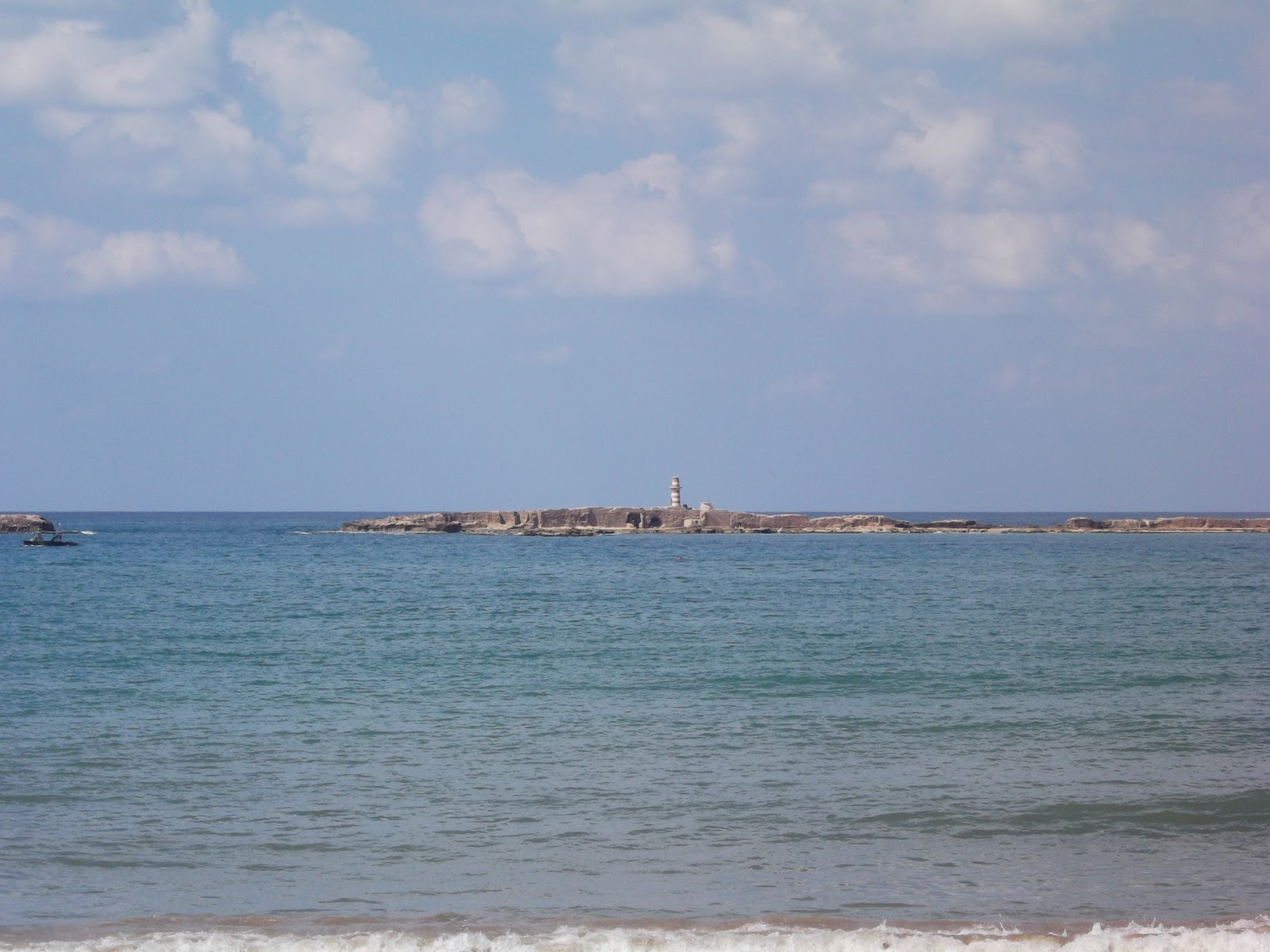
Sidon is one of the great ancient cities of the eastern Mediterranean littoral; a thriving Phoenician metropolis mentioned in the literature of Homer and Herodotus, as well as both the Old and New Testaments (where, in a naked display of Jewish chauvinism, Jesus twice refuses to heal a Canaanite woman, whom he compares to a dog – Matthew 15:21-8), whose population has survived millennia of foreign conquests, be they Assyrian, Babylonian, Egyptian, Greek or Roman (Beirut was always a relatively inconsequential settlement by comparison, not reaching prominence until the 19th century). Today the place retains much of its history, with the ruins of the Crusaders’ Sea Castle and the adjacent Old Souk perched atop the promontory of the port, bejewelled with the winsome lighthouse on the nearby Zeereh Island. The atmosphere is agreeable in other ways, too; for while Sidon is primarily a Sunni city – indeed, it is the hometown of the late Prime Ministers Rafiq Hariri and Riadh es-Solh – the menace of sectarianism is much less palpable than in the northern Sunni heartland of Tripoli, where the residents have even seen fit to erect tributes to Saddam Hussein. Such was my hastily-formed first impression, anyway: with more than half the distance to the border still ahead of us, we lamentably didn’t have time for more meaningful exploration. 

Crusader Sea Castle and Old Souk, Sidon

Zeereh Island, Sidon

Saddam Hussein poster, Tripoli


And so we pressed on south, tracing the gentle convexity of the brilliant Mediterranean through al-Ghaziyeh, site of the killing of eleven children and fifteen other civilians by two Israeli air strikes in ’06; and through Saksakieh, where yet another luckless shop owner fell victim to Hizbullah’s perennial war on alcohol when he arrived one morning in July to find his premises burnt to cinders – a casual trashing of a poor man’s livelihood that shows how much Nasrallah’s gangsters really care for the ‘downtrodden’. Just north of the Litani river, we passed Mazraat al-Yahoudieh – ‘the Jewish Farm’ – where the Jews of Deir al-Qamar had fled during the Christian-Druze war of 1848. God knows whether any Jews live there today - the website of the Lebanese Jewish Community Council puts the total size of today’s Jewish population at “less than 200”; a community that once numbered tens of thousands of Lebanese patriots, forced from their land by barbarous minds who could not distinguish between Jew and Zionist. 

The British Foreign & Commonwealth Office advises against “all but essential travel south of the Litani”. This seems to me an arbitrary point of reference, for there is nothing obviously different about the other side. True, the Party of God certainly makes its presence known, littering the streets with its green-and-yellow flags (bearing the AK-47 insignia it shares with the Iranian regime’s death squads); its morbid galleries of fallen ‘martyrs’; and of course its endless veneration of the Dear Leader himself. But the same could also be said of just about every village we passed since Sidon. It’s also true that crossing the Litani takes one closer to Israel; a state rather famed for its preference for bullets over questions in its dealings with unexpected company. But then the Israeli armed forces can, and do, hit any part of Lebanon they like - as the residents of al-Aabde, a small port town by the northern border with Syria, were reminded when fourteen were killed by Israeli air strikes in '06 (“Nothing is safe”, as the IDF Chief Dan Halutz bragged at the time). 

No, the only difference I could discern as we approached the bay of Tyre (Sour) was an amplification of the splendour of the general surroundings; the sea taking on a lighter, glossier sheen; the clouds breaking apart in tufts of cotton. The city itself is a living refutation of biblical ‘prophecy’; for despite the words of Ezekiel (and more than three decades at the frontline of the Arab-Israeli war), Tyre not only still exists but is once more a centre of regional commerce and culture. Seeing the city in 1697, ruined successively by Crusader and Mamluk conquests, the Oxford academic and Anglican priest Henry Maundrell crudely declared a vindication of scripture:

On the north side it has an old Turkish ungarrison’d castle; besides which, you see nothing here, but a mere Babel of broken walls, pillars, vaults, &c. there being not so much as one entire house left. Its present inhabitants are only a few poor wretches [...] subsisting chiefly upon fishing; who seem to be preserv’d ill this place by Divine Providence, as a visible argument, how God has fulfill’d his word concerning Tyre, viz. That it should be as the top of a rock, a place for fishers to dry their nets on, Ezek 26:14.1

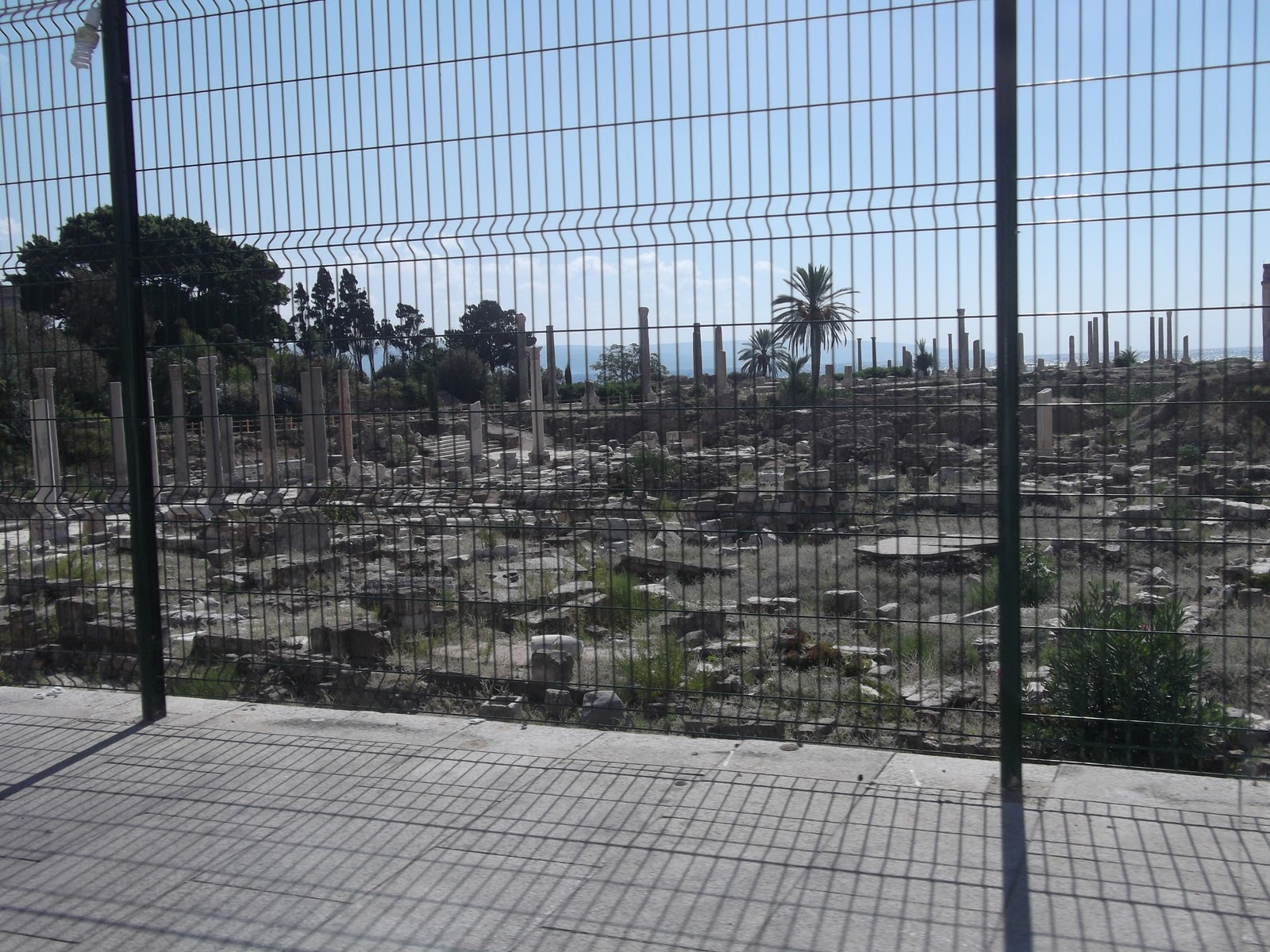
How satisfying it is to see this infantilism made laughable, and to find in Tyre today a population of over 100,000 flourishing in very much “entire” dwellings that, moreover, strike an enviable balance between the polish of urban modernity and the ungroomed charm of the seaside. Stopping at a Byzantine villa-turned-resort – where I was able to get that drink after all – we encountered a group of Europeans who told us they’ve been holidaying in Tyre for years, and I can’t say I blame them. From its unique location, protruding so starkly from the mainland, one can see almost as far as Sidon to the north, and to the beginnings of Israel to the south. And should one tire of idling on the beach, the Roman ruins of the Al Mina excavation site, a mere five minute drive away, are the equal of anything to be seen in Byblos (Jbeil) – just as the shawarmas I had in the city centre were the equal of anything on Beirut’s Bliss Street. I left the city much as I had left Sidon; with regret that I couldn’t have stayed longer and with a wish to return for much more extensive investigation in future. 

View north from the Al Fanar resort, Tyre. Taken by MA

Al Mina Roman excavation site, Tyre


Heading south of Tyre, the road veers inland somewhat, the sea disappearing behind the vast banana plantations that will be disturbingly familiar to those who have seen Ari Folman’s 2008 film, Waltz With Bashir. An ostensible sign of increased danger arrives in the form of an army checkpoint, bearing a stern warning that no “foreigners” may pass without permission from the moukhabarrat, or intelligence agency, in Sidon. My heart plummeted, for I most certainly hadn’t obtained any such permission, and could scarcely imagine the headache that would be involved in doing so. However, by a blessing of fortune that mystifies me to this day, our car was waved through before we had even come to a halt. And so for the next twenty minutes it was us and the bananas, the sighting of other human beings becoming suddenly infrequent. Good pace was made possible by the remarkably fine condition of the roads – newly rebuilt, no doubt, after annihilation in ‘06 – and as the trees cleared and the Mediterranean came once more into view, we soon found ourselves being waved through the checkpoint at the entrance to Naqoura, the small town just two miles from the border that is also the headquarters of the United Nations Interim Force in Lebanon, or UNIFIL. These ‘peacekeeping’ units were initially deployed in response to Operation Litani, Israel’s first invasion of Lebanon in 1978, “for the purpose of confirming the withdrawal of Israeli forces, restoring international peace and security and assisting the Government of Lebanon in ensuring the return of its effective authority in the area”. Given that only the first of these three has been achieved – 22 years later than scheduled, at that, and little thanks to UNIFIL – the poor bastards, despised by Israel and Hizbullah alike, look doomed to be stuck in south Lebanon for quite some time yet. 

Checkpoint south of Tyre
UN base in Naqoura
“From here”, Ali announced as we left Naqoura, “UNIFIL bas”: UNIFIL, and nobody else. And so it proved, as we entered territory that, from 1978 to 2000, was for all practical purposes a part of the Israeli state. To come across a landmine or an unexploded cluster bomb would by no means be unheard of in these deserted plains, and so it was rigidly to the tarmac that we stuck as we began the final stretch, alone but for a UNIFIL jeep a few hundred metres ahead of us. What struck me most about the moment that the road ran out, and we were forced to turn east, was how utterly tranquil the whole scene was. No sniper-topped watchtowers; no rows of tanks; no convoys of helicopters swirling overhead. The border fence itself was the sort of thing a moderately foul-tempered farmer might erect to keep out teenage pranksters, not the frontline between two militarised nations officially at war. The dark green field through which we were driving simply dipped down a slight recess and there, not more than fifty metres away, was a parallel road in Israel. And behind it, not more than five hundred metres away, were the beige walls and red roofs - the same colour scheme I had seen at the Ma’ale Adumim settlement in the West Bank - of the Israeli village of Kfar Rosh HaNikra, a kibbutz and tourist attraction renowned for its grottoes.

UNIFIL jeep
A road in Israel


Israeli village


Amazingly, the more we drove east, the more our road and the parallel one in Israel began to converge. We passed Labbouneh, where the kibbutz of Hanita was practically touching the Blue Line; and Btaichiye, opposite the village of Arab al-Aramshe, where three Israeli Arab Bedouin civilians were killed by Hizbullah rocket fire in ‘06. At Boustane, just west of the Nabatieh governorate, we could practically read the number plates of cars in the Israeli village of Zar’it. And still, the calm in the air was preternatural; tantric; catatonic. Can it really have been from this very spot that Hizbullah crossed the border on July 12th, 2006, firing explosives and anti-tank missiles at an IDF jeep convoy, killing eight soldiers and dragging two back into Lebanon alive; in doing so provoking the most destructive Israeli assault on the country since ‘82? Apparently so, and yet aside from a fenced-off compound a couple of kilometres inside Israel, which Ali believably claimed was an IDF base, I could see no one around to stop me doing something similar myself – least of all the UNIFIL patrolmen, who regarded us on the whole with astounding incuriosity, as though to make inquiries about our intentions or indeed to acknowledge our presence at all would be an unpardonable violation of proprieties. 

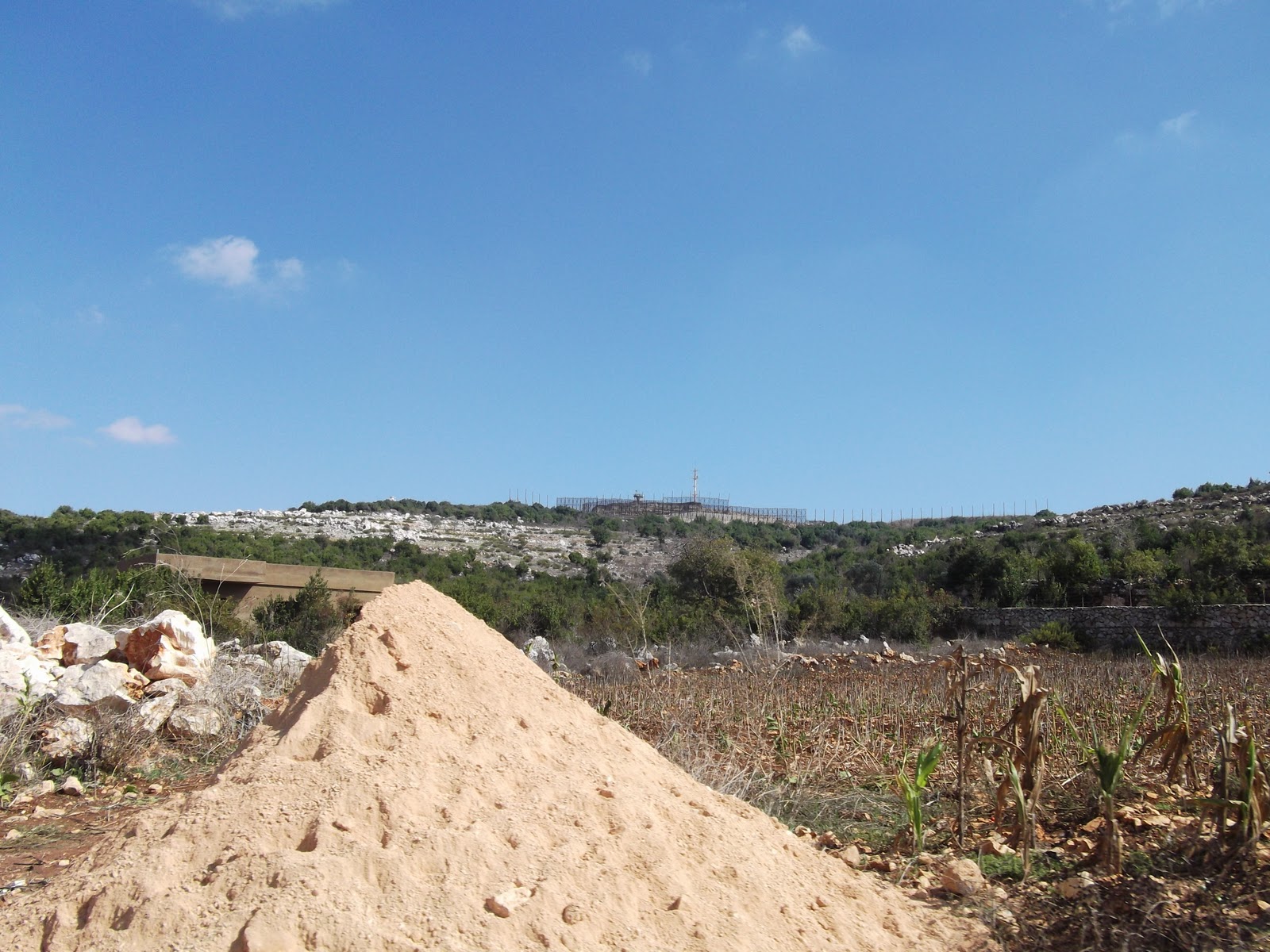
IDF base in the distance

UNIFIL jeep. Taken by MA


Even the Party of God was nowhere to be seen here. The American writer, Michael J. Totten – of whose book on Lebanon I am no great fan – saw the Blue Line further up to the north-east in ‘05 and posted pictures on his blog of various miscellanea assembled along the border in apparent attempts to intimidate Israelis: wrecked IDF trucks; ‘martyr’ shrines; photos of severed Israeli heads; etc. I have seen similar things myself in Baalbek. But nothing remotely of the kind could be found where we were; indeed, aside from one poster of the late Shiite cleric, Muhammad Fadlallah – bearing the not-too-terrifying inscription, “With my love and blessing” – the only graphic we came across was a white dove painted next to a green cedar on a concrete block. One wouldn’t wish to sentimentalise matters, or to pretend that the Lebanese are pacifists. But it’s useful all the same to have a qualification of the Totten narrative in which the Lebanese side of the border is little but a barbarous carnival of venom and violence.

Israel in the background. Taken by MA


Which brings me, somewhat elliptically, to Qana, roughly ten kilometres north of the Blue Line, which was to be our last stop before rejoining the coastal highway and returning to Beirut. A modest town in many ways, Qana is nevertheless believed by many to be the biblical Cana of Galilee, where Jesus performed his most useful miracle when he supplied the drink at an otherwise boozeless party, thereby delivering the presumably bored guests from further tedium (John 2:1-10). A spiriting distinction, to be sure, but I can’t say I felt much inclined to smile on my visit. For Qana today is a morbid town, known not for miracles but for massacres. The first one occurred during a sixteen-day battle between Hizbullah and Israel in ‘96, when on 18 April, the Israelis deliberately and repeatedly shelled a UN compound that was housing some 850 civilians, killing 106 (over half of them children) in a most unimaginably gruesome manner2. The second came just over a decade later, on 30 July, 2006, when Israeli jets bombed a three-story residential building housing 63 civilians, killing 27 (16 of them children). In both cases, the Israeli government involved itself in a disgraceful series of lies: in the first case claiming that a computer malfunction was to blame, and denying that a pilotless ‘drone’ reconnaissance aircraft had been flying over the compound before the shelling began; and in the second case insisting that Hizbullah combatants had fired rockets from the residential building, thus making it a legitimate military target. In both cases, the Israelis were forced to recant their original claims: in the first case after the discovery of a video clearly filming the ‘drone’ by the UN compound; and in the second after it became clear that eyewitnesses to the attack, including international rescue workers, journalists and human rights observers, were too numerous, and too consistent in their reports to the contrary of the Israeli claim, for the deception to work. In both cases, in other words, the flow of venom and violence was from Israel to Lebanon, not the reverse – a partial vindication, come to think of it, of Ezekiel after all. 

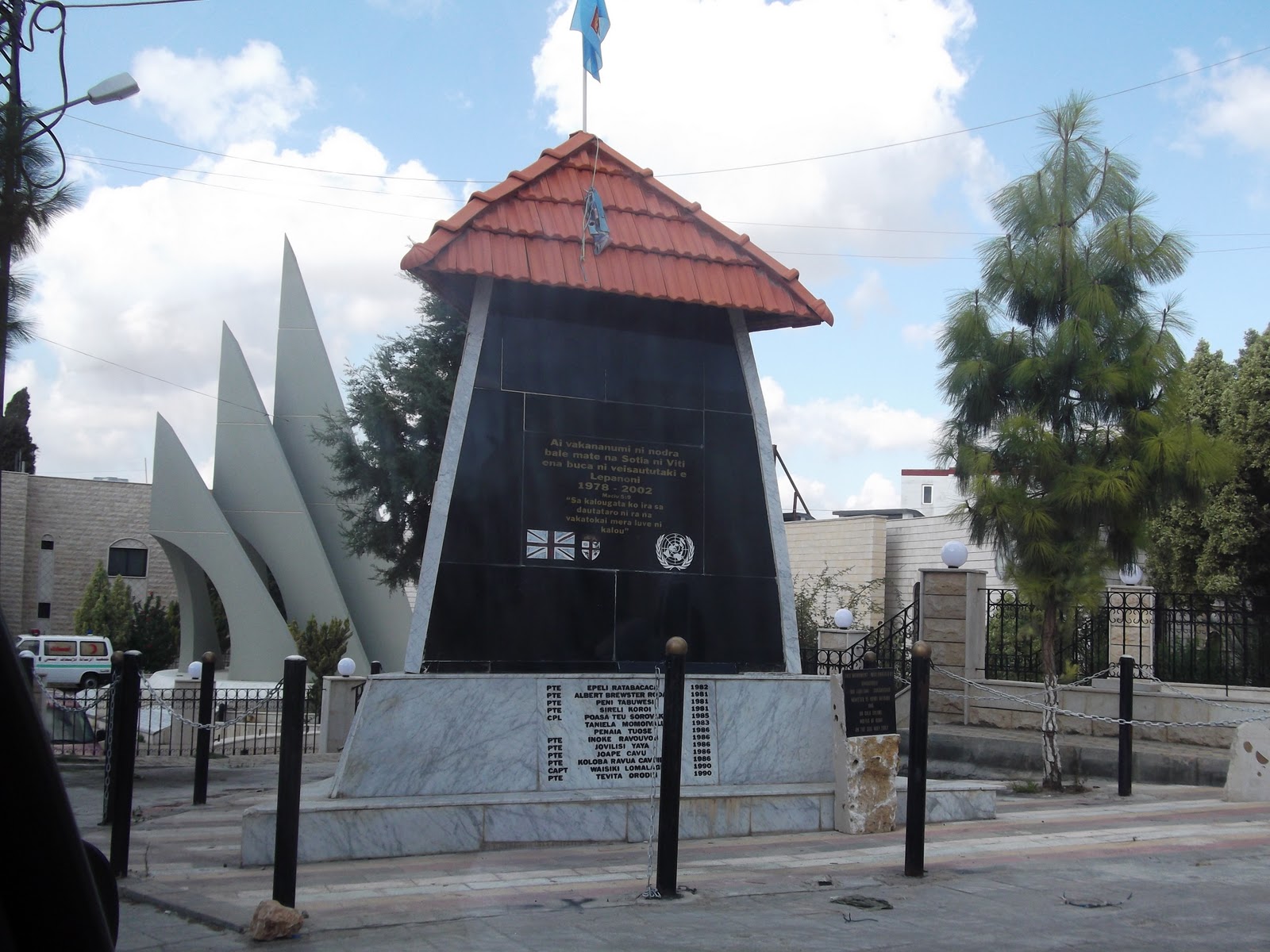
Memorial at the UN compound in Qana


Was it also a partial vindication of Hizbullah, and its claim to be a ‘liberator’ of the land? Certainly there are many who would answer in the positive. And in a way, the question isn’t for me to answer: I may not presume to speak on behalf of my Lebanese companions, for whom the trip we had taken that day would not have been possible just twelve years ago. What it means to stand on one’s national soil, previously stolen by a foreign power is unknown to me. Still, for however little it may be worth, my answer would always be an unhesitating ‘no’. The reason for this was neatly encapsulated in a poster I saw about five minutes south of Naqoura. Impaled on the shore of the resplendent Mediterranean, with the hills of Israel lining the horizon, stood a metal frame displaying the faces of two politicians, neither of them Lebanese: the inaugural Supreme Leader of the Islamic Republic of Iran, Ruhollah Khomeini; and his successor, Ali Khameini. Whether this was an expression of theological solidarity with these most eminent Ayatollahs – as is suggested by the total absence of tributes to the non-clerical President Ahmadinejad - or merely a thank-you for the vast sums of reconstruction funds donated, it points in either case to the long shadow cast by Tehran on Lebanese civil society. 

Khomeini and Khameini, just south of Naqoura


This shadow manifests itself in a number of ways: partly in the trampling of political dissent within the regions of the country which the Party controls, where members of rival factions such as Amal and the Communists are either subjugated or liquidated. It also manifests itself on a national scale, in the acquisition of a huge private arsenal, which the Party uses to suffocate the country’s democracy and hold the entire population hostage to its whims - a humiliation that further involves dragging the government into sordid alliances with grossly unsavoury regimes, most notably the Assad crime family in Damascus and the Putin dictatorship in Moscow (to say nothing of the Iranian theocracy itself). 

But more sinister than any of these is that part of the Iranian shadow that fell on the aforementioned shop owner in Saksakieh. How readily some people appear to forget that the original Hizbullah manifesto, published in the as-Safir newspaper in 1985, called openly and repeatedly for the Lebanese to submit to an “Islamic government” and a “culture [...] based on the Holy Koran, the Sunna and the legal rulings of the faqih [jurist] who is our source of imitation”, clarifying that the faqih in question was “Ruhollah Musawi Khomeini”. And despite much loose talk about the Party ‘softening’ its stance in its amended manifesto of 2009, Nasrallah plainly reaffirmed its “allegiance to the Fakih” and “commitment to the [Islamic] Jurisconsult” when challenged on the point by a journalist at the press conference launching the manifesto. Hizbullah has, in this sense, not removed the Israeli occupation but replaced it. Once again, the essential point is underscored: as long as it’s the mullahs and imams who have the power - or the patriarchs or popes or the rabbis for that matter – then real ‘liberation’ will never be attained. One hopes in Lebanon, as one hopes in every country, that it isn’t too late to realise this, and to act upon it.

1 Maundrell, H., Journey from Aleppo to Jerusalem at Easter A.D. 1697 (1703); as reprinted in Gorton, T.J. & Gorton, A.F., Lebanon: Through Writers’ Eyes (2009), p. 103
2 See esp. Fisk, R., Pity the Nation: Lebanon At War (3rd edition, 2001), pp.669-89